How to Make Flashcards That Still Work Three Weeks Later
To make flashcards that work, put one idea on each card, phrase the front as a specific question, keep the answer short, and add why cards for concepts, not only definitions. Then study them as recall: say the answer before flipping, keep one large shuffled deck, and review on a spaced schedule.
Flashcards are one of the few popular study tools that research actually backs. They make you pull answers out of memory, and they are easy to space over days. Yet many students give up on them, because their decks turn into piles of cards they flip through without remembering much. The problem is almost always in how the cards were written. Knowing how to make flashcards well matters more than the app or the paper you use.
This guide covers seven writing rules with before and after examples, a template for the five card types worth knowing, the question of homemade versus ready-made decks, and a study routine that keeps your cards working until the exam.
Why do flashcards work when you make them well?
A good card forces you to recall an answer from memory, which strengthens it far more than reading. Cards are also easy to review again after a delay, and spacing reviews out is one of the most reliable ways to make memories last.
Flashcards combine the two techniques that a major review of study methods rated highest: practice testing and spaced practice. Each card is a tiny test, and a deck reviewed over weeks is spaced practice by design. That is the theory behind active recall.
Students already reach for them. In one survey of 177 college students, 40% listed flashcards as a study strategy. But only 11% said they practiced recall, which suggests many people use cards without really testing themselves. A card you glance at and flip right away is just a tiny piece of rereading.
How to make flashcards: seven rules
One idea per card, a specific question on the front, a short answer on the back, your own words, why and how cards for concepts, context for terms, and images for anything visual. Each rule fixes a common way cards fail.
1. One idea per card
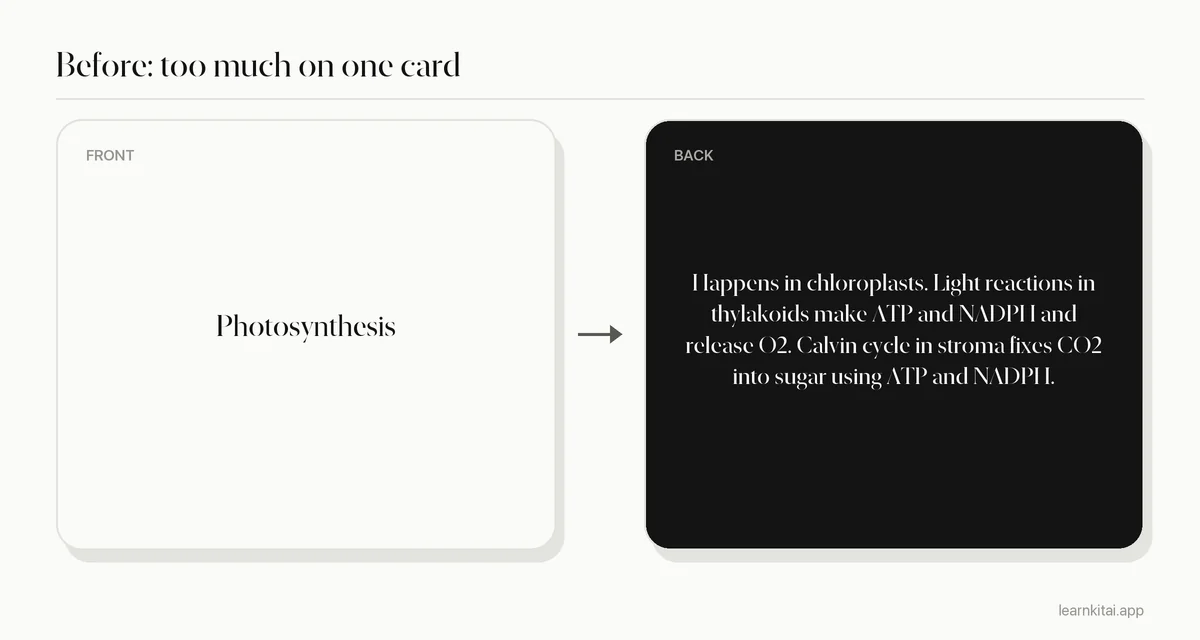
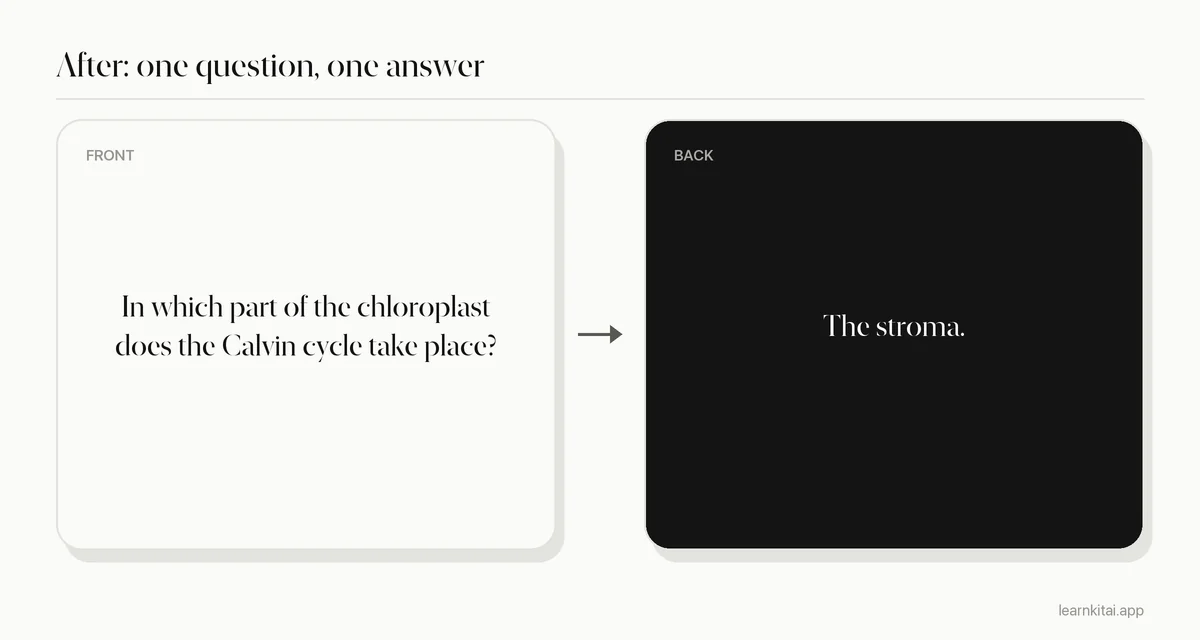
A card that asks for five things gets graded as half right, and you never learn which half you keep missing. Split it. This is the minimum information principle, and it is the rule that most improves a deck. SuperMemo's well known 20 rules of formulating knowledge put it near the top of the list for good reason.
2. Ask a question, not a topic
A front that says Photosynthesis or Mitosis does not tell your brain what to retrieve. You end up recalling something vaguely related and calling it correct. Write a full question with one right answer: What two products of the light reactions does the Calvin cycle use?
3. Keep the answer short
If the back is a paragraph, you will skim it and mark yourself right. Aim for a word, a number, a phrase or one sentence. If you need more, the card probably holds more than one idea.
4. Use your own words
Copying a textbook sentence onto a card trains you to recognize that sentence. Rephrasing makes you process the idea once while writing. It also exposes parts you do not understand yet, because you cannot rephrase what you cannot explain.
5. Add why and how cards
Definitions are the easy part of a course. Exams also ask why something happens and how two ideas connect. For every few fact cards, add one that asks for a reason: Why does the Calvin cycle stop in the dark, even though it does not use light directly? Answer: It depends on ATP and NADPH from the light reactions.
6. Give terms some context
A bare term on the front, like Stroma, invites a memorized definition with no link to anything else. A sentence with a blank keeps the context: The Calvin cycle takes place in the ___ of the chloroplast. This format is called cloze deletion, and it is the fastest way to turn notes into cards.
7. Use images for visual material
If the exam shows a diagram, your cards should too. Label one structure per card, or hide one label on a diagram and ask for it. This is essential for subjects like anatomy; see image flashcards for anatomy for a full method.
Which card types should a deck include?
Most good decks mix five types: fact questions, why or how questions, cloze sentences, image cards and reverse cards for two-way facts. Facts and cloze cover the basics; why and image cards cover what exams test hardest.
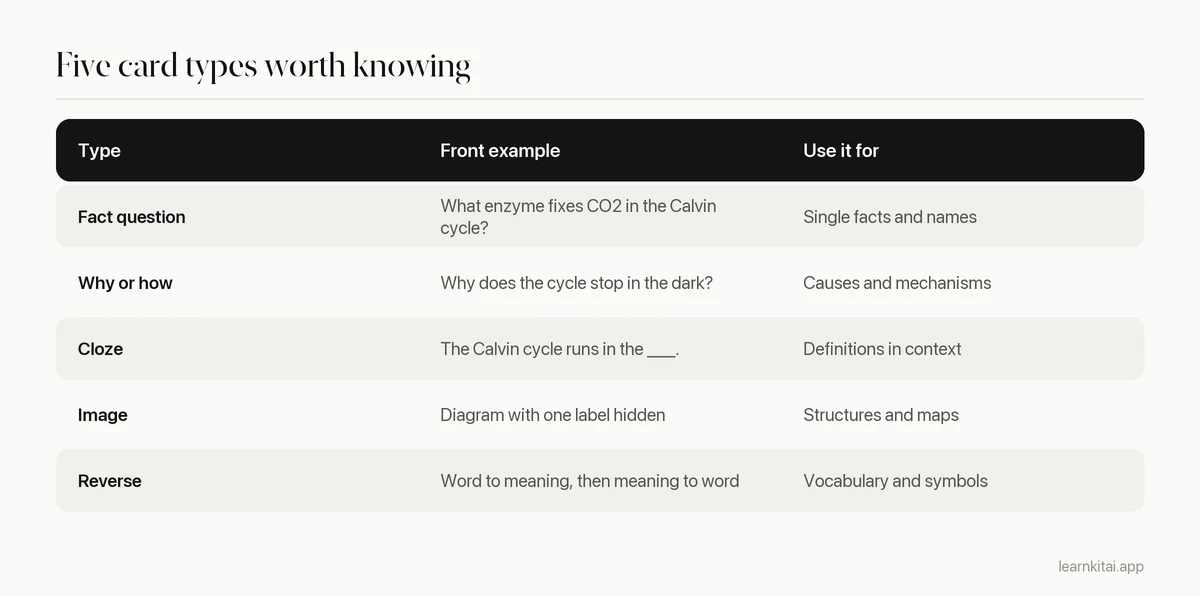
Reverse cards are mainly for languages. If you only learn Spanish to English, you will understand words but struggle to produce them. See vocabulary flashcards for how to set up both directions without doubling your work.
A worked example: one paragraph, six cards
Read the paragraph, list each testable idea, then write one card per idea, mixing fact, why and cloze types. A 90-word paragraph about enzymes becomes six focused cards in about five minutes.
Theory is easier to apply once you see it done. Here is a short textbook-style paragraph on enzymes, then the cards it produces. Watching this process is the quickest way to learn how to make flashcards that you will actually be able to grade.
- Fact: How do enzymes speed up reactions? They lower the activation energy.
- Cloze: The part of an enzyme where the substrate binds is the ___. Active site.
- Why: Why does an enzyme act on only one type of substrate? The active site has a shape that fits only that substrate.
- Cause and effect: What happens to an enzyme's active site when it is denatured by heat? Its shape changes, so the substrate no longer fits.
- Apply: Why would pepsin stop working if it moved into the small intestine? The pH there is no longer strongly acidic, so it is far from pepsin's optimum.
- Contrast: What is the difference between an enzyme slowing at low temperature and being denatured at high temperature? Cold slows molecules but leaves the shape intact; heat changes the shape.
Notice what did not become a card: the phrase enzymes are proteins. If you already know it, skip it. Notice also that cards 5 and 6 go beyond the paragraph. They ask you to apply and compare, which is where exam questions tend to live. A deck with only cards 1 and 2 would leave you ready for the easy questions and stuck on the rest.
What should go on the front of a flashcard?
A complete question with exactly one correct answer, written so you could not answer it by guessing the topic. Include just enough context to rule out other answers, such as the subject, the process or the unit of measurement.
A quick test: show the front to a classmate in the same course. If they could give a different but reasonable answer, the front is too vague. Add a constraint. Instead of What does the liver do? ask Which organ stores glycogen and releases glucose between meals? Instead of Causes of World War I? ask Which 1914 event in Sarajevo triggered the July Crisis?
Avoid yes or no fronts. You have a 50% chance of guessing, and you learn little either way. Turn them into which, why, how or what questions so you have to produce something.
Should you make your own flashcards or use ready-made ones?
Both can work. Writing cards yourself makes you process the material, but it takes time and beginners often write weak cards. Ready-made or generated cards save time; check and edit them so they match your course and follow the rules above.
The research is more mixed than the common advice suggests. In a study comparing paper, computer and tablet flashcards, students recalled more words from ready-made cards than from cards they made themselves. Making cards has value, but only if the cards come out well. A carefully written premade card beats a sloppy homemade one.
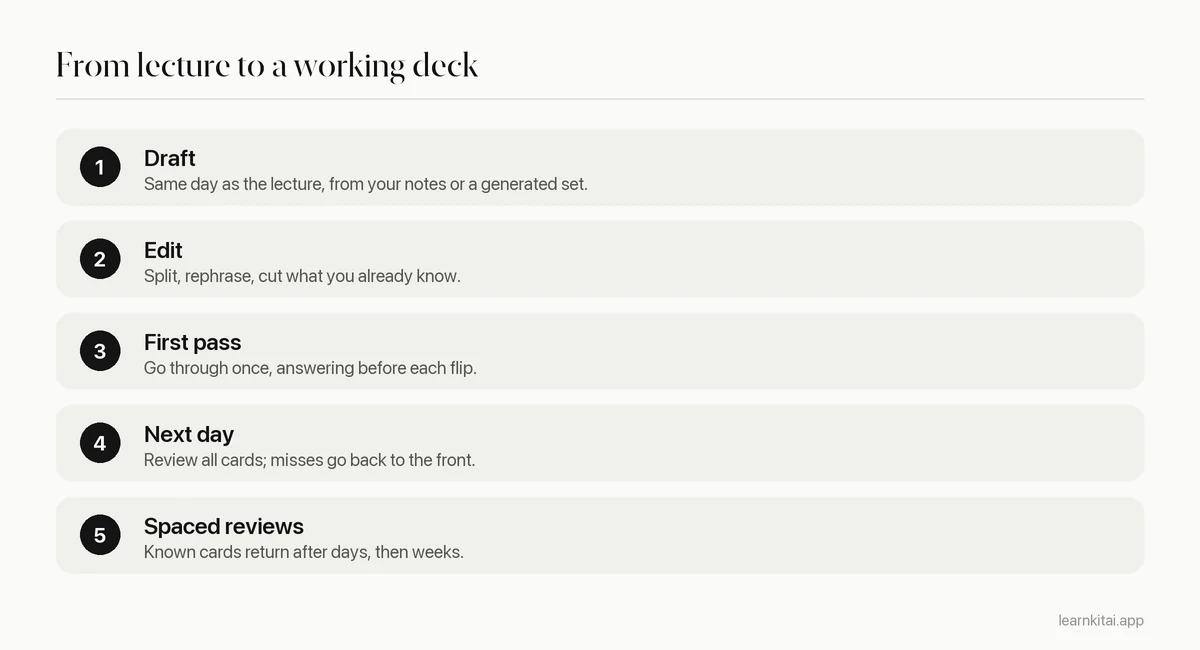
A practical middle path: generate or borrow a first draft, then edit it. Delete cards for things you already know, split overloaded ones, and rewrite anything that does not match how your teacher frames the topic. Editing still makes you think about every card, in a fraction of the time. You can draft cards from a PDF or from lecture notes, and decide between paper and digital cards based on how you will review.
How should you study flashcards once they are made?
Say or write the answer before you flip. Keep one large shuffled deck instead of many small piles. Do not retire cards after one correct answer. Review on a spaced schedule, with shorter gaps for cards you miss and longer gaps for cards you know.
- Commit before you flip. A real attempt, out loud or on paper, is what makes a card work. A silent maybe is not an answer.
- Use one big stack. A 2009 study by Kornell found that studying one large stack beat studying several small ones, because more cards sit between each repeat. Spacing beat massing for 90% of participants, yet 72% believed the opposite after their first session.
- Do not drop cards too early. In experiments by Kornell and Bjork, letting students set aside cards they felt they knew had small but consistently negative effects on learning. Move known cards to longer gaps instead.
- Space the reviews. A simple box system like the Leitner system or an app scheduler does this for you.
How many cards should one lecture produce?
There is no fixed number, but a useful rule is one card per testable idea. A dense one-hour science lecture might give 20 to 40 cards; a discussion-heavy humanities seminar might give 10. If a lecture gives 100 cards, you are probably copying, not selecting.
Also count the cost. Every new card brings a stream of future reviews. The Anki manual notes that learning 20 new cards a day leads to roughly 200 reviews a day once the deck matures. Make cards for what you need to remember, not for everything you read. Our guide on how many flashcards per day shows how to size your daily load.
Good cards are small, specific and honest about what you know. Write them that way, test yourself before every flip, and let spacing do the rest.
Frequently asked questions
Should flashcards be handwritten or typed?
Studies comparing paper and digital cards mostly find similar learning, as long as you answer before flipping. Pick the format you will actually review on a schedule. Digital decks make spacing automatic; paper makes drawing and quick diagrams easier.
How many words should be on a flashcard?
Keep the front to one clear question and the back to a word, a phrase or one short sentence. If the answer needs a paragraph, split the card into several smaller ones.
Can flashcards work for math and problem solving?
Yes, for formulas, definitions and recognizing which method fits a problem. Put a short problem on the front and the first step or the method name on the back. Keep full problem sets for practice outside the deck.
When should I start making flashcards for an exam?
From the first week of the course. Making cards after each lecture keeps the job small and lets spacing work over weeks. Starting a few days before the exam turns cards into a cramming tool, which fades quickly.
Sources
- Optimising learning using flashcards: Spacing is more effective than cramming, Applied Cognitive Psychology (Kornell, 2009) (One large stack beat smaller stacks; spacing beat massing for 90% of participants while 72% believed massing worked better.)
- Optimising self-regulated study: The benefits and costs of dropping flashcards, Memory (Kornell and Bjork, 2008) (Allowing students to drop cards had small but consistently negative effects on learning.)
- Flip, Slide, or Swipe? Learning Outcomes from Paper, Computer, and Tablet Flashcards, Technology, Knowledge and Learning (Sage, Krebs and Grove, 2019) (Students recalled more words from ready-made cards than self-created ones.)
- Effective learning: Twenty rules of formulating knowledge, SuperMemo (Piotr Wozniak) (Minimum information principle and cloze deletion as card writing rules.)
- Metacognitive strategies in student learning, Memory (Karpicke, Butler and Roediger, 2009) (40% of 177 students listed flashcards; 11% reported practicing recall.)
- Deck Options: Daily Limits, Anki Manual (20 new cards a day leads to roughly 200 reviews a day.)
Keep reading
Minimum Information Principle: Small Cards, Big Recall
One flashcard, one fact. Here is why splitting fat cards into tiny ones makes reviews faster and memories stronger, with worked examples.
Cloze Deletion: Fill-in-the-Blank Cards Done Right
Cloze cards are the fastest way to turn notes into flashcards, and the easiest to get wrong. Rules, examples and the exact Anki syntax.
The Leitner System: Five Boxes That Schedule Your Reviews
A shoebox, some dividers and one simple rule give you spaced repetition without an app. Here is a ready-to-use five-box schedule and how to adapt it to your exam date.
How Many Flashcards per Day? Count Reviews, Not Cards
The right number of new flashcards depends on the reviews they create later. A simple formula, a budget table and the warning signs that you are adding too many.
9 Flashcard Mistakes That Feel Like Progress
Flipping fast, dropping known cards, studying in tidy little stacks: the habits that make flashcards feel productive are often the ones that waste your time.