Mind Map Notes vs Linear Notes: Match the Material
Mind map notes put one topic in the center and branch out to related ideas, which makes connections easy to see. Linear notes run top to bottom in order, which suits sequences, arguments and step-by-step processes. Choose by the shape of the material, then test yourself on either kind.
Some students swear by colorful branches, others by tidy bullet points, and both camps are partly right. Mind map notes and linear notes are good at different things. The useful question is not which one is better in general, but which one fits the topic in front of you, and what you do with the notes once they exist.
What is the difference between mind map notes and linear notes?
A mind map starts with a central topic and branches outward, with keywords on each branch. Linear notes are written in order, usually as headings and bullets. Mind maps show how ideas relate; linear notes show the order in which they come.
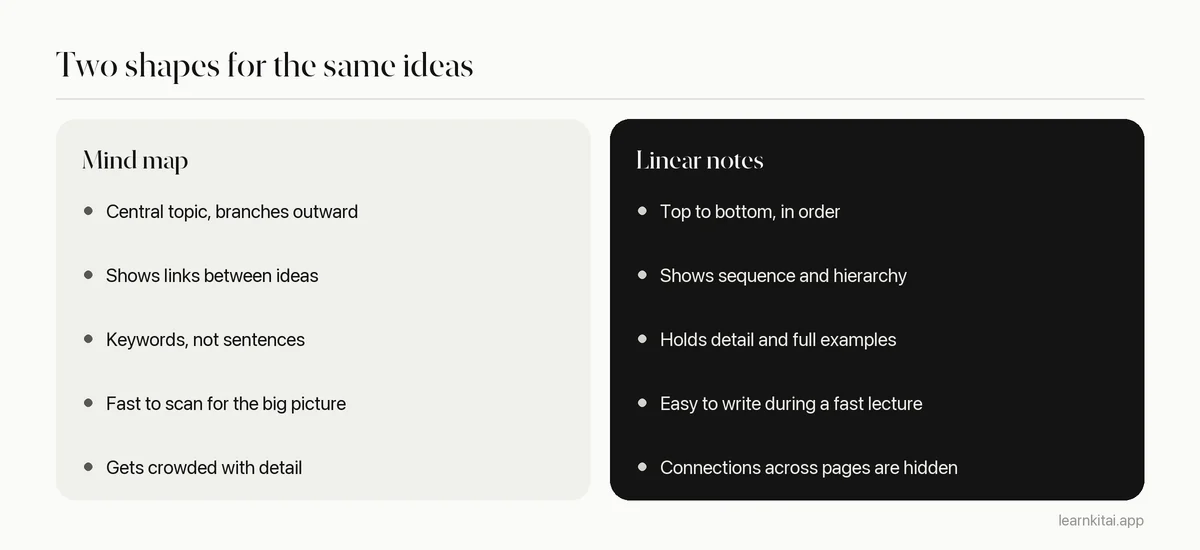
Linear notes include several formats you may already use, such as plain bullets, the outline method, and the notes column of Cornell notes. A concept map is a close cousin of the mind map: it also uses nodes and lines, but every line is labeled with the relationship, such as "causes" or "is part of".
Are mind maps effective for studying?
There is some evidence that they help. In a study with 50 medical students, the mind map group recalled about 10% more facts after a week, though the result was uncertain. A meta-analysis of concept maps across 55 studies also found benefits for retention.
The best-known test is a 2002 study by Farrand, Hussain and Hennessy. Fifty second- and third-year medical students read a 600-word passage. One group was trained to make mind maps, the other used their usual methods. A week later, the mind map group's factual recall was about 10% higher after adjusting for baseline scores. The confidence interval ran from minus 1% to 22%, so the gain was not certain. The mind mappers were also less motivated, and the authors estimated the gain would have been about 15% if motivation had been equal.
A broader picture comes from a meta-analysis by Nesbit and Adesope that pooled 55 studies with 5,818 participants, from grade 4 to university. Learning with concept and knowledge maps was linked to better knowledge retention than several comparison activities, though results varied a lot with how the maps were used.
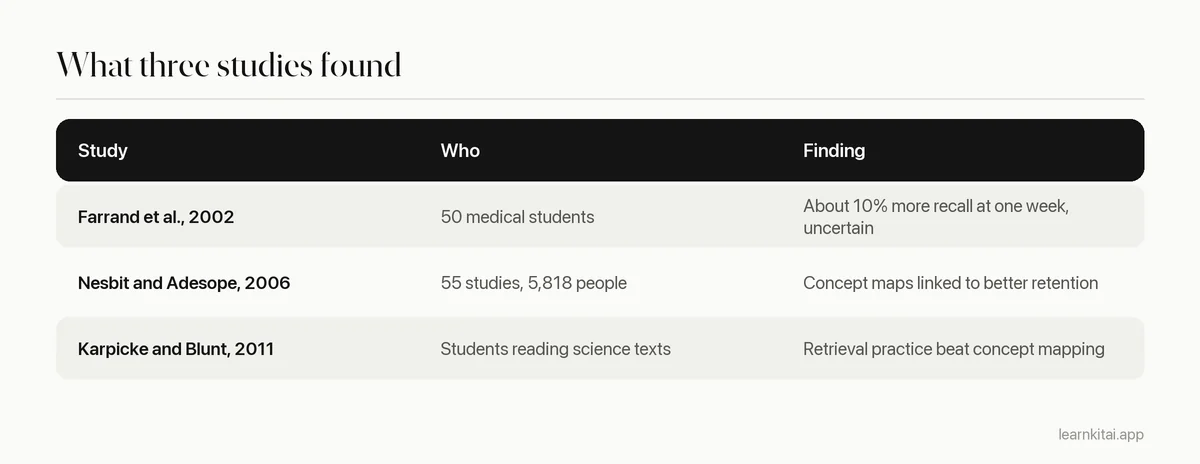
The third row is the important caveat. In a study published in Science, Karpicke and Blunt compared students who built concept maps while reading with students who practiced recalling the text. Retrieval practice produced more learning, even on a final test that asked students to draw a concept map. So the map is a good way to organize ideas, but recalling them is what makes them stick.
When should you use mind map notes instead of linear notes?
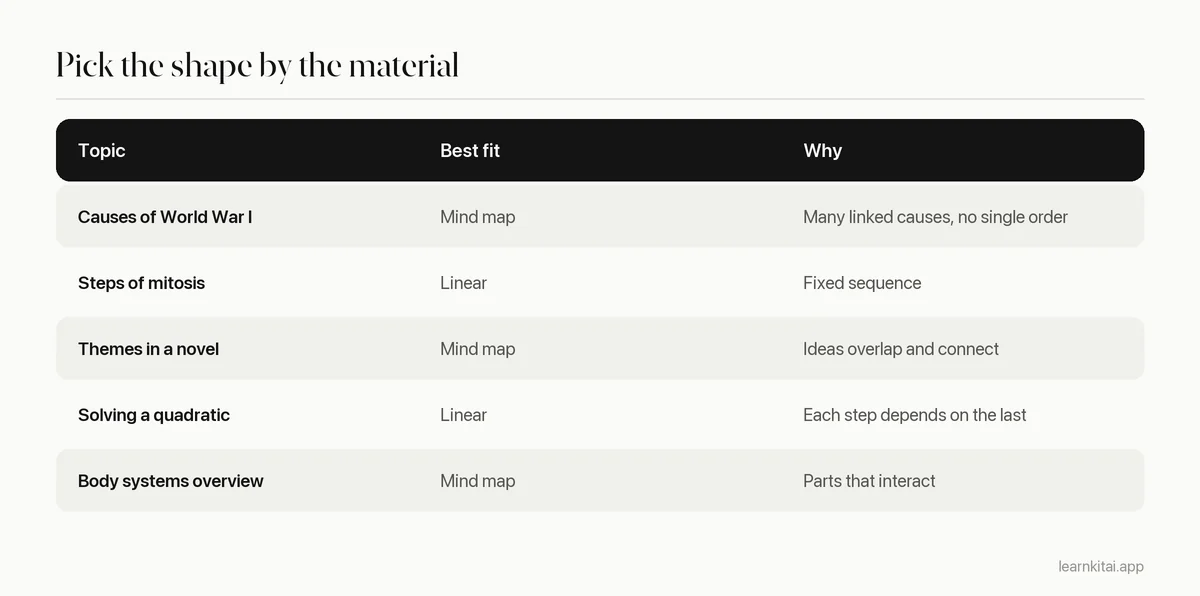
Use a mind map when a topic is a web of related parts, such as themes in a novel, causes of a war, or systems in the body. Use linear notes when order matters, such as a proof, a lab procedure, a legal test, or a historical timeline.
A quick test helps: ask whether the topic has a natural first step. If it does, write it linearly. If you could start anywhere and still make sense, map it. Here is how that plays out across common subjects:
Many students get the best of both by taking linear notes during a lecture, when speed matters, and drawing a mind map afterward as a review. Turning a page of bullets into a map forces you to decide how ideas relate, which is real thinking. Pairing words with a simple visual also uses the idea behind dual coding.
How do you make a mind map that helps you remember?
Build it from memory first, then check your notes. Use one or two keywords per branch, write the link between branches in a word or two, and keep it to one page. Then cover branches and recall them.
- Write the topic in the center of a blank page with your notes closed.
- Add the main branches you can remember, one keyword each.
- Add smaller branches and draw lines between related ideas on different branches. Label each cross-link with a verb, like "causes" or "blocks".
- Open your notes and add what you missed in another color.
- Later, cover one branch with your hand and say everything on it aloud.
What mistakes make mind maps less useful?
The usual problems are maps with full sentences, maps with no cross-links, maps copied straight from notes, and maps that are never reviewed. Each one keeps the look of a mind map but loses what makes it work.
- Sentences on branches. If a branch holds a whole sentence, the map is linear notes drawn in a circle. Cut it to a keyword and let your memory fill in the rest.
- No cross-links. A map with only a center and spokes is just a list. The links between distant branches are where the understanding lives.
- Too much on one page. If you need a magnifying glass, split the topic into two maps, each with its own center.
- One map, never revisited. A map you drew in September and never covered and recalled will not help much in December.
Linear notes have their own traps. The biggest is writing down everything the lecturer says, word for word, which feels productive but skips the thinking. Whichever format you use, short phrases in your own words beat full transcripts.
How do you turn mind map notes into flashcards?
Each cross-link makes a strong card. Put the two ideas and a blank for the link on the front, and the relationship on the back. Each branch can also become a card that asks you to list its parts.
For example, a link from "rising bread prices" to "French Revolution" labeled "fuels unrest" becomes the card: How did bread prices relate to the start of the French Revolution? Cards like this test understanding, not just recall of labels. If you prefer to start from text, LearnKit can make flashcards from your typed notes, and you can then check that the cards cover your map's cross-links.
The short version: let the material choose the shape, keep your maps small, and always finish with some form of retrieval practice. Notes in any format are a starting point. What you recall from them is the result. For condensing a whole chapter before you map it, see how to summarize a textbook chapter.
Frequently asked questions
Is a mind map the same as a concept map?
Not exactly. A mind map branches out from one central topic, usually with keywords. A concept map can have several starting points and labels each connecting line with the relationship, which makes it more precise but slower to draw.
Can I make mind maps during a lecture?
You can if the lecture is slow and topic-based. For fast lectures with lots of detail, most students do better taking linear notes in class and drawing a map afterward as review.
Are digital mind map apps better than paper?
They are easier to edit and expand, which helps with large topics. Paper keeps maps small and quick, which helps with review. The format matters less than whether you recall the map from memory.
Do mind maps work for math?
They work for organizing topics, such as how different types of functions relate. They are a poor fit for solving problems, which are sequences of steps and are best practiced by working through problems.
Sources
- The efficacy of the 'mind map' study technique, Medical Education (Farrand, Hussain and Hennessy, 2002) (50 medical students; about 10% higher recall at one week (95% CI -1% to 22%), estimated 15% with equal motivation)
- Learning With Concept and Knowledge Maps: A Meta-Analysis, Review of Educational Research (Nesbit and Adesope, 2006) (55 studies with 5,818 participants; concept maps linked to better retention)
- Retrieval practice produces more learning than elaborative studying with concept mapping, Science (Karpicke and Blunt, 2011) (Retrieval practice outperformed concept mapping, even on concept map tests)
Keep reading
How to Summarize a Chapter So You Never Reread It
Most chapter summaries are just shorter copies of the book. The closed-book method turns summarizing into practice that sticks, so you can study from your page instead of the chapter.
Outline Note Taking: Build the Skeleton First
An outline shows which ideas sit under which. That structure makes notes faster to write, easier to review, and simple to turn into questions.
Cornell Notes: The Page That Quizzes You Back
A Cornell page is not just a neat layout. Its left column turns your notes into a built-in self-test you can run in ten minutes.
Dual Coding: Pair Words With Pictures to Remember More
Your memory has a verbal channel and a visual one. Use both and ideas get two routes back. How to dual code your notes, with formats for every kind of topic.
Retrieval Practice vs Review: Why Pulling Beats Looking
Looking over material and pulling it out of memory feel similar. They are not. Here is how to tell them apart and convert any review session into retrieval.