Retrieval Practice vs Review: Why Pulling Beats Looking
Review means looking at material again. Retrieval practice means pulling it from memory with the material hidden, then checking. Review wins on a test a few minutes later, but retrieval wins after days or weeks, which is when exams happen. Most review habits can be turned into retrieval by closing the source first.
Two students spend an hour on the same chapter. One reads her notes, rewatches a lecture clip and looks over the summary. The other covers his notes and tries to write out each section, then checks. Both call it reviewing. Only the second is doing retrieval practice, and a week later the difference shows.
This article draws the line between the two, shows what the research measured, and gives you a table for converting your usual review habits into retrieval without adding time.
What is the difference between retrieval practice and review?
Review puts the information in front of you again. Retrieval practice makes you produce it from memory first, with the source closed, and only then look. The test is simple: if you can see the answer while you think, it is review.
Review is input. Your eyes take in the page again, and you recognize it. Retrieval is output. You reconstruct the idea, the steps or the term with nothing to lean on. Recognition and recall are different memory skills, and exams mostly test recall.
Retrieval is the engine of active recall. The phrase active recall usually names the habit; retrieval practice is the term researchers use for the same act of pulling information out of memory.
Why does review feel better if it works worse?
Because review is smooth and shows you the answer, so you feel ready. Retrieval is slow and exposes gaps, so it feels like failing. In studies, students who reread were more confident yet remembered less a week later.
In a classic 2006 experiment, Roediger and Karpicke had students study short prose passages. After one reading, half the students read the passage again, and half wrote down all they could remember. Then everyone took a final test at one of three delays.
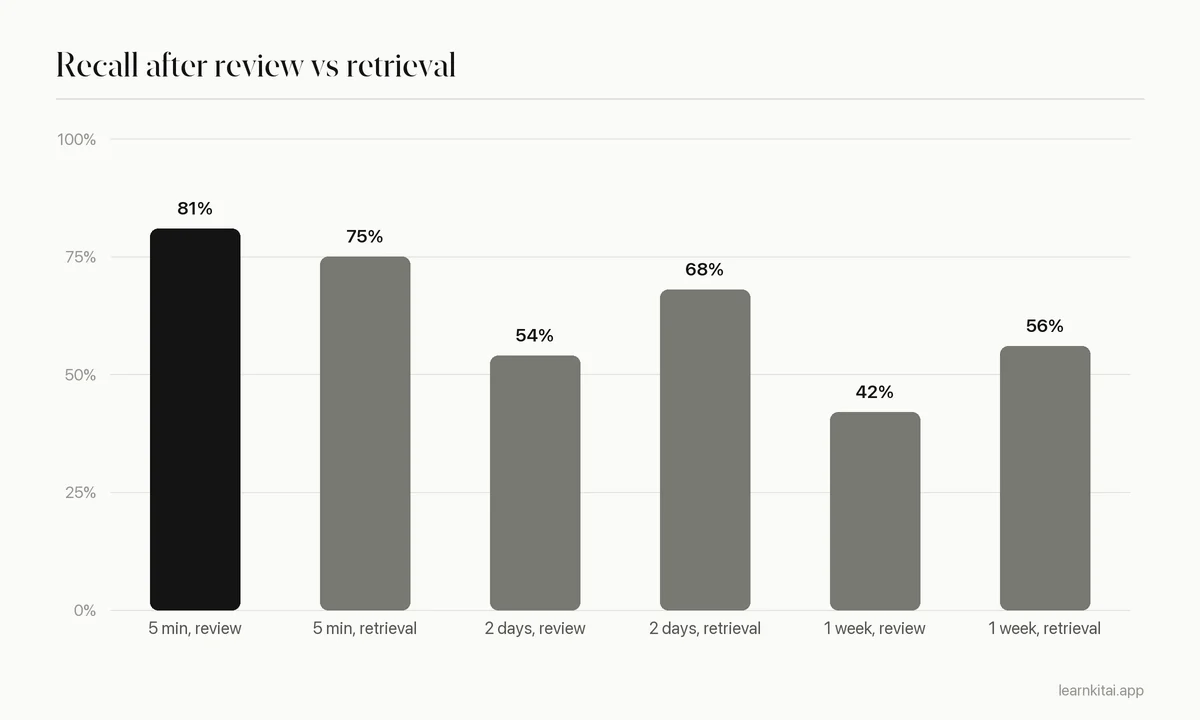
The pattern is the whole story. Five minutes later, the reviewers were slightly ahead. Two days and one week later, the retrieval group was clearly ahead. In fact, after one week the retrieval group remembered about as much as the review group had after only two days. If your exam is not in five minutes, review is the weaker choice.
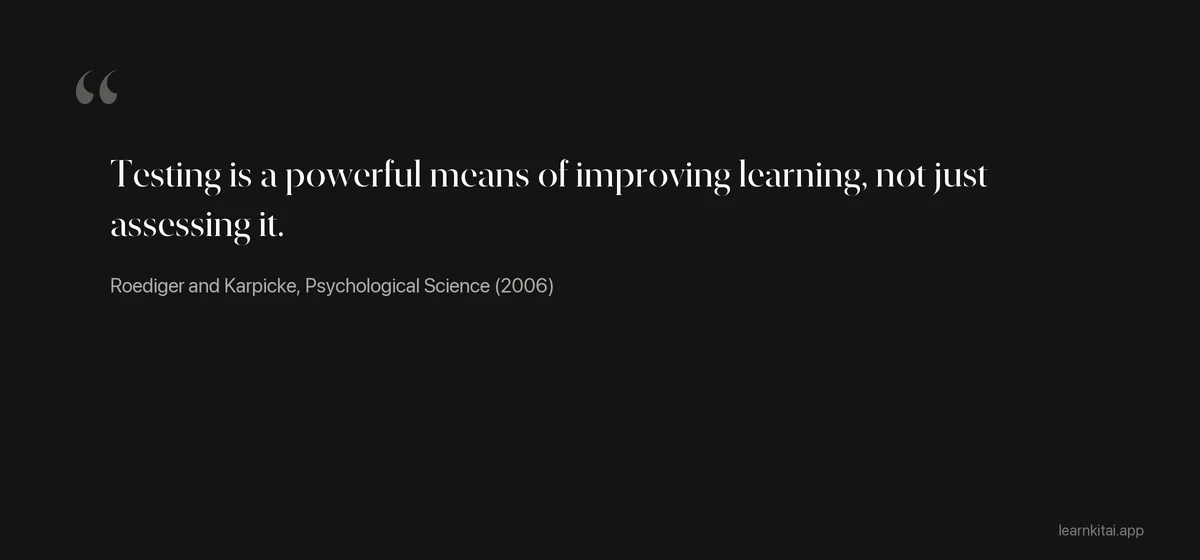
This is not a single lucky study. A 2017 meta-analysis in Review of Educational Research concluded that practice tests are more beneficial for learning than restudying and every other comparison condition it examined. The broader phenomenon is called the testing effect.
Does multiple choice count as retrieval practice?
Partly. Choosing from options is mostly recognition, so it helps less than writing or saying the answer from scratch. Use multiple choice for quick checks and broad coverage, and free recall or short answers for the material that matters most.
A 2014 meta-analysis by Rowland found that recall tests produced larger benefits than recognition tests. The more effort the retrieval takes, the more it tends to help, as long as you can still get some of it right. A blank page is the hardest format. Fill-in-the-blank and short answer sit in the middle. Multiple choice is the easiest.
Retrieval is not only for memorizing terms. In a 2011 study in Science, students who practiced retrieving a science text learned more than students who built detailed concept maps while looking at it. The advantage held on questions that asked them to draw inferences, and even on a final test where they had to make a concept map themselves.
How do you turn review into retrieval practice?
Keep the activity, change the order. Hide the source, attempt an answer, then check. Every common review habit has a retrieval version that takes about the same time.
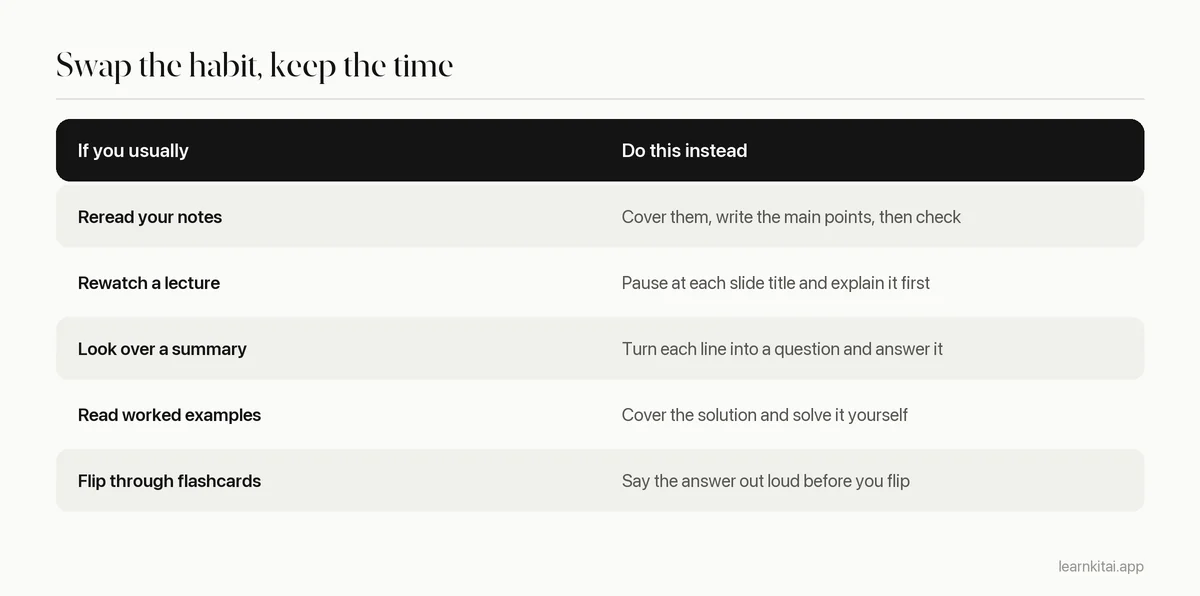
The last row matters. Flashcards are only retrieval practice if you commit to an answer before turning the card. Glancing at the front and flipping right away is review in disguise.
A 25-minute retrieval session
- Brain dump (5 minutes). Write everything you remember about the topic on blank paper. This is the blurting method.
- Check (5 minutes). Open the source. Mark misses and errors in a second color.
- Targeted questions (10 minutes). Answer five to ten specific questions on the weak parts, ideally ones you wrote or generated earlier.
- Second attempt (5 minutes). Close everything and try the missed items again. Write down any still missing for tomorrow.
When is plain review still useful?
When you have not understood the material yet, and right after a failed retrieval attempt. Review fills a specific gap you just found. It is the follow-up to retrieval, not a replacement for it.
You cannot retrieve what you never learned. On the first pass, read for understanding. After that, use review only as feedback: look up the exact thing you missed, then test it again. This keeps review short and targeted instead of the hour-long rereading most students default to.
Four ways retrieval practice goes wrong
- Peeking. Checking after three seconds of effort turns it back into review. Give each question a real attempt, even a wrong one.
- Only easy questions. If you get 100% every time, the questions are too easy or too familiar. Rephrase them or ask why and how.
- No feedback. Guessing without checking can lock in errors. Always compare with the source after each attempt.
- One big session. A single marathon the night before is better than rereading, but the same minutes spread over a week work far better.
Expect your first scores to be low. That is normal and useful. A 50% score on a self-quiz is not a grade; it is a map of what to study next, and it is far more honest than the warm feeling that comes from looking over the notes again.
If you want a full plan for using questions across a course, see the practice testing guide. The short version: whenever you sit down to review, close something first.
Frequently asked questions
How often should I do retrieval practice?
Aim for a short session on each topic within a day of learning it, then again a few days later and about a week later. Several brief sessions spread out beat one long session the night before.
Does retrieval practice work if I get the answers wrong?
Yes, as long as you check the correct answer afterward. A failed attempt followed by feedback still strengthens memory and shows you exactly what to revisit. Without feedback, errors can stick, so always check.
Is retrieval practice good for understanding, or only for facts?
Both. In a 2011 study in Science, retrieval practice beat concept mapping even on questions that required inference. Use why and how questions, not only definitions, to practice understanding.
Can I do retrieval practice in my head without writing?
Yes, but be strict. Say the full answer out loud or in clear sentences in your head before checking. Vague mental nods such as yes, I know that are easy to fake and often turn into review.
Sources
- Test-enhanced learning: taking memory tests improves long-term retention, Psychological Science (Roediger and Karpicke, 2006) (Experiment 1: restudy 81% vs test 75% at 5 minutes; test 68% vs 54% at 2 days; test 56% vs 42% at 1 week.)
- Rethinking the Use of Tests: A Meta-Analysis of Practice Testing, Review of Educational Research (Adesope, Trevisan and Sundararajan, 2017) (Practice tests are more beneficial for learning than restudying and all other comparison conditions.)
- The effect of testing versus restudy on retention: a meta-analytic review of the testing effect, Psychological Bulletin (Rowland, 2014) (Recall tests yield larger testing benefits than recognition tests.)
- Retrieval practice produces more learning than elaborative studying with concept mapping, Science (Karpicke and Blunt, 2011) (Retrieval practice beat concept mapping, including on inference questions.)
Keep reading

Active Recall: Why Closing the Book Beats Rereading
Rereading feels productive but fades fast. Here is how to study by pulling answers out of memory, with a session plan, examples and the mistakes to avoid.
The Testing Effect: Why a Quiz Beats Another Reread
Taking a test is not just a way to measure memory. It changes memory. Here is what the research shows and how to use it this week.
Rereading Notes Feels Like Studying. It Mostly Isn't
Rereading is the most popular study habit and one of the weakest. Here is why it fools you, and a 20-minute swap that works better.

Practice Testing: The Study Habit That Beats Rereading
Testing yourself is not just a way to check what you know. It is one of the best-supported ways to learn. Here is how to do it well, week by week.
The Blurting Method: Empty Your Head to Fill It
Write down everything you remember, then check what is missing. A simple revision method with a step-by-step routine, a worked example and four variations.