Outline Note Taking: Build the Skeleton First
Outline note taking puts main topics at the left margin and indents subtopics and supporting details beneath them, so the page shows how ideas are ranked. It works best for structured lectures and textbooks. To study from it, cover the details under each heading and try to recall them.
Most lectures and textbook chapters already have a skeleton: a few big topics, each with smaller points, each with examples or facts. Outline note taking simply makes that skeleton visible on your page. Instead of a long stream of sentences, you get a ranked list in which indentation tells you what belongs under what. That makes outlines quick to write and quick to review.
What is the outline method of note taking?
It is a way of writing notes in levels. Main ideas go at the left margin, subtopics are indented under them, and details are indented further. The indentation shows how each idea relates to the ones above it.
The University of Portland Learning Commons describes it this way: main ideas go on the left side of the page, subtopics go below with an indent to the right, and supporting facts get more indentation still. Their guide also notes that the format makes review easier because notes are already sorted into topics.
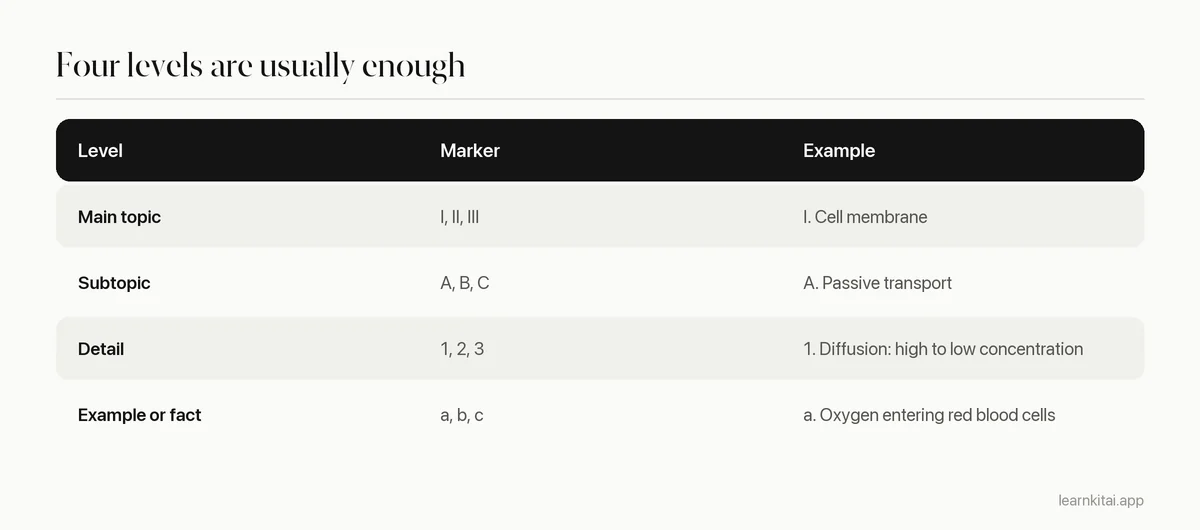
You do not have to use Roman numerals. Dashes and indents work just as well in a notebook or a notes app. What matters is that every item has a clear parent. If you cannot tell which heading a line belongs to, the outline has stopped doing its job.
Outline note taking: a worked example
Here is how ten minutes of a history lecture on the causes of the American Revolution might look in outline form:
- I. Money problems after the Seven Years' War
- A. Britain in heavy debt, wants colonies to pay
- 1. Stamp Act, 1765: tax on printed paper
- 2. Colonists protest: "no taxation without representation"
- II. Growing tension
- A. Boston Massacre, 1770: troops fire on crowd
- B. Boston Tea Party, 1773: tea dumped in protest
- 1. Britain responds with the Coercive Acts
- III. Break toward war
- A. First Continental Congress, 1774
Notice how little is written. Each line is a phrase, not a sentence. Yet anyone reading it can see the argument: debt led to taxes, taxes led to protest, protest led to punishment and then to organized resistance. That chain of cause and effect is exactly what an essay question will ask about.
When should you use outline note taking?
Use it when the material is clearly organized, such as a lecture with slides and headings or a textbook chapter. It struggles with lectures that jump around, with subjects full of diagrams or equations, and with topics where ideas connect in many directions.
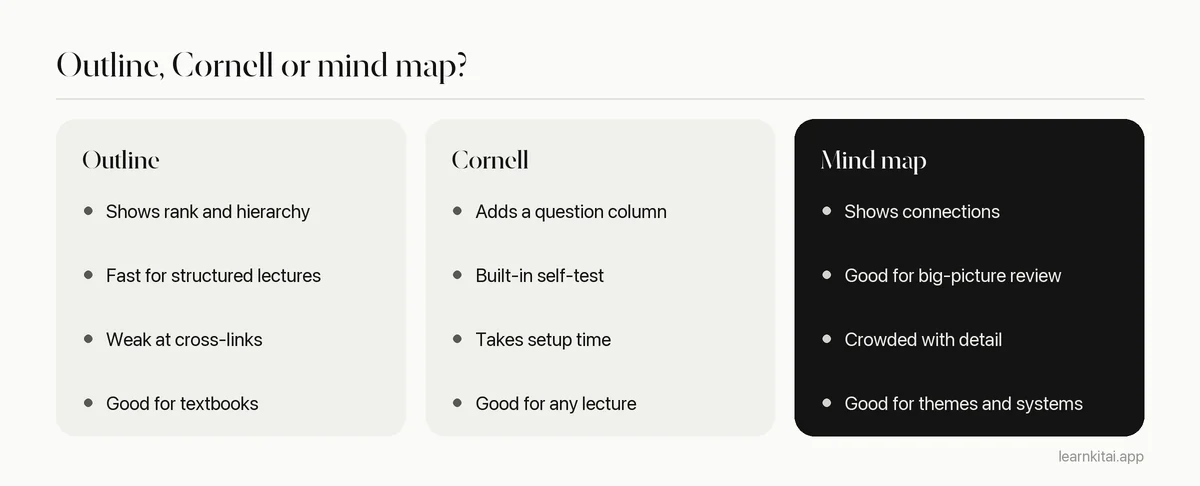
The methods mix well. Many students write an outline inside the notes column of Cornell notes, so they get structure and a question column on the same page. If a topic is more of a web than a ladder, our comparison of mind maps and linear notes helps you choose.
How do you outline a lecture that moves fast?
Write only main topics and key phrases during the lecture and leave blank lines under each topic. Fill in details from the slides, the textbook, or the recording within a day, while you still remember the gaps.
- Before class, copy the slide titles or chapter headings as your level-one topics, with space under each.
- During class, add subtopics and short phrases under the right topic. Skip full sentences.
- If you get lost, write a question mark and a time, like "? 32:00", and keep going.
- After class, fill the gaps from the slides or a lecture recording.
Keep your notes short and in your own words. A study by Mueller and Oppenheimer found that students who typed notes on laptops tended to copy the lecture word for word, and they did worse on conceptual questions. An outline pushes against this, because you have to decide where each point fits before you write it.
What are common outline note taking mistakes?
The usual ones are full sentences on every line, too many levels, details filed under the wrong heading, and outlines that copy the slides without adding anything. Each makes the outline longer without making it clearer.
- Copying the slides. If your outline matches the slide deck line for line, you have a second copy of the slides. Add the examples and explanations the lecturer said out loud.
- Everything at the same level. A list with no indents is just a list. Ask which points are main ideas and which are support.
- Orphan lines. A detail with no clear parent will make no sense in three weeks. Move it under a heading or cut it.
- No room to add. Leave a blank line under each main topic so you can fill gaps after class without cramming text into the margins.
How do you study from an outline?
Cover everything below a heading and try to recall it, then check. Turn each main topic into a question, such as "What caused the growing tension between Britain and the colonies?", and answer it aloud or on paper.
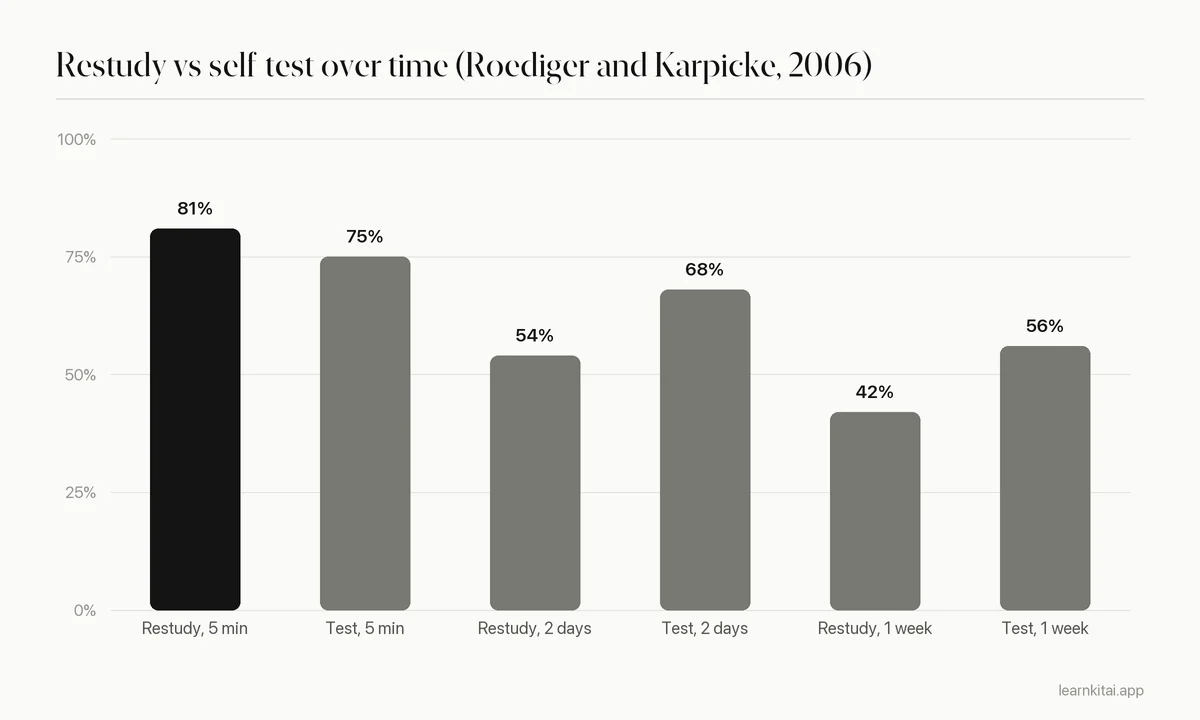
An outline is easy to reread, which is its hidden danger. Rereading feels like studying but holds up poorly. In a well-known experiment by Roediger and Karpicke, students who reread a passage did slightly better five minutes later, but students who tested themselves remembered much more after two days and after a week.
The hierarchy makes self-testing easy. Read a level-one heading, then try to list its subtopics. Read a subtopic, then try to recall its details. Mark anything you miss and review those lines first next time. For more ways to do this, see how to quiz yourself from notes.
If you type your outlines, LearnKit can turn them into a summary or quiz questions, which is a quick way to check that your outline covers what the course expects. Treat the output as a second opinion and keep your own outline as the main record.
Outlines turn a messy stream of information into a clear ladder of ideas. Write the skeleton first, keep lines short, and always finish by covering the details and recalling them. For condensing an outline further before an exam, see the guide on how to summarize a textbook chapter.
Frequently asked questions
How many levels should an outline have?
Three or four is usually enough. If you need a fifth or sixth level, the topic is probably too big for one heading. Split it into two main topics instead.
Is outlining good for math or science?
It works for theory and concepts, but problem-solving steps and diagrams fit poorly into an outline. Many students outline the concepts and keep worked examples on a separate page.
Should I outline before reading a chapter?
A quick skeleton from the chapter headings helps. It shows you the structure before you read, and you can fill in the details as you go. Just do not let it replace actually reading the text.
Can I outline in a notes app?
Yes. Most notes apps support nested bullet lists, and many let you collapse levels, which is a handy built-in self-test. Collapse a heading, recall what is under it, then expand to check.
Sources
- The Outline Method (note-taking guide), University of Portland Learning Commons (Main ideas at the left margin, subtopics and details indented; best for structured lectures and textbooks)
- The pen is mightier than the keyboard: advantages of longhand over laptop note taking, Psychological Science (Mueller and Oppenheimer, 2014) (Verbatim transcription linked to worse conceptual performance)
- Test-enhanced learning: taking memory tests improves long-term retention, Psychological Science (Roediger and Karpicke, 2006) (Experiment 1: restudy 81% vs test 75% at 5 minutes; test 68% vs 54% at 2 days and 56% vs 42% at one week)
Keep reading
How to Summarize a Chapter So You Never Reread It
Most chapter summaries are just shorter copies of the book. The closed-book method turns summarizing into practice that sticks, so you can study from your page instead of the chapter.
Cornell Notes: The Page That Quizzes You Back
A Cornell page is not just a neat layout. Its left column turns your notes into a built-in self-test you can run in ten minutes.
Mind Map Notes vs Linear Notes: Match the Material
Mind maps shine when ideas branch and connect. Linear notes win when ideas follow a sequence. A simple test tells you which one a topic needs.
Lecture Recording Notes Without Rewatching It All
A recording is not a second lecture. Use it as a search tool for gaps, and you can turn a 50-minute class into solid notes in a fraction of the time.

Quiz Yourself From Your Notes in 15 Minutes a Day
Your notes already contain the questions. Here is how to pull them out, five ways to test yourself, and a short daily routine that keeps old topics alive.