AI Flashcard Generator Tips: Make Cards Worth Reviewing
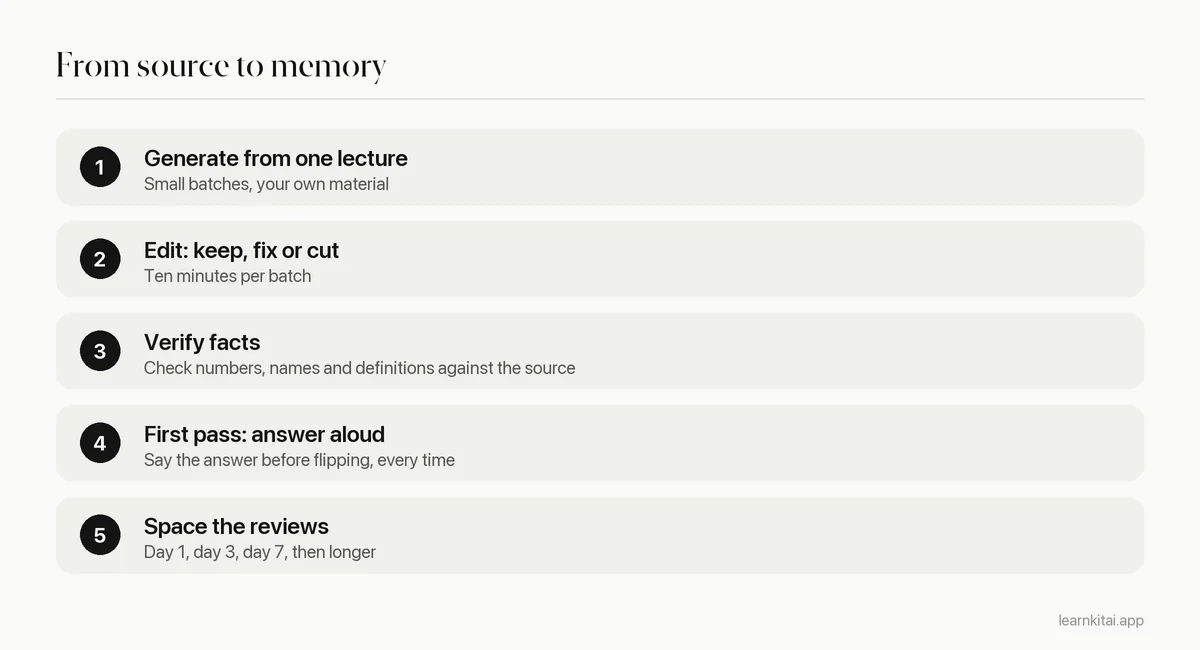
An AI flashcard generator saves the slow part of making cards, but its first draft is rarely ready to study. Feed it your own notes, then edit every card: one fact per card, a question that forces recall, an answer you can check. Cut trivia and duplicates, verify facts, and review the deck on a spaced schedule.
An AI flashcard generator can turn a 30-page lecture into 50 cards before your coffee cools. That speed is real and useful. Writing cards by hand is slow enough that many students never do it, so they fall back on rereading. AI removes that barrier.
But a deck is only as good as its cards. A raw AI deck often has vague questions, long answers, trivia your professor will never ask, and the occasional confident error. This guide shows you what to look for, a fast rule for editing, and how to study the finished deck so it actually sticks.
Are AI-generated flashcards good for studying?
They can be, after editing. Flashcards work because they make you retrieve answers, and practice testing is one of the best-supported study methods. AI drafts can be as good as human ones, but quality varies more, so review each card before you study it.
The method behind flashcards is strong. A large review of study techniques rated practice testing and spaced practice as the two most useful methods for students. Flashcards combine both. The open question is whether AI writes good questions.
Early evidence says: often, but not reliably. In a study of exam questions, ChatGPT-written multiple choice questions were rated about as good as professors' questions overall, and were made in about a tenth of the time. But AI questions scored lower on relevance and had a much wider range of quality. That is the pattern you will see in AI flashcards too: many good cards, a few poor ones, and the poor ones are not labeled.
What do AI flashcard generators get wrong?
The common problems are long answers that pack several facts, fronts that can be answered by recognition instead of recall, trivia from captions and examples, duplicates, missing context, and occasional factual errors. Each one is quick to fix once you know to look for it.
- Overloaded backs. A card asking What is the Krebs cycle? with a six-line answer is a reading exercise, not a recall test.
- Yes or no fronts. Is mitosis a type of cell division? lets you guess. Rewrite it to demand the answer.
- Trivia. Names from figure captions or a lecturer's side story become cards because they appear in the text.
- Context gaps. What does it inhibit? makes sense in the lecture but not three weeks later in a shuffled deck.
- Errors. A wrong number or a swapped term, stated with full confidence. See our guide to AI hallucinations.
- Lists as one card. Name the seven functions of the liver is hard to grade and easy to half-know.
Most of these break a single idea that card makers have repeated for decades: keep each card to one small piece of knowledge. SuperMemo creator Piotr Wozniak listed it among his twenty rules of formulating knowledge, along with avoiding sets and not learning what you do not understand. Our guide to the minimum information principle explains why small cards are easier to remember.
How do you edit an AI flashcard deck fast?
Use a keep, fix or cut rule. Keep a card if it asks one thing you might be tested on and has a short checkable answer. Fix it if the idea is right but the wording is vague or overloaded. Cut trivia, duplicates and anything you cannot verify against your notes.
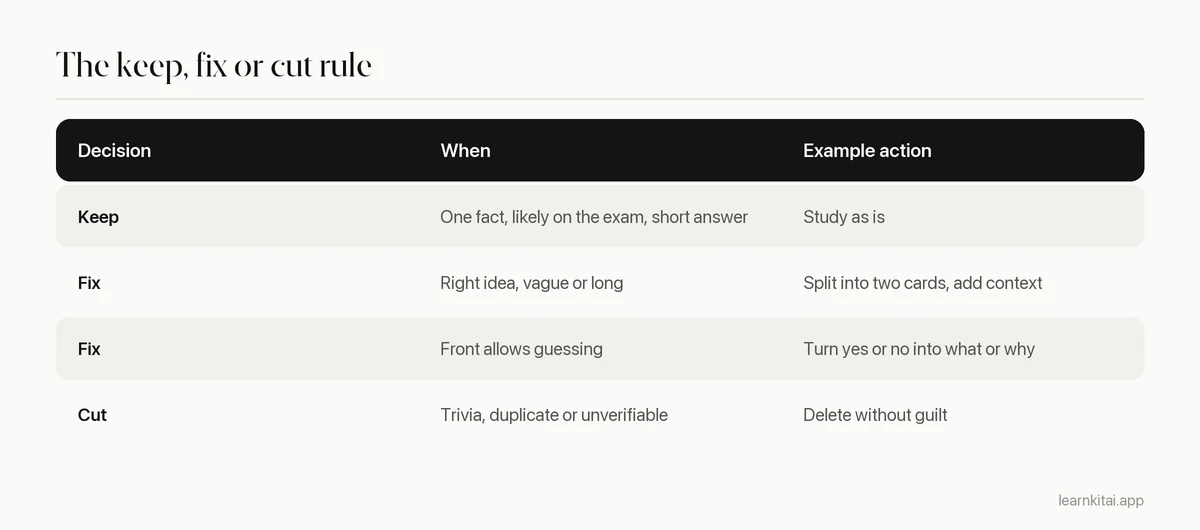
Work fast. Read the front, answer it in your head, flip, and decide in a few seconds. If you hesitate over whether a card matters, ask one question: would my instructor plausibly test this? If not, cut it. A smaller deck you actually review beats a big one you avoid.
Here is a typical fix. The AI draft below is accurate but overloaded.
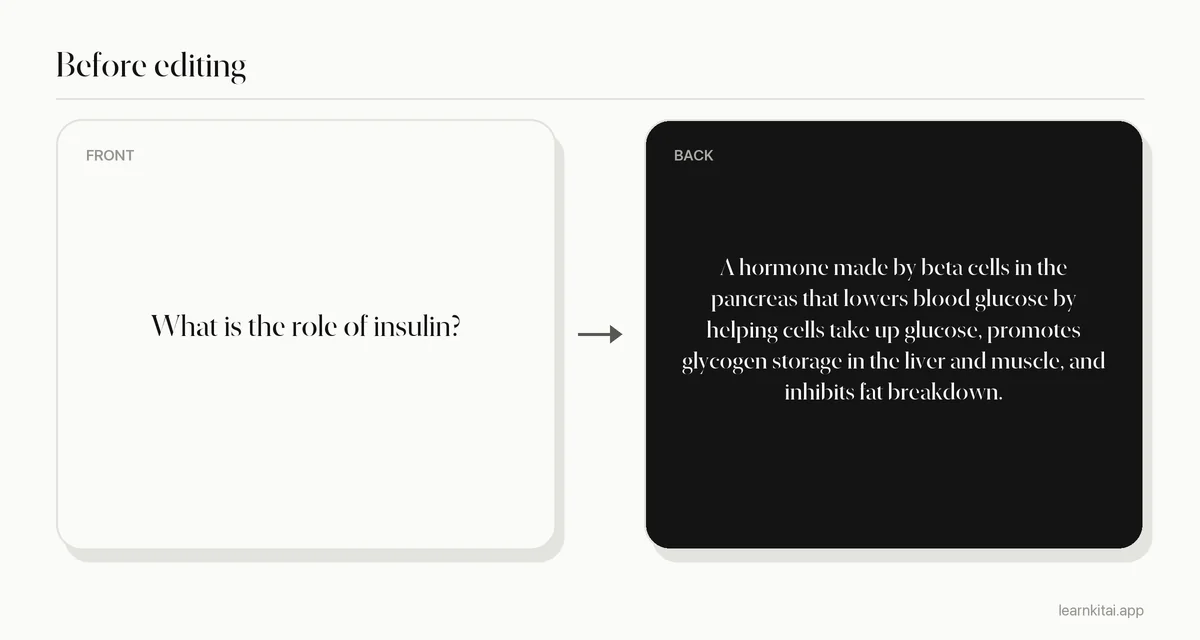
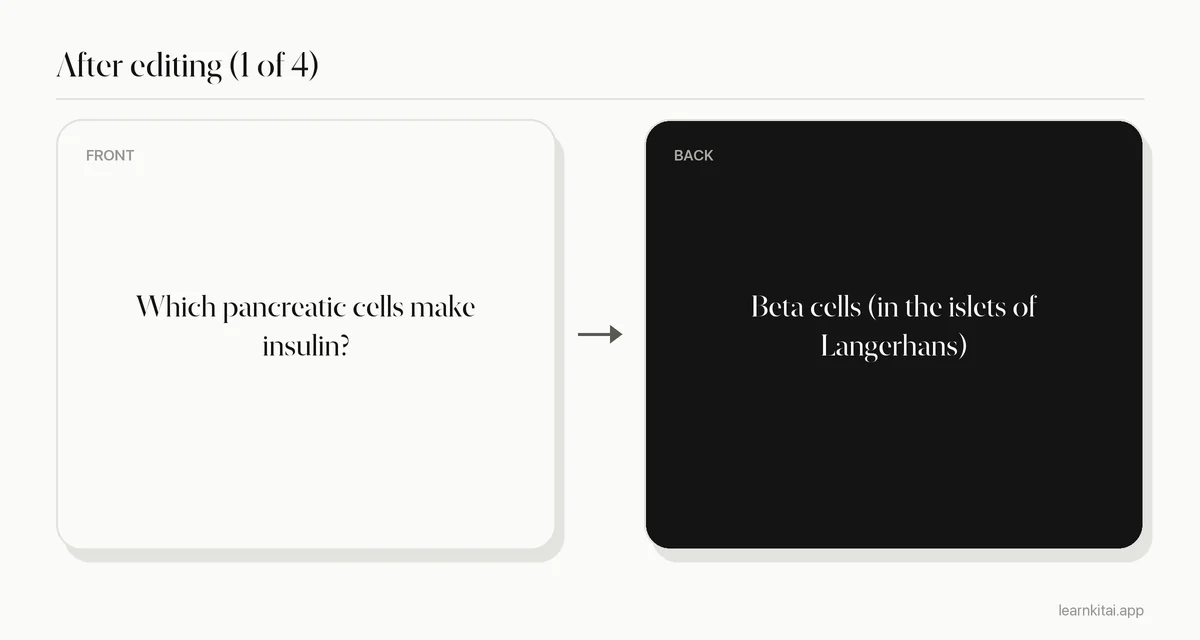
The other three cards cover what insulin does to blood glucose, where it promotes glycogen storage, and its effect on fat breakdown. Four small cards take less total review time than one big one, because you stop half-remembering the big one.
What should you feed an AI flashcard generator?
Your own course material: lecture notes, the assigned chapter, slides or a recording transcript. Cards built from your sources match what your instructor emphasizes. Cards from general knowledge drift toward textbook trivia and may not match your course's terms.
Generate from one lecture or one section at a time, not a whole semester. Small batches are easier to edit and easier to schedule. If you work from slides or PDFs, our guide to flashcards from a PDF covers how to handle diagrams and tables.
How to study an AI-generated deck
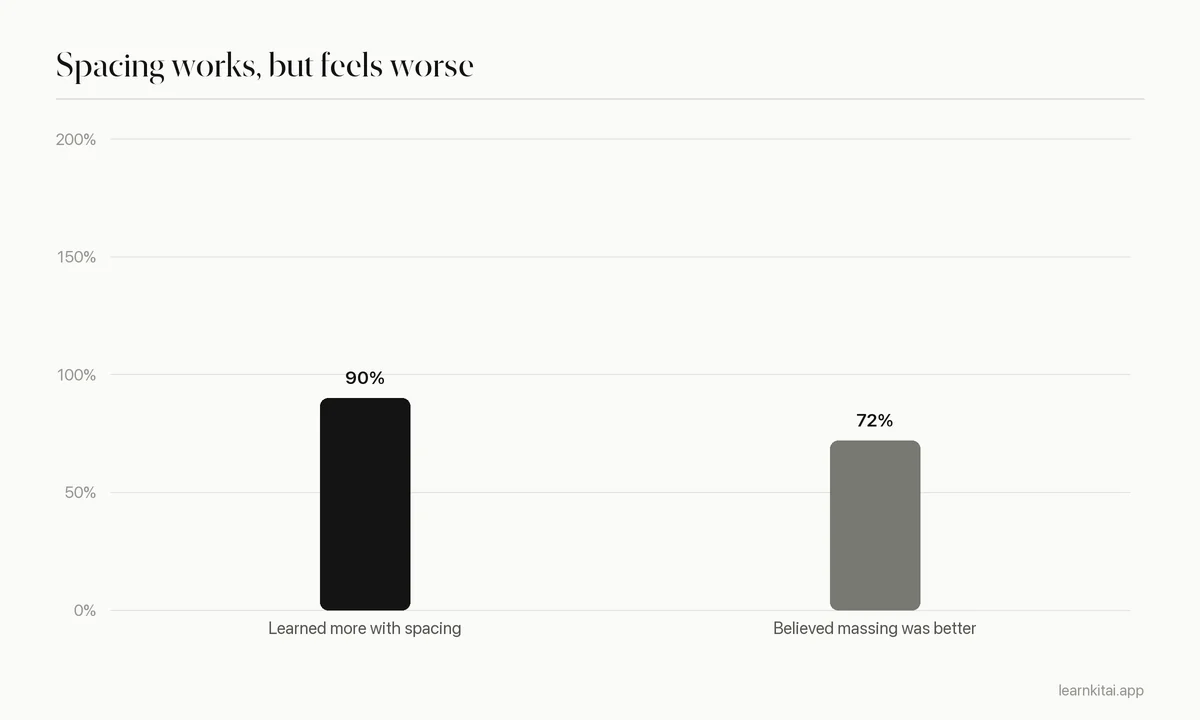
Spacing matters as much as the cards. In a set of flashcard experiments, Kornell (2009) found that studying one large spaced stack beat several small massed stacks for 90 percent of participants. Yet after the first session, 72 percent believed massing had worked better. Your feelings will lie to you about this. Trust the schedule. Our guide to spaced repetition explains how to set the gaps.
When should you write flashcards by hand instead?
When you are learning something you do not yet understand, or when the act of writing is the learning. For brand new, tricky concepts, and for your own mistakes, writing the card yourself forces you to decide what matters. Use AI for bulk coverage, and hand-write the hard cards.
An AI deck assumes you already understand the material well enough to judge it. If a chapter still confuses you, cards will only help you memorize words you cannot explain. Read, ask questions, work an example, and then make cards. Hand-written cards also make sense for errors from practice tests, because you know exactly which misconception you are fixing.
An AI flashcard generator is a fast first draft, not a finished deck. Spend ten minutes editing, check the facts, and space the reviews, and you get the speed of AI with the learning power of good cards. For the full craft of card writing, read our guide on how to make flashcards, and for the bigger picture of studying with AI, see AI for studying.
Frequently asked questions
How many AI flashcards should I make per lecture?
Enough to cover the ideas you will be tested on, which is often 15 to 40 cards for a typical lecture. If you end up with far more, you probably have trivia or overloaded cards to cut.
Should I use cloze cards or question cards from AI?
Both work. Cloze cards, where a key term is blanked out of a sentence, are good for definitions and facts. Question cards are better for why and how ideas. Check that each cloze blank has only one sensible answer.
Can I share an AI deck with classmates?
You can, but each person still benefits from editing it themselves. The edit pass is part of the learning, and a shared deck spreads any errors to everyone.
Are AI flashcards good for language learning?
They are useful for vocabulary, especially when each card includes a short example sentence. Check translations with a dictionary, since AI sometimes picks a rare meaning or the wrong register.
Sources
- Optimising learning using flashcards: Spacing is more effective than cramming, Applied Cognitive Psychology (Spacing beat massing for 90 percent of participants; 72 percent believed massing was more effective)
- ChatGPT versus human in generating medical graduate exam multiple choice questions, PLOS ONE (via PubMed Central) (50 AI vs 50 human questions; similar overall quality, AI lower on relevance with a wider range; about 20 vs 211 minutes)
- Improving Students' Learning With Effective Learning Techniques, Psychological Science in the Public Interest (PubMed) (Practice testing and distributed practice rated high utility)
- Effective learning: Twenty rules of formulating knowledge, SuperMemo (Card writing rules including avoiding sets and not learning what you do not understand)
Keep reading
AI for Studying: Make It Quiz You, Not Think for You
AI can make you a stronger student or a more dependent one. The difference is whether it does the thinking or makes you do it.
How to Make Flashcards That Still Work Three Weeks Later
Most flashcards fail before you ever study them, because of how they are written. Seven rules, real before and after cards, and a study routine that keeps them working.
Minimum Information Principle: Small Cards, Big Recall
One flashcard, one fact. Here is why splitting fat cards into tiny ones makes reviews faster and memories stronger, with worked examples.
Flashcards From PDF: Turn a Chapter Into 30 Good Cards
A PDF chapter can become a focused deck in under an hour, by hand or with AI. Where to look for card material, how to handle scanned files, and how to check the result.

Spaced Repetition: Why Forgetting Is Part of the Plan
Reviewing right before you forget builds memories that last. Learn how long the gaps should be, with a ready schedule for exams one week to one semester away.