Cloze Deletion: Fill-in-the-Blank Cards Done Right
A cloze deletion card is a sentence with one key part hidden, which you fill in from memory. It keeps facts in context and is quick to make from notes. Hide one meaningful word or phrase per card, keep the sentence short, and add a hint when the blank could have several answers.
Cloze deletion is the simplest way to turn a sentence from your notes into a flashcard: you hide one part and try to fill it in. The mitochondria produce most of the cell's ___ through aerobic respiration. You answer ATP, flip, and check. It takes seconds to make, keeps the fact inside its context, and works for almost any subject.
It is also easy to misuse. Hide the wrong word and you are testing grammar. Hide too much and the card becomes a guessing game. This guide shows how to write cloze cards that test what matters, with examples and the syntax used by Anki.
What is a cloze deletion card?
A card built from a full sentence with one or more parts replaced by a blank. The front shows the sentence with the gap, the back shows the complete sentence. One sentence can produce several cards, each hiding a different part.
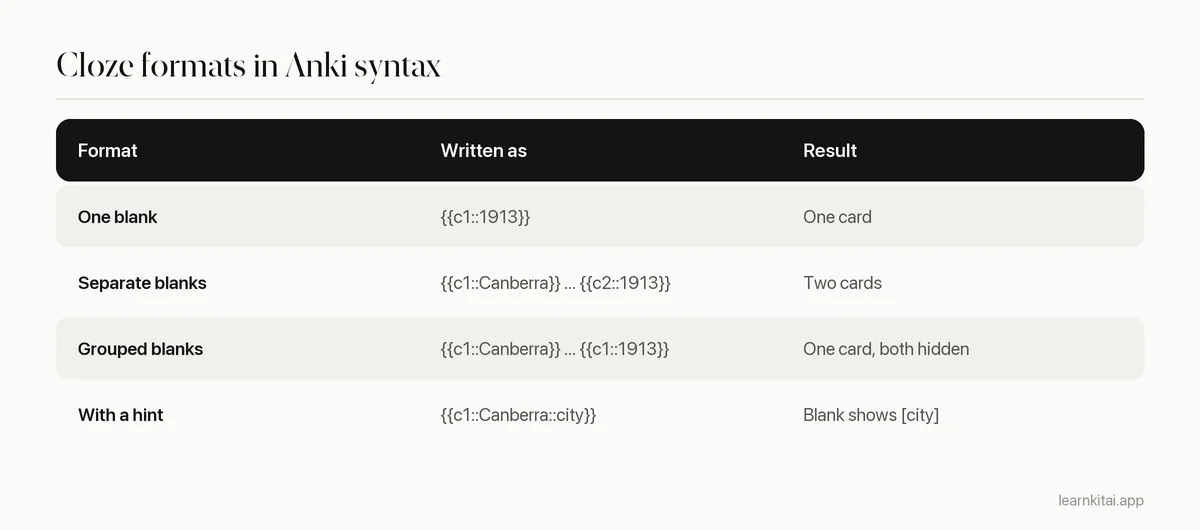
The Anki manual uses a neat example. Start from Canberra was founded in 1913. Hide the year and you get one card: Canberra was founded in [...]. Hide the city and you get a second card from the same sentence: [...] was founded in 1913. Both cards come from one note, so if you fix a typo, both update.
SuperMemo's twenty rules of formulating knowledge call cloze deletion easy and effective, and recommend it especially to beginners who struggle to keep cards small. A sentence with one blank naturally follows the minimum information principle.
When are cloze cards better than question and answer cards?
Use cloze for definitions, terms in context, formulas and fixed facts that live naturally in a sentence. Use question and answer cards for causes, comparisons and anything that needs reasoning, where the sentence would give away too much.
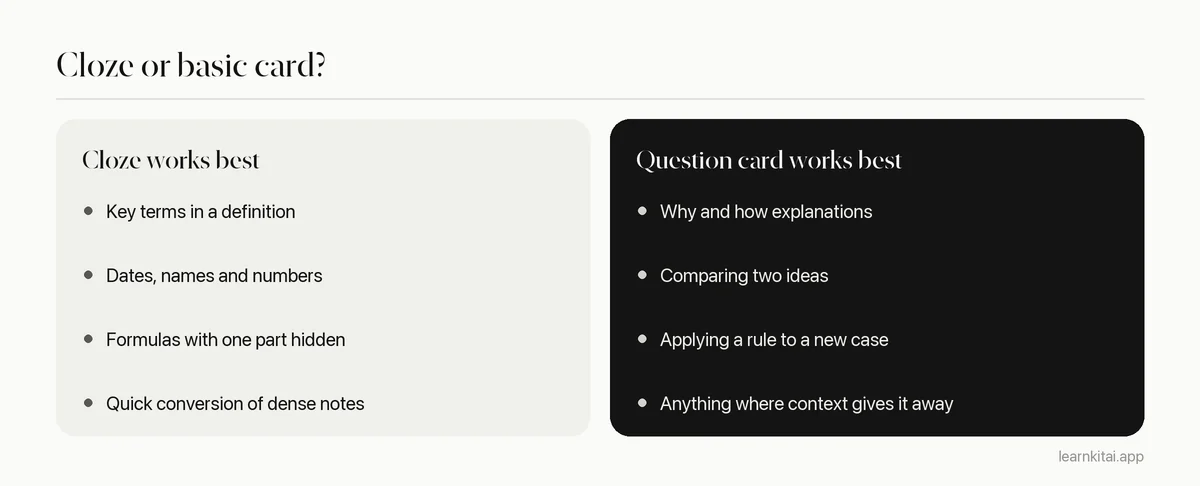
The risk with cloze is that the sentence itself carries hints. If you have seen the same sentence twenty times, you may recognize its shape and fill the gap without knowing the fact. That is why a healthy deck mixes both formats. Our pillar guide on how to make flashcards covers the other card types.
Which word should you hide?
Hide the word or phrase an exam would ask for: the term, the number, the cause or the name. Never hide filler words. If you could guess the blank from grammar alone, pick a different word.
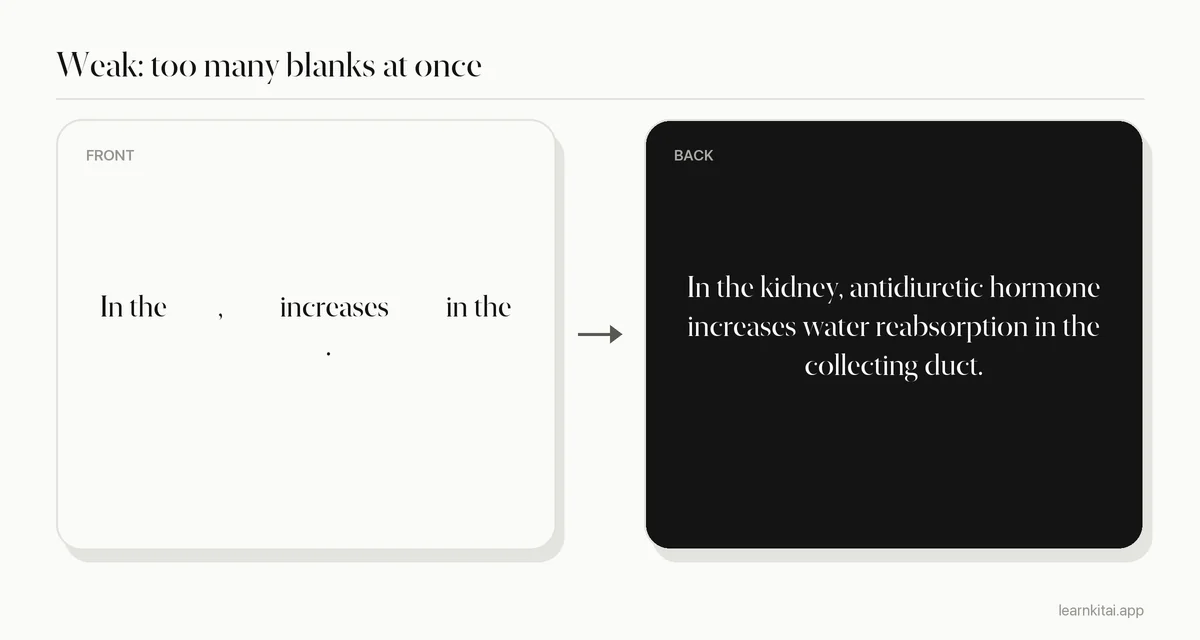
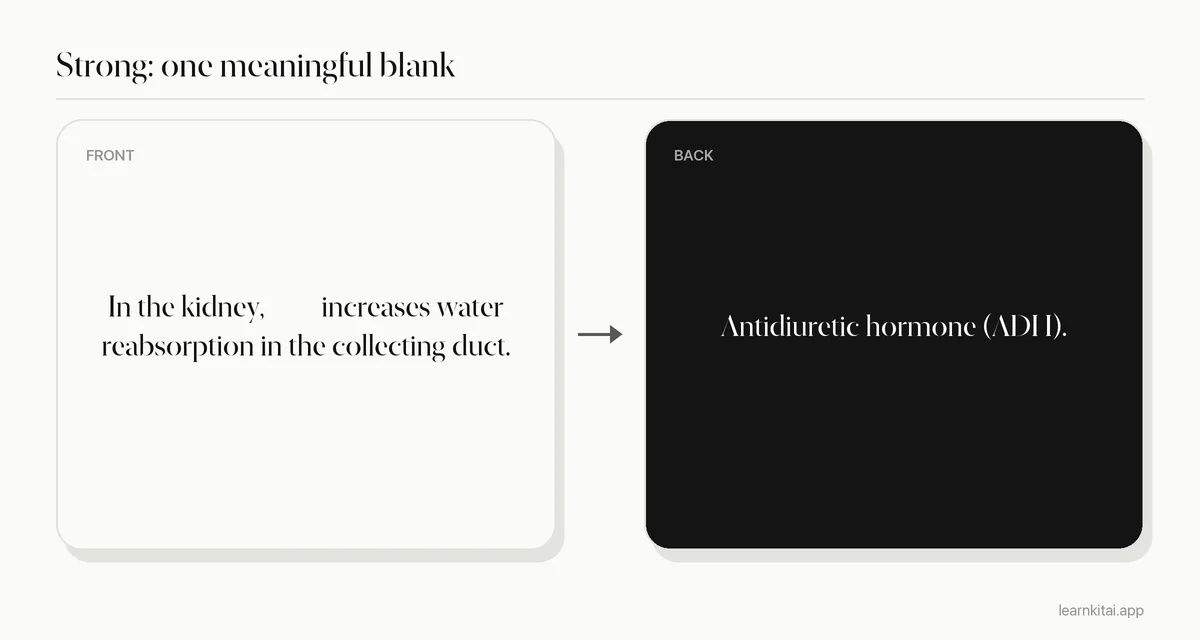
Take this note: In the kidney, antidiuretic hormone increases water reabsorption in the collecting duct. There are three useful blanks: the hormone, what it increases, and where. There are also bad blanks, such as the or in. Each useful blank becomes its own card.
How many blanks should one cloze card have?
Usually one. Hide two parts on the same card only when they must be recalled together, such as a pair of opposite terms. If two blanks are independent, make two cards from the same sentence instead.
Here is the trap. Every blank you add as a separate card is another card in your daily reviews. The Anki manual estimates that 20 new cards a day leads to roughly 200 reviews a day. A dense paragraph with eight clozes is eight cards, not one. Choose the two or three blanks an exam would really ask for, and see how many flashcards per day you can sustain.
When should you add a hint?
When the blank has more than one reasonable answer. A hint like [hormone], [year] or [organ] narrows the target without giving it away, so you are tested on the fact and not on guessing what the card wants.
The ___ regulates blood sugar could be insulin, glucagon or the pancreas. Adding [hormone, lowers] makes the card fair. Keep hints to a category or a direction. If the hint contains the first letters of the answer, you are back to recognition.
How do you use cloze deletion for lists?
Do not hide a whole list on one card. Make one card per item, each showing the rest of the list as context, or split long lists into small groups with a memorable order. Each card then has one clear answer.
Lists are where cloze cards most often go wrong. Say you need the four stages of mitosis in order: prophase, metaphase, anaphase, telophase. One card that hides all four is hard to grade and easy to half-know forever. Instead, write the sentence once and make four cards, each hiding one stage:
- The stages of mitosis are ___, metaphase, anaphase and telophase.
- The stages of mitosis are prophase, ___, anaphase and telophase.
- The stages of mitosis are prophase, metaphase, ___ and telophase.
- The stages of mitosis are prophase, metaphase, anaphase and ___.
Each card tests one position with the rest as support. Once these are easy, add a single question card that asks for the whole list in order with no context. That final card checks that you can produce the sequence on your own, which is what a written exam will need. For lists longer than about seven items, split them into groups first.
A five-minute routine for turning notes into cloze cards
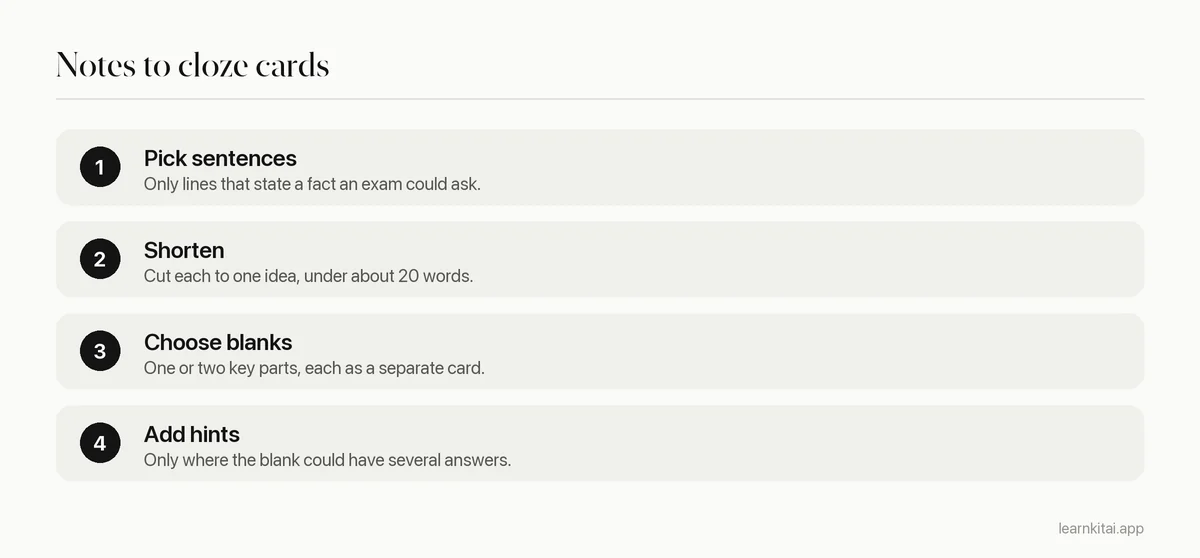
This works well right after a lecture. For a full system, see turning lecture notes into flashcards. For language learning, cloze sentences are one of the best ways to learn words in context; vocabulary flashcards shows how.
Cloze cards shine when they are short and pointed. Use them for the facts that sit naturally in a sentence, pair them with why questions for everything else, and keep an eye on how many cards each paragraph creates. The goal of active recall is to produce answers, and a good blank makes you do exactly that.
Frequently asked questions
Are cloze deletion cards good for learning a language?
Yes. A sentence with the target word hidden teaches meaning, grammar and usage together. Use real example sentences and hide only the word you are learning, with a hint in your own language if the gap is ambiguous.
Can I make cloze cards on paper?
Yes. Write the sentence with a blank on the front and the full sentence on the back. You lose automatic multiple cards per sentence, so write a separate card for each blank you want to test.
Why do my cloze cards feel easy but I still forget the facts?
You may be recognizing the sentence rather than recalling the fact. Rephrase a few cards, shuffle the deck, and convert some clozes into direct questions so the wording no longer gives the answer away.
What does cloze actually mean?
The word comes from closure, an idea from Gestalt psychology: your mind fills in a missing part to complete a pattern. Wilson Taylor described the cloze procedure in 1953 as a way to measure how readable a text is, and it later became a common language test.
Sources
- Editing: Cloze Deletion, Anki Manual (Cloze syntax c1 and c2, grouped clozes producing one card, and hints written with two colons.)
- Deck Options: Daily Limits, Anki Manual (Learning 20 new cards a day leads to roughly 200 reviews a day.)
- Effective learning: Twenty rules of formulating knowledge, SuperMemo (Piotr Wozniak) (Rule 5: cloze deletion is easy and effective, recommended for beginners.)
Keep reading
How to Make Flashcards That Still Work Three Weeks Later
Most flashcards fail before you ever study them, because of how they are written. Seven rules, real before and after cards, and a study routine that keeps them working.
Minimum Information Principle: Small Cards, Big Recall
One flashcard, one fact. Here is why splitting fat cards into tiny ones makes reviews faster and memories stronger, with worked examples.
Vocabulary Flashcards That Survive Real Conversations
Most word cards train recognition and stop there. Here is how to build vocabulary flashcards that let you actually say the word when you need it.
Turn Notes Into Flashcards in 20 Minutes After Class
Your lecture notes are a reading pile until you turn them into questions. A simple 20-minute routine converts each class into cards you can actually test yourself with.
How Many Flashcards per Day? Count Reviews, Not Cards
The right number of new flashcards depends on the reviews they create later. A simple formula, a budget table and the warning signs that you are adding too many.