Music While Studying: When It Helps and When It Hurts
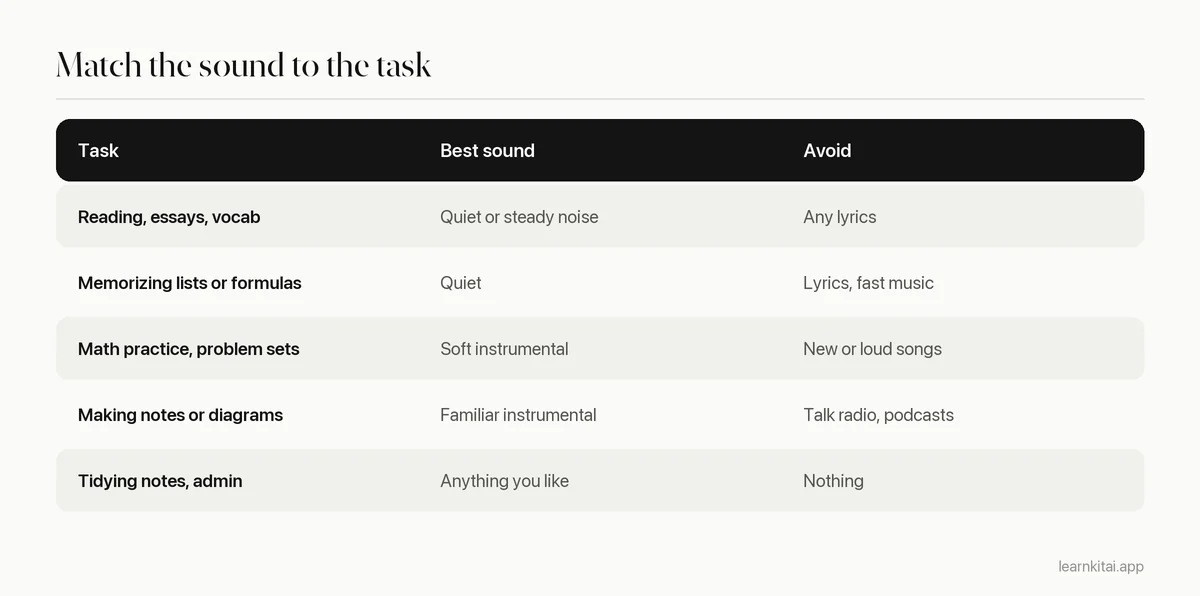
It depends on the task and the music. Songs with lyrics tend to hurt reading and writing, because the words compete with the words you are processing. Instrumental music at low volume does little harm for many tasks and can lift your mood. For hard reading or memorizing, quiet is usually best.
Almost every student has a strong opinion on music while studying. Some cannot start without a playlist; others need total silence. Both groups are partly right, because the answer depends on what you are studying and what you are listening to. This guide sorts the research into a simple rule you can use for every study session.
Is it bad to listen to music while studying?
Not always. Music with lyrics usually hurts tasks that involve words, like reading and writing. Instrumental music causes less trouble and can improve mood and motivation. The harder and more verbal the task, the more silence or steady background noise wins.
The clearest study for students tested reading comprehension directly. Nick Perham and Harriet Currie at Cardiff Metropolitan University had 30 students answer SAT-style reading questions in four sound conditions: quiet, lyrical music they liked, lyrical music they disliked, and instrumental music. Performance was best in quiet and with instrumental music, and worst in both lyrical conditions. Liking the song made no difference. The study is published as Does listening to preferred music improve reading comprehension performance? in Applied Cognitive Psychology.
The students were not fooled about distraction: they rated the songs they liked as just as distracting as the songs they disliked. Yet liked songs with lyrics are exactly what most people put on to study. Enjoying a song does not cancel the cost of its words, so your own sense that a playlist 'works' is not a reliable test.
Why do lyrics make studying harder?
Your brain processes words automatically, even when you try to ignore them. When you read or write, the lyrics compete for the same language processing you need for the task. Instrumental music has no words to compete, so it interferes much less with verbal work.
Psychologists call the broader problem the irrelevant sound effect: background sound that changes from moment to moment, like speech or a melody with words, makes it harder to hold information in order in your head. Steady sound, like a fan or rain, interferes less. This is also why a quiet cafe can feel easier than a room where one person is talking on the phone. The changing speech is the problem, not the volume alone.
Does classical music make you smarter?
No. The so-called Mozart effect came from a 1993 study, but a meta-analysis of about 40 studies with more than 3,000 participants found no support for a specific boost in spatial ability from listening to Mozart. Any small effects are better explained by mood and arousal.
Researchers at the University of Vienna pooled the published and unpublished studies on the effect. As ScienceDaily reports, they concluded there remains no support for gains in spatial ability specifically due to listening to Mozart. Perham and Currie note that later work pointed to mood and arousal from enjoyable music as the real driver. So if classical music relaxes you, use it. Just do not expect it to raise your grade on its own.
When can music help you study?
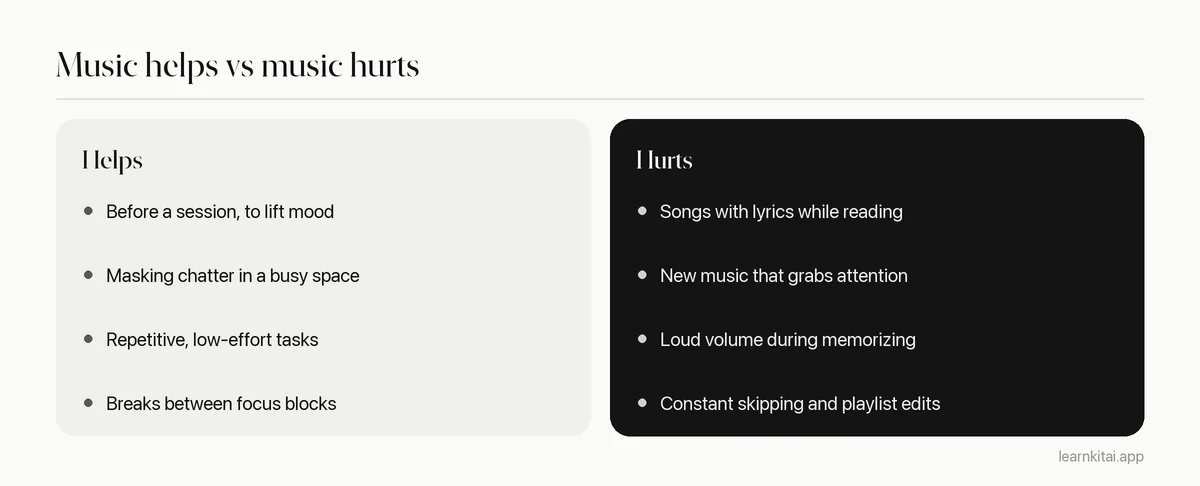
Music helps most before or around studying rather than during the hardest part. It can lift your mood before a session, cover distracting noise in a busy place, make repetitive tasks less boring and mark the start of a study routine. Keep it instrumental and quiet during focused work.
- As a starting ritual. Two songs you love before the timer starts can make it easier to sit down.
- To mask noise. In a loud dorm or cafe, steady instrumental music or noise can hide distracting conversations.
- For low-effort tasks. Recopying a timetable or organizing files does not need silence.
- On breaks. Music plus a short walk is a good way to recover between focus blocks.
What is the best music for studying?
If you want music during focused work, pick instrumental tracks you already know, at low volume, with a steady tempo and few sudden changes. Lo-fi, ambient and calm classical often fit. Build the playlist before you start so you never touch the phone mid-session.
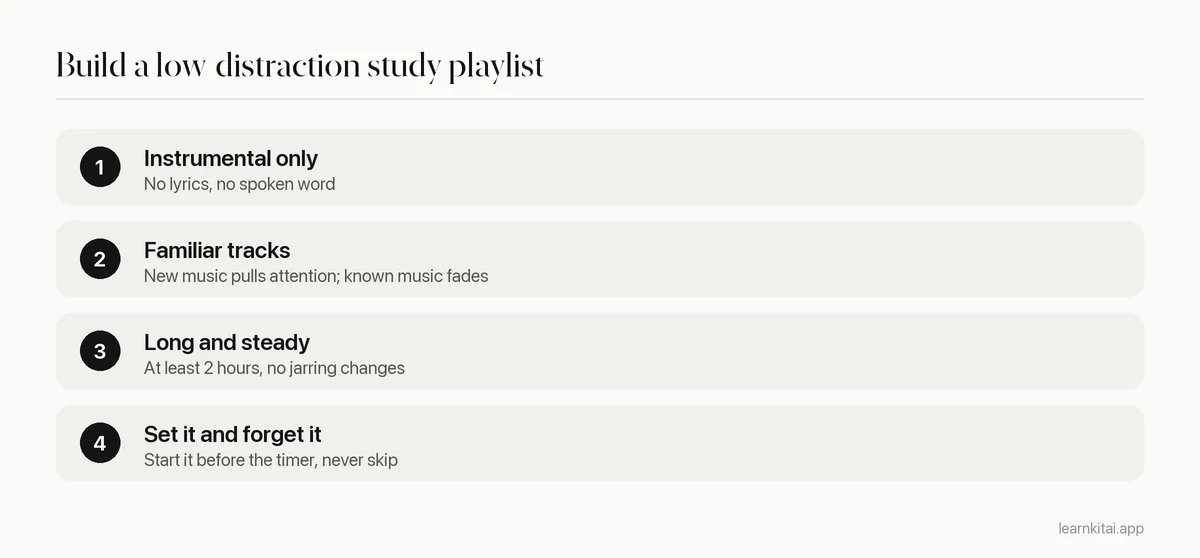
Familiarity matters. A new album makes you listen; a playlist you have heard fifty times fades into the background. Volume matters too: you should be able to forget the music is on. And skipping tracks is a hidden cost. Each skip is a small task switch, and it usually means picking up the phone, which brings its own problems. Our guide on phone distraction while studying explains why.
How do you test music while studying for yourself?
Run a small experiment over a week. Do similar practice tasks in silence on some days and with your usual music on others, then compare scores rather than how the session felt. Two or three rounds of each are enough to spot a clear pattern.
- Pick one task type you do often, such as 15 practice questions or reading a section and answering questions on it.
- Alternate days: silence on Monday, music on Tuesday, silence on Wednesday, and so on.
- Keep everything else the same: time of day, place, phone in another room.
- Write down your score and the minutes you took after each session.
- After a week, compare averages. If music costs you more than a question or two, save it for breaks.
Scores beat feelings here because, as the reading study showed, enjoyment and distraction can sit side by side. You may find that music is fine for math drills and costly for reading, which would match the research. Or you may find no difference at all for your favorite instrumental playlist, and that is a perfectly good result too.
To make the test fair, you need two sets of questions on the same material. LearnKit can generate a short quiz from a page of notes on the web version, so you can make one quiz for the silent session and a second one for the music session. If you study in a noisy place, you can also summarize a long reading in advance and save your quiet hour for the hardest part.
Music is one part of your study environment. For the rest, see how to set up a study space that supports focus, how to fit music into the Pomodoro technique, and the wider guide on how to focus on studying.
Frequently asked questions
Is lo-fi music good for studying?
Lo-fi without vocals is a reasonable choice, because it is steady, familiar in style and has no lyrics. Watch out for tracks with spoken samples, and keep the volume low enough to forget it is playing.
Is white noise better than music for studying?
For many people, steady noise like white noise, rain or a fan interferes less than music because it does not change much. It is especially useful for masking conversations in a shared space.
Can I listen to music in a language I do not understand?
It is probably less distracting than lyrics in your own language, but still not as clean as instrumental music. Voices still draw attention, especially during reading.
What if silence makes me anxious or sleepy?
Try soft, steady instrumental music or background noise instead. The goal is a sound level that keeps you comfortable without grabbing your attention.
Sources
- Does listening to preferred music improve reading comprehension performance?, Applied Cognitive Psychology (Cardiff Metropolitan University) (30 students, four sound conditions; quiet and instrumental best, lyrical music worst; liked and disliked lyrical music did not differ)
- Mozart's music does not make you smarter, study finds, ScienceDaily (University of Vienna) (Meta-analysis of about 40 studies with more than 3,000 participants found no support for a Mozart-specific spatial boost)
Keep reading
Pomodoro Technique for Studying: 25 Minutes, Done Right
A kitchen timer, 25 minutes and a short break. Here is how to use the Pomodoro technique for real study tasks, what the research says and how to adapt it.

Your Study Space Is a Memory Cue. Build It on Purpose
Where you study shapes how well you focus and what you remember. Here is how to set up a space that does part of the work for you.
How to Focus When Your Mind Keeps Leaving the Room
Focus is not a trait you have or lack. It is the skill of noticing drift and coming back, and you can train it.
Phone Distraction: Why Silent Mode Is Not Enough
Your phone can cost you focus even when it is silent and face down. What the research shows, and a setup that actually keeps it out of your study time.
Deep Work for Students: Fewer Hours, Harder Thinking
A few hours of undistracted, demanding work beat a whole day of half attention. Here is how to plan deep work around classes.