Your Study Space Is a Memory Cue. Build It on Purpose
A good study space is quiet, cool, well lit and boring. Keep your phone in another room, set the room to about 71 to 72 F (around 22 C), use one surface only for study, and keep materials ready to start in under a minute. For review, studying in more than one place can help memory.

Your study space works on you before you read a single line. A cluttered desk, a buzzing phone and a warm room all pull a little attention away, and those small pulls add up over an evening. The good news is that setting up a better space takes about ten minutes and pays off every day after.
This guide covers what the research says about phones, temperature and place, then gives you a setup checklist and a simple rule for when to switch rooms.
What makes a good study space?
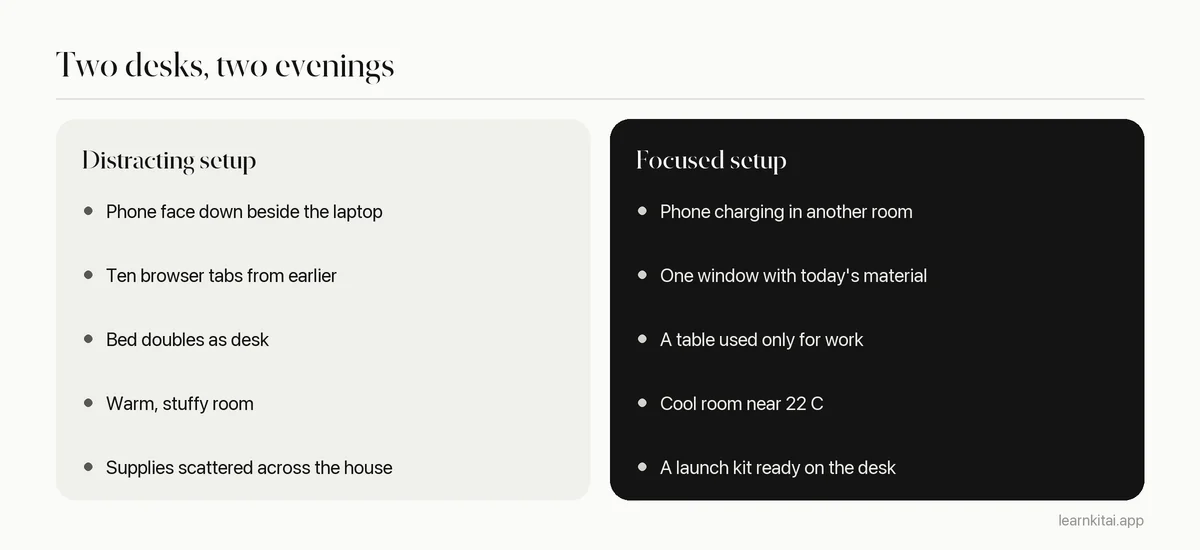
A good space removes choices. Few visible distractions, the phone out of the room, comfortable temperature, steady light and everything you need within reach. The aim is that sitting down there means starting work, with nothing to negotiate.
Think of your space as a set of defaults. Every object in view is an option, and options cost attention. A game controller on the desk is a question you have to answer no to, again and again. A clear desk asks nothing.
Good spaces share four traits: they are cued (you only study there, so your brain links the place with work), ready (materials in reach), comfortable but not cozy (a bed is too cozy), and quiet in the ways that matter for you. You do not need a home office. A kitchen table at a fixed hour can work if you set it up the same way each time.
Where should you put your phone while studying?
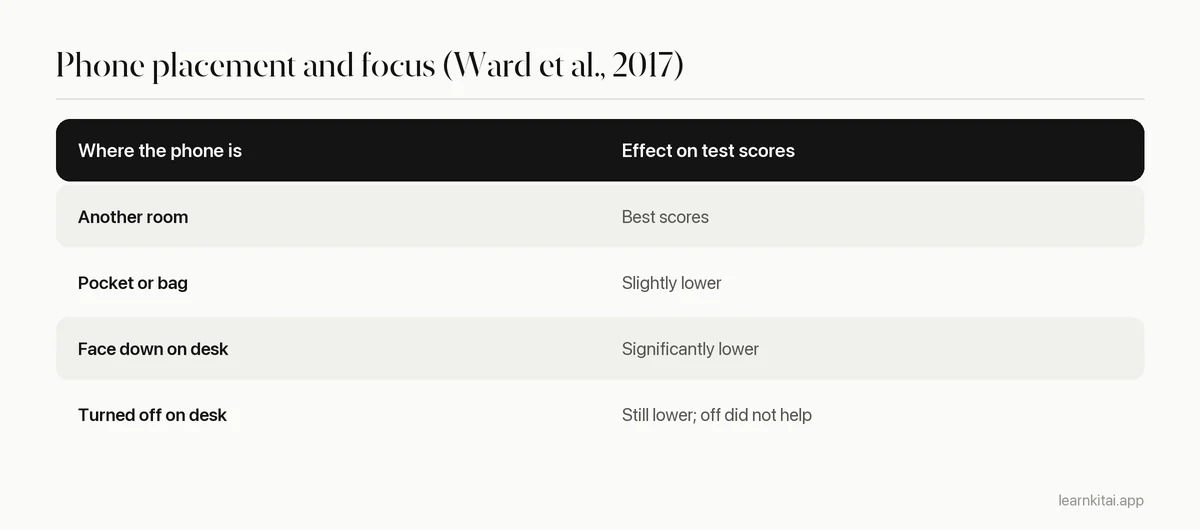
In another room. In a study of nearly 800 people, those whose phones were in a different room did better on tests of working memory and reasoning than those with phones face down on the desk, even when the phone was silent or off.
This is the single biggest change most students can make. Researchers at the University of Texas ran the brain drain experiments: people took concentration tests with the phone on the desk, in a pocket or bag, or in another room. Performance dropped as the phone got more noticeable. Turning it off or flipping it over did not fix it. Part of your mind is busy not checking it.
If you need the phone for two factor login or a timer, take what you need and then move it. Our guide to phone distraction has more tactics for students who rely on their phone for everything.
What temperature and lighting are best for studying?
Aim for about 71 to 72 F (around 22 C). Office studies find performance peaks near that range and falls as rooms get warmer or colder. For light, use bright, even light on your desk and a separate lamp so you are not working in a dim room.
Researchers at Lawrence Berkeley National Laboratory pooled studies of office tasks and found performance was highest at about 71 F, with a later analysis putting it near 72 F. Work got worse as the room moved away from that point in either direction. A warm, stuffy room makes you sleepy. A cold one makes you restless. If you cannot control the heating, a sweater or a window gives you a little leeway.
Light matters too, mostly for comfort. Use a desk lamp aimed at your page, not at your eyes, and keep the screen brightness close to the room's brightness so you are not squinting. Daylight is pleasant if you can sit near a window, but avoid glare on the screen.
Does studying in the same place help you remember?
A little, and it cuts both ways. Memory is partly tied to the place where you learned, but the effect is modest and shrinks when you focus inward. Studying in a few different places can make memories less tied to one room, which helps on exam day.
Psychologists call this context dependent memory. A review and meta-analysis by Smith and Vela found the effect is reliable but gets weaker when learners focus on the material rather than the room, and when they mentally picture the original room at test. That gives you two practical rules.
- Use one main space to start work. The place becomes a cue that says it is time to study, which makes starting easier.
- Do some review somewhere else. Quiz yourself in the library, at a cafe table or on the bus. Your memory then depends less on one desk, and you will not take your exam at your desk.
- On exam day, picture your study spot. If you blank on an answer, recall where you sat and what was around you when you learned it.
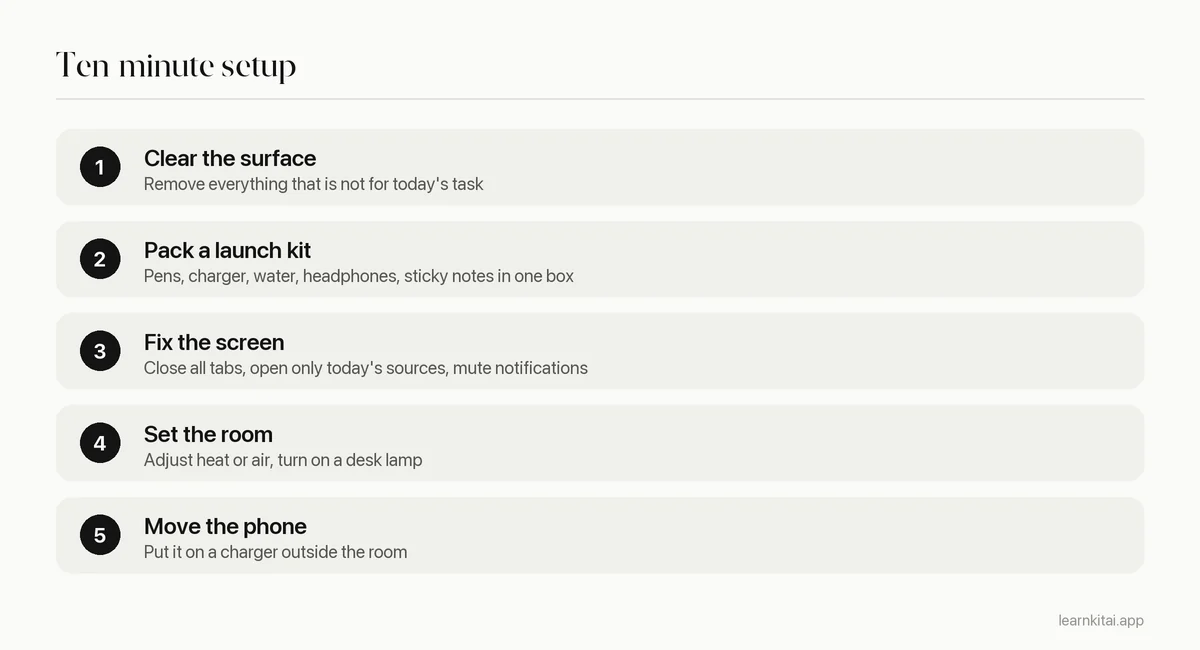
How to set up your study space in ten minutes
Noise is personal. Many people read better in quiet and do routine tasks fine with background sound. If you share a space, noise canceling headphones with nothing playing, or steady sound like rain, can help. Our article on music while studying covers when songs help and when lyrics get in the way.
Your screen is part of the space too. Keep study tools in one window so you are not flipping between apps. Some students open a study side panel next to their reading so they can turn a page into questions without leaving the tab.
Is the library better than studying at home?
Often, yes, for focus. A library removes home distractions and adds quiet social pressure to work. But pick your seat with care: a study found that students who could see a classmate multitasking on a laptop scored lower too. Sit where screens are not in your line of sight.
That last point comes from a York University study in a mock lecture: students near a multitasking peer underperformed, and they did not realize they were distracted. In a library or a cafe, face a wall or sit at the front so other people's screens are behind you.
A study space does not need to be pretty. It needs to make starting easy and drifting hard. Clear it, cool it, move the phone, and pair it with the right hours from our guide to the best time to study. For the session itself, the Pomodoro technique gives you a rhythm to work in.
Frequently asked questions
Should my study space face a window?
A window is fine if it gives light without a busy view. If you keep watching people or traffic, turn the desk so the window is beside you. Side light also cuts screen glare.
Do plants or decorations help focus?
A plant or a calm photo is fine if it makes you want to sit there. The rule is to avoid anything that invites action, like a game console, a TV or a stack of unrelated tasks.
How do I study in a shared dorm room?
Agree on quiet hours with your roommate, use headphones, and face the wall. For long sessions, the library or an empty classroom is often easier than negotiating every evening.
Is a standing desk better for studying?
It is a matter of comfort. Some people like switching between sitting and standing to stay alert. What matters more is a stable surface at the right height, so your neck and wrists are relaxed.
Sources
- Is your smartphone draining your brain?, McCombs School of Business, University of Texas at Austin (Nearly 800 participants; phones in another room gave the best scores, off or face down did not help)
- Brain Drain: The Mere Presence of One's Own Smartphone Reduces Available Cognitive Capacity, Journal of the Association for Consumer Research (Original study by Ward, Duke, Gneezy and Bos (2017))
- Temperature and Office Work Performance, Lawrence Berkeley National Laboratory (Performance highest at about 71 F; later analysis about 72 F)
- Environmental context-dependent memory: a review and meta-analysis, Psychonomic Bulletin and Review (PubMed) (Context effects reliable but reduced by focusing on material and mental reinstatement)
- Multitasking on laptop impedes classroom learning, York U study shows, York University (Students in view of a multitasking peer scored lower)
Keep reading
Pomodoro Technique for Studying: 25 Minutes, Done Right
A kitchen timer, 25 minutes and a short break. Here is how to use the Pomodoro technique for real study tasks, what the research says and how to adapt it.
Phone Distraction: Why Silent Mode Is Not Enough
Your phone can cost you focus even when it is silent and face down. What the research shows, and a setup that actually keeps it out of your study time.
Music While Studying: When It Helps and When It Hurts
Lyrics, lo-fi, classical or silence? What research says about music while studying, and a simple rule for matching sound to the task.
How to Focus When Your Mind Keeps Leaving the Room
Focus is not a trait you have or lack. It is the skill of noticing drift and coming back, and you can train it.
Best Time to Study: Match Hard Work to Your Body Clock
Morning or night? The research says the right answer depends on your chronotype and on the kind of thinking a task needs.