Stop Procrastinating on Studying: Fix the Feeling First
To stop procrastinating, make the task feel smaller and less unpleasant. Name what bothers you about it, shrink it to a first step that takes two minutes, remove the phone, and set a deadline that is days away rather than weeks. When you slip, forgive yourself quickly; guilt feeds the next delay.
You know the exam is in ten days. You know you should start. And yet you have cleaned your desk, reorganized your folders and watched three videos about productivity. If you want to stop procrastinating, the first step is to understand that this is not a time management problem. It is mostly a feeling management problem: the task feels bad, and delaying it makes the bad feeling go away, for now.
Why do students procrastinate on studying?
The strongest predictors are a task that feels unpleasant, a deadline that feels far away, low confidence that you can do it well, and being easily distracted. Laziness is not on the list. Each of these has its own fix, so it helps to know which one is driving you.
That list comes from a large review by Piers Steel at the University of Calgary, which combined 691 correlations from earlier research. In The nature of procrastination, the strong and consistent predictors were task aversiveness, task delay, self-efficacy and impulsiveness, along with parts of conscientiousness such as self-control, distractibility and organization. Traits like neuroticism showed only a weak link. In plain terms: we put off tasks that feel bad, pay off late, seem hard to succeed at, and compete with easy distractions.
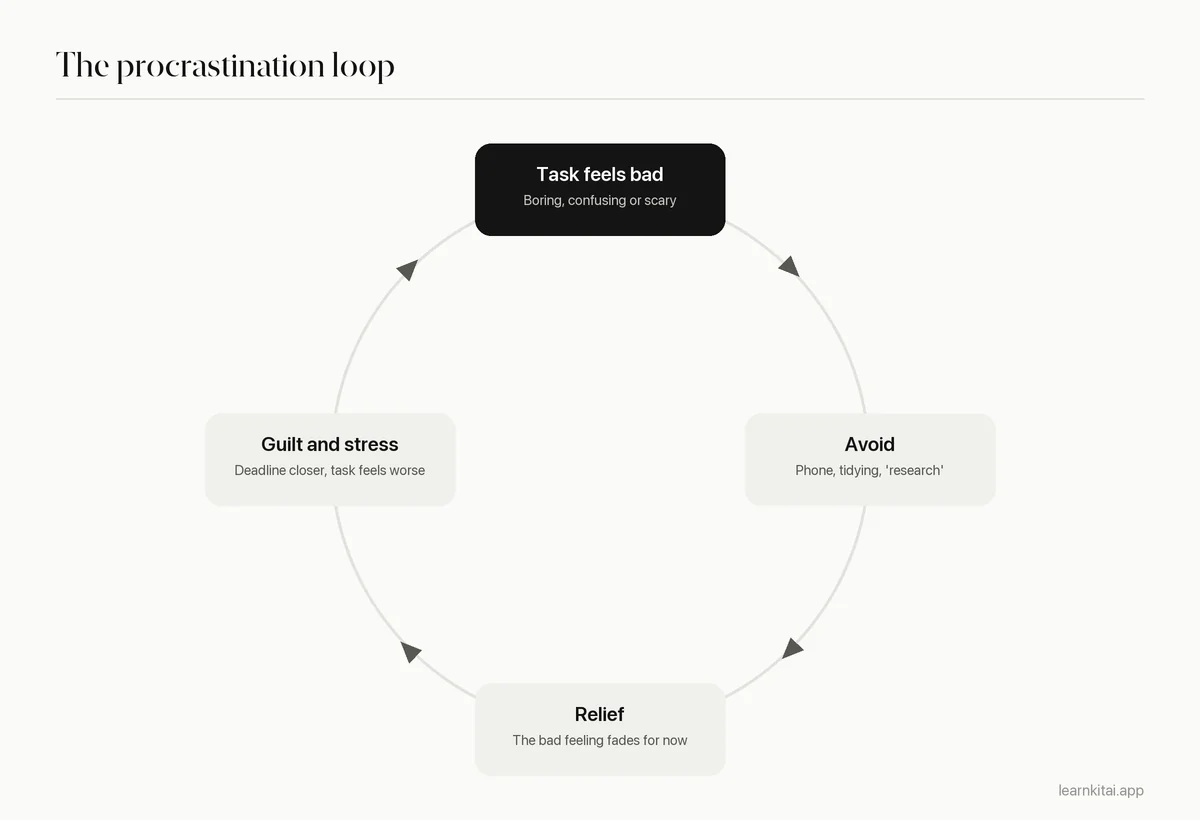
The loop explains why procrastination grows. Every round of avoidance is rewarded with relief, so the habit gets stronger. And every round adds guilt, so the task feels even worse next time. Breaking the loop means changing the feeling at the start, not just adding willpower at the end.
What kind of procrastinator are you right now?
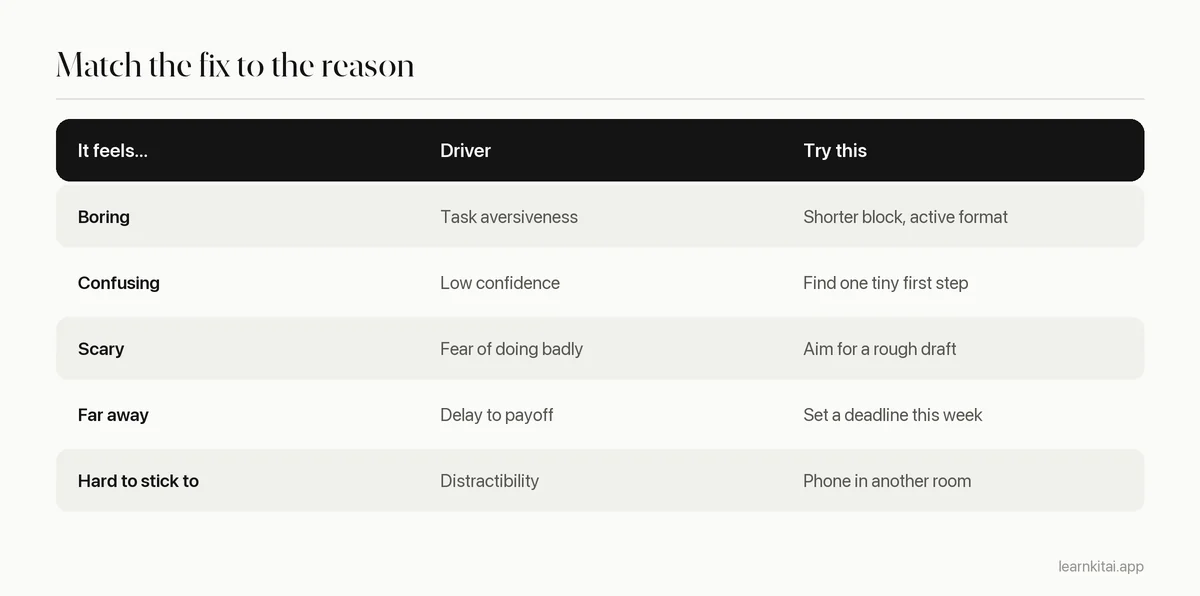
Ask what bothers you about the task at this moment. If it is boring, make it shorter or more active. If it is confusing, find the first clear step. If you fear doing badly, aim for a rough attempt. If the deadline feels far, set a near one. If you keep drifting, remove distractions.
How do you start studying when you do not want to?
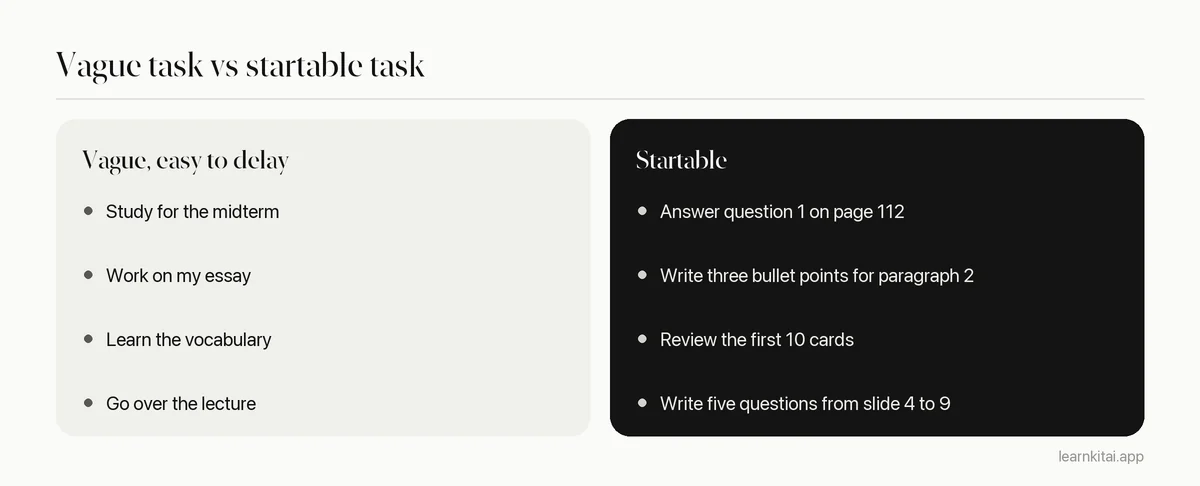
Make the first step so small it feels silly to refuse. Open the notes and write the title of the topic, or answer one practice question. Set a timer for a short block and promise yourself you can stop when it rings. Starting is the hardest part; continuing is much easier.
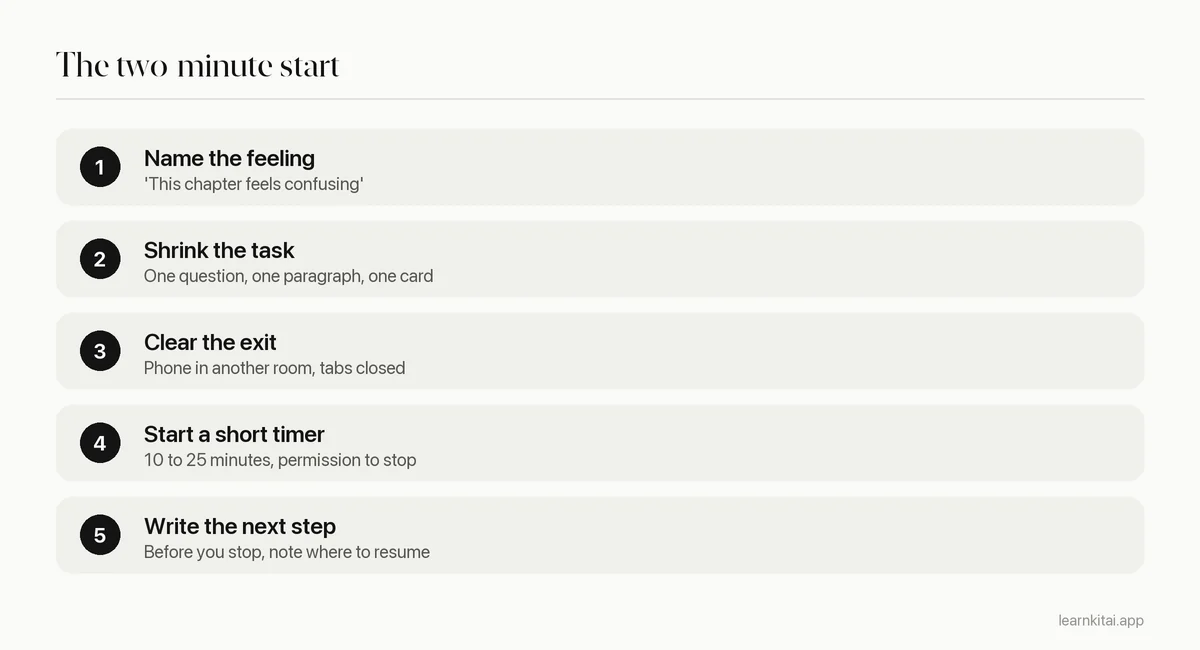
Here is a worked example. Task: 'Study for the biology midterm.' That is not a task; it is a cloud. Shrink it: 'Answer the five review questions on page 112.' Still feels heavy? 'Answer question 1 on page 112.' Now start a 15-minute timer. Most of the time, by the end of the first question you have momentum, and the timer is the reason you keep going rather than the reason you stop.
The timer approach is the heart of the Pomodoro technique, and it suits procrastinators well because it changes the promise. You no longer commit to 'studying biology', which has no end. You commit to 25 minutes, which does.
Does being hard on yourself make procrastination worse?
It seems to. In a study of first-year students, those who forgave themselves for procrastinating before their first exams felt less negative and procrastinated less before their next exams. Self-criticism keeps the task linked to bad feelings, which is what drives avoidance in the first place.
The study, by Michael Wohl and colleagues, followed 134 first-year undergraduates through two rounds of midterms. As the British Psychological Society's Research Digest reports, self-forgiveness for earlier delay was linked with less negative mood and less procrastination the next time around. It is a correlation from one group of students, so it is not proof. But it fits the loop: guilt makes the task feel worse, so the next round of avoidance becomes more likely.
Forgiving yourself does not mean pretending it did not matter. It means saying: I put this off, it cost me, and now I am starting. Then you start. Dwelling on the lost days is just another way to avoid the task.
A useful script when you notice you have drifted: 'I have been avoiding this because it feels confusing. That is normal. The next step is question 1 on page 112.' Notice it has three parts: name the feeling, accept it without a lecture, and point at one small action. Saying it out loud or writing it down sounds silly, but it moves you from judging yourself to doing the task, which is the only move that helps you stop procrastinating.
How to stop procrastinating with better deadlines
A deadline four weeks away does almost nothing today. Your brain discounts rewards and costs that are far off, which is why the last few days before an exam are suddenly productive. The fix is to create near deadlines that matter:
- Break the exam into weekly targets. 'Chapters 1 to 3 done with practice questions by Sunday.'
- Make it public. Tell a study partner what you will finish by when, and check in.
- Book a session. A library slot or a study group meeting is harder to cancel than a private plan.
- Use small daily streaks. One focused block every day builds the habit; see our guide to study streaks and habits.
For a full plan to an exam date, our guide to a study schedule for exams shows how to turn one far deadline into many close ones.
What if the first step is setting up your study material?
Then make setup quick, because setup is a favorite hiding place for procrastination. Gather the notes for one topic only, and get to the first question within minutes. Do not rebuild your entire note system before you start studying.
Making flashcards and practice questions can feel productive while you put off the actual studying. If setup is where you stall, cut it short: drop a lecture PDF or a page of notes into LearnKit, get a short quiz, and answer the first question right away. You have started before the procrastination loop has a chance to begin.
Distraction is the last piece. If your escape route is the phone, the guide to phone distraction while studying explains why distance beats willpower. Procrastination rarely disappears for good, but each quick start makes the next one a little easier.
Frequently asked questions
Is procrastination a sign of laziness?
Usually not. Research points to task feelings, distant deadlines, low confidence and distractibility rather than a lack of effort in general. Many procrastinators work very hard, just on the wrong things at the wrong time.
Can procrastination ever be useful?
Sometimes letting an idea sit helps with creative work, but that is planned delay, not avoidance. For exam studying, delay mostly removes the time you need for spaced review.
What if I procrastinate because the material is too hard?
Then the real problem is confusion, not motivation. Find an easier entry point, such as a summary, a worked example or a classmate's explanation, and ask your teacher about the specific part you do not understand.
How long does it take to break a procrastination habit?
There is no fixed timeline. Focus on the next start rather than the whole habit. A few days of quick starts in a row usually make starting feel noticeably easier.
Sources
- The nature of procrastination: A meta-analytic and theoretical review of quintessential self-regulatory failure, Psychological Bulletin (PubMed) (691 correlations; strong predictors were task aversiveness, task delay, self-efficacy, impulsiveness and conscientiousness facets)
- The cure for procrastination? Forgive yourself, British Psychological Society Research Digest (134 first-year undergraduates; self-forgiveness linked to less negative mood and less procrastination before second exams)
Keep reading
Pomodoro Technique for Studying: 25 Minutes, Done Right
A kitchen timer, 25 minutes and a short break. Here is how to use the Pomodoro technique for real study tasks, what the research says and how to adapt it.
Phone Distraction: Why Silent Mode Is Not Enough
Your phone can cost you focus even when it is silent and face down. What the research shows, and a setup that actually keeps it out of your study time.
Study Habits That Stick: Why Streaks Beat Willpower
Habits take longer to form than the 21-day myth suggests, but one missed day does not ruin them. Here is how to build a study streak that survives real life.
How to Focus When Your Mind Keeps Leaving the Room
Focus is not a trait you have or lack. It is the skill of noticing drift and coming back, and you can train it.
The Study Schedule That Works Backward From Exam Day
Most study plans fail because they start from today. Start from the exam date instead, count your real hours, and space every topic at least three times.