Predict Exam Questions Like the Person Who Writes Them
To predict exam questions, start from the course learning objectives, then look for what the instructor repeated, spent time on or called important, and check past papers for recurring formats. Write the questions you expect, answer them from memory, and focus on concept questions rather than small details.
Every exam is written by a person with goals, habits and limited time. That makes it more predictable than it feels. You will not guess the exact wording, but you can predict exam questions well enough to know which topics will appear, in what form, and how deep the answers must go. Doing that work is also one of the best ways to study.
This guide shows where the clues are, how to turn them into a list of likely questions, and how to practice with that list. It belongs to our practice testing guide, which explains why answering questions beats rereading.
Can you really predict exam questions?
You can predict topics, formats and the level of thinking with good accuracy, though rarely the exact wording. Writing and answering your own likely questions is useful even when the predictions miss, because it is a form of retrieval practice.
A 2020 study by Mirjam Ebersbach and colleagues at the University of Kassel tested this during a real university lecture. Students either generated their own questions about the content, answered questions, or restudied. A week later, both generating questions and answering them improved recall, while restudying did not. The authors called question generation another powerful learning strategy with effects similar to testing.
Where do the clues come from?
From five places: the learning objectives in the syllabus, topics the instructor repeats or spends extra time on, review sessions, assigned problems, and past papers. Each one tells you something different about what will be tested.
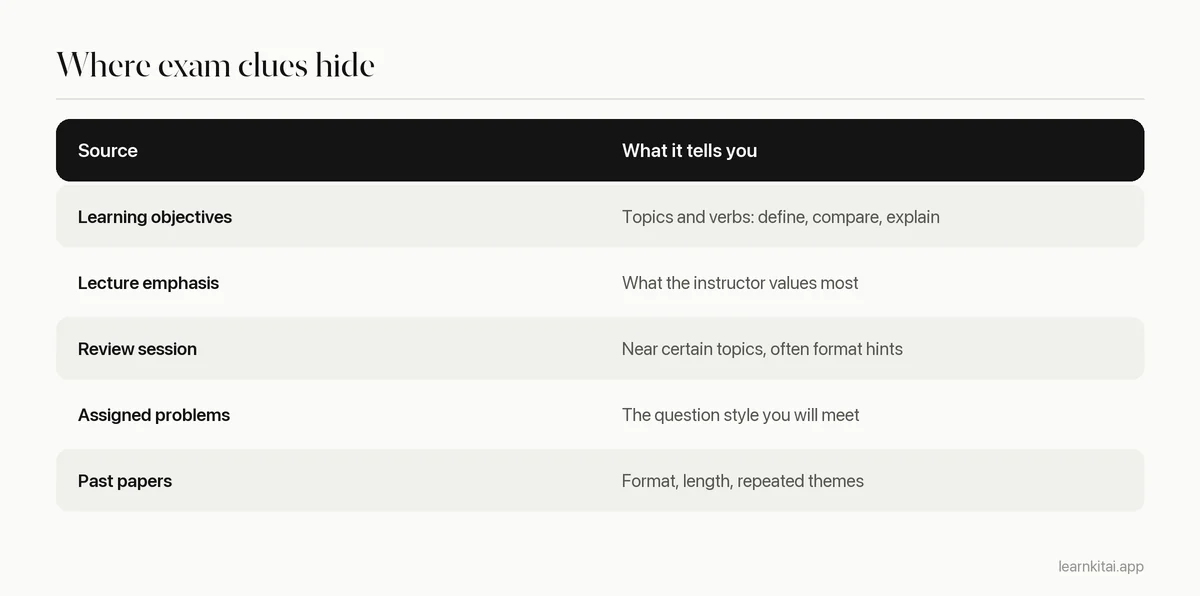
Read the verbs in the objectives
Objectives such as "students will be able to compare X and Y" are close to a question already. The verb tells you the level. "Identify" suggests a short answer or multiple choice item. "Evaluate" or "justify" suggests an essay or a long answer. Copy each objective, swap the verb into a question, and you have a first draft.
Track emphasis in lectures
Put a small star in your notes whenever the instructor says "this is important", writes something twice, returns to an idea in a later lecture, or works a full example on the board. At the end of the term, the starred items are your shortlist. Examples worked in class often return on the exam with new numbers or a new setting.
Mine past papers for patterns, not answers
Past papers show how many questions there are, how marks are split and which themes come back. Do not just memorize old answers. Ask what each question was testing, then write a fresh version on this year's material.
What kind of questions should you predict?
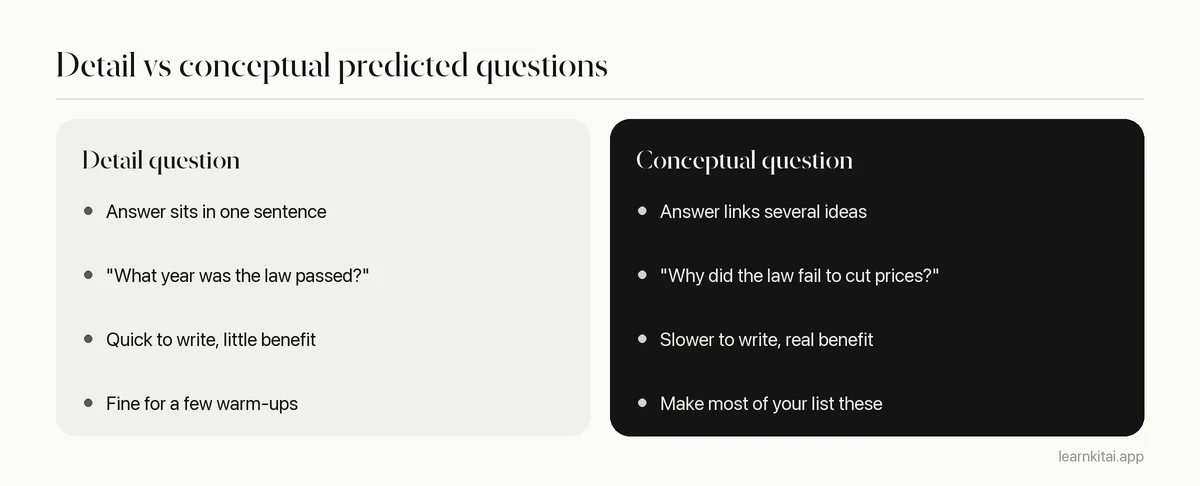
Mostly conceptual questions that require linking ideas, not tiny details. Research on self-generated questions found that writing and answering conceptual questions improved memory for concepts, while detail questions gave no benefit over rereading.
Julie Bugg and Mark McDaniel at Washington University in St. Louis compared two ways of self-generating questions while studying texts. Students who wrote and answered questions that tied together several sentences did better on conceptual test questions than students who simply reread. Students who wrote detail questions, whose answers sat in a single sentence, got no benefit. The lesson: predict the big questions.
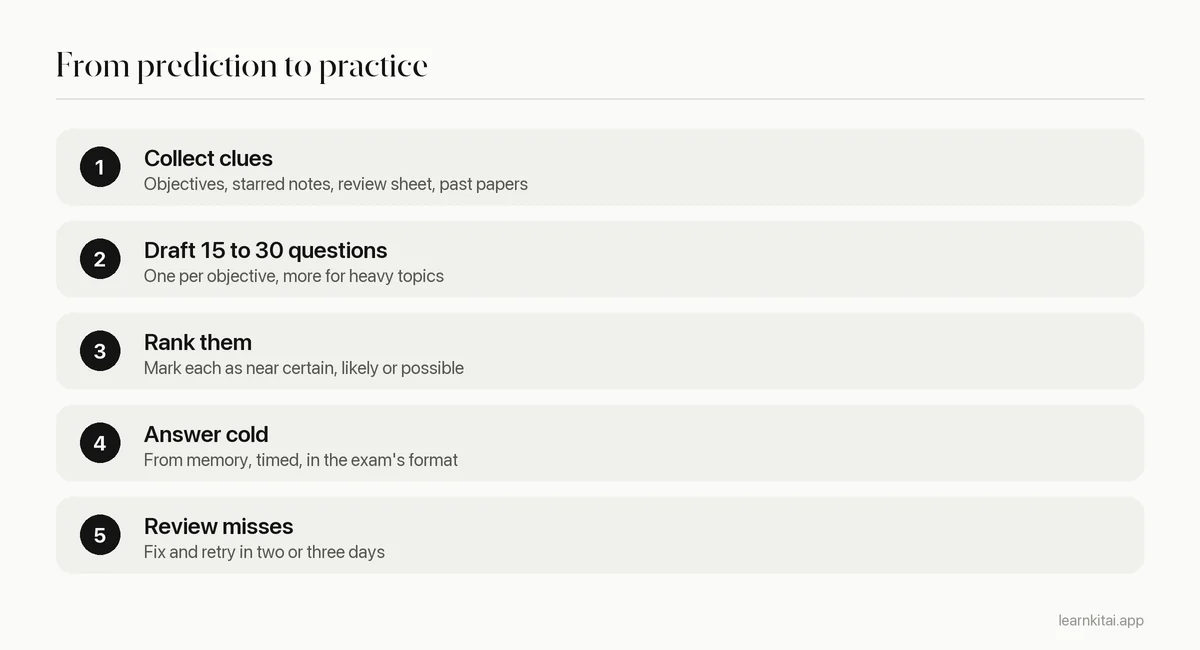
How to turn predictions into a practice set
A worked example
Say an economics syllabus lists the objective "explain how a binding price ceiling affects a market". Your notes have a star next to a rent control example, and last year's paper had a diagram question worth ten marks. Put those clues together and you can predict exam questions with real confidence: something like "Using a supply and demand diagram, explain the effect of rent control on the quantity of housing supplied, and identify one unintended consequence." Rank it near certain, draw the diagram from memory, write the answer in eight minutes, then check it against your notes and textbook. If the shortage on your diagram is drawn on the wrong side of the equilibrium price, that is the exact error you want to find now, not in the exam hall.
Ranking keeps you honest about time. Near certain questions get full written answers. Likely ones get outlines. Possible ones get a one line answer. That way a wrong prediction costs you little, and a right one gives you a rehearsed answer on the day.
A second pair of eyes helps here. After you draft your list, generate a set of open questions from the same material in LearnKit and compare. Questions that appear on both lists are strong bets, and questions only the tool found can point to blind spots in your predictions.
Mistakes that make predictions backfire
- Betting everything on a few topics. Use predictions to set priorities, not to skip whole chapters. Cover every objective at least lightly.
- Predicting only what you like. Students tend to write questions about the parts they already understand. Force a question from each weak area.
- Memorizing model answers word for word. If the question is phrased differently, a memorized script falls apart. Practice the reasoning instead.
- Ignoring format. If the exam has problems, predict problems. If it has essays, outline essays. See essay exam preparation for that format.
Predicting questions fits neatly into a final review plan. Once your list is ready, build it into a timed practice test, and schedule the topics across the weeks you have left using our guide on how to study for finals.
Frequently asked questions
Is it worth asking the instructor what will be on the exam?
Yes, if you ask well. Questions such as "What format will the exam use?" or "Which objectives matter most?" often get useful answers, while "What is on the test?" usually does not.
What if I have no past papers?
Use assigned problems, end of chapter questions and the review sheet instead. Ask upper year students what the format was, and lean more heavily on the learning objectives.
How many predicted questions should I write for one exam?
For a typical midterm or final, 15 to 30 well chosen questions is enough. More than that and you spend more time writing than answering.
Sources
- Comparing the effects of generating questions, testing, and restudying on students' long-term recall in university learning, Applied Cognitive Psychology (Ebersbach, Feierabend and Nazari, 2020) (After one week, generating questions and testing improved recall; restudying did not)
- Selective Benefits of Question Self-Generation and Answering for Remembering Expository Text, Journal of Educational Psychology (Bugg and McDaniel, 2012) (Conceptual self-generated questions helped conceptual test performance; detail questions gave no benefit over rereading)
Keep reading

Practice Testing: The Study Habit That Beats Rereading
Testing yourself is not just a way to check what you know. It is one of the best-supported ways to learn. Here is how to do it well, week by week.
Make a Practice Test That Feels Like the Real Exam
A good practice test copies the real exam's format, mixes topics, and comes with an answer key you check honestly. Here is a step by step build.
Open Ended Questions: Study by Explaining, Not Spotting
Questions with no options to pick from force you to build the answer yourself. Here are 12 question stems, a marking method and a weekly routine.
How to Study for Finals: A 3-Week Plan That Holds Up
Finals reward the student who starts with a plan, not the one who studies longest. Here is a three-week system for triage, testing and sleep.
Essay Exam Prep: Write Your Answers Before You Sit Down
The best essay exam answers are mostly planned before the exam starts. Predict the prompts, build an evidence bank and rehearse outlines from memory.