Essay Exam Prep: Write Your Answers Before You Sit Down
To prepare for an essay exam, predict the likely prompts from the syllabus and lectures, group your notes into themes with two or three pieces of evidence each, and practice writing thesis statements and outlines from memory under a timer. In the exam, budget time by points and plan before you write.
An essay exam looks like a test of writing speed. It is really a test of preparation. The students who write clear, well-supported answers in 40 minutes are rarely faster writers. They have already decided what they think about the big questions in the course, and they walk in with arguments and evidence ready to arrange.
This guide shows how to get there: predicting prompts, building an evidence bank, rehearsing answers from memory and managing the clock on the day.
How do you predict essay exam questions?
Look for the course's big recurring themes. Check the syllabus headings, the questions your teacher keeps asking in lectures, past exams and any review sheet. Most essay prompts are variations on four to eight core debates or comparisons.
Every course has a small set of ideas it keeps returning to. In a history course, it might be causes of a war, the role of individuals versus systems, and continuity versus change. In a literature course, it might be how two authors treat the same theme. Write down six to eight possible prompts in your own words. You will rarely guess the exact wording, but you will usually guess the territory. Our guide to predicting exam questions has more techniques.
What should an essay exam study session look like?
Group your notes by theme, not by week. For each theme, write a position you could defend and list two or three specific pieces of evidence. Then practice writing outlines and full answers from memory, and check them against your notes.
Notes organized by week are hard to use in an essay. Reorganize them by theme. For each likely prompt, build an evidence bank: a short list of facts, examples, quotations, data or cases you can use, each with a one-line note on what it proves. Aim for two or three strong pieces of evidence per theme rather than ten weak ones.
Then rehearse. Close your notes, set a timer for 10 minutes, and write a thesis and outline for one prompt. Compare it with your evidence bank and fill the gaps. Retrieval like this works much better than rereading. In a classic study, students who took recall tests remembered 61 percent of a passage a week later, while those who reread it four times remembered 40 percent (Roediger and Karpicke, 2006).
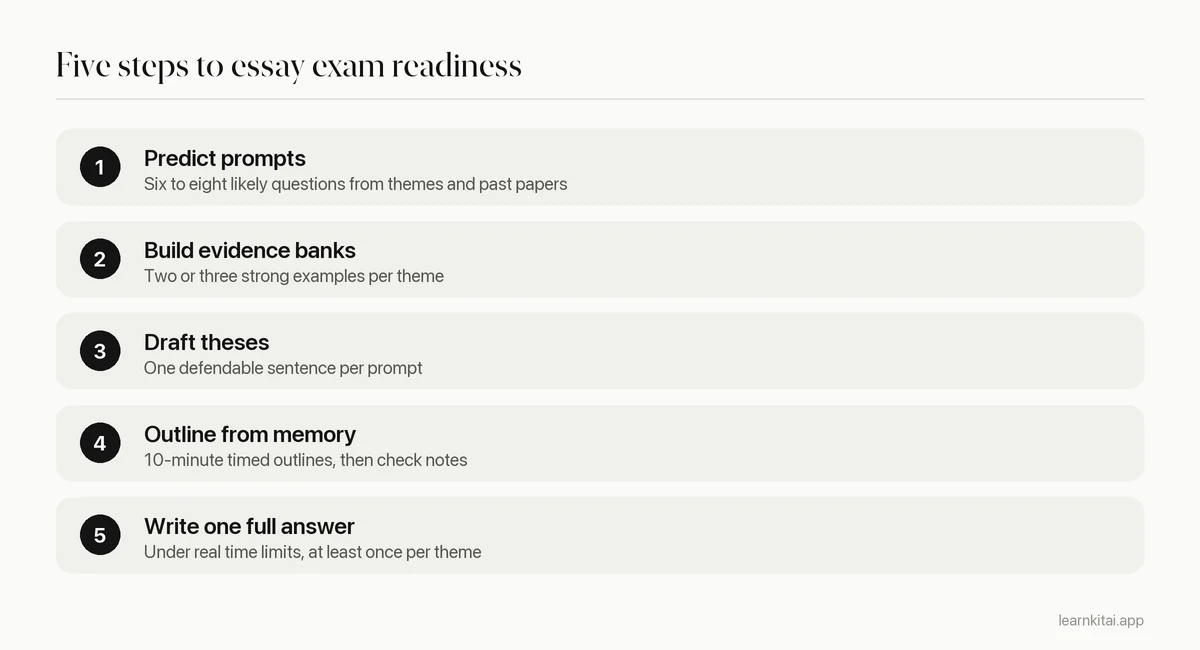
Open questions with sample answers are ideal for this stage. LearnKit can turn your notes into open questions and show a sample answer after you write yours, which makes it easy to see what you left out.
What do essay question command words mean?
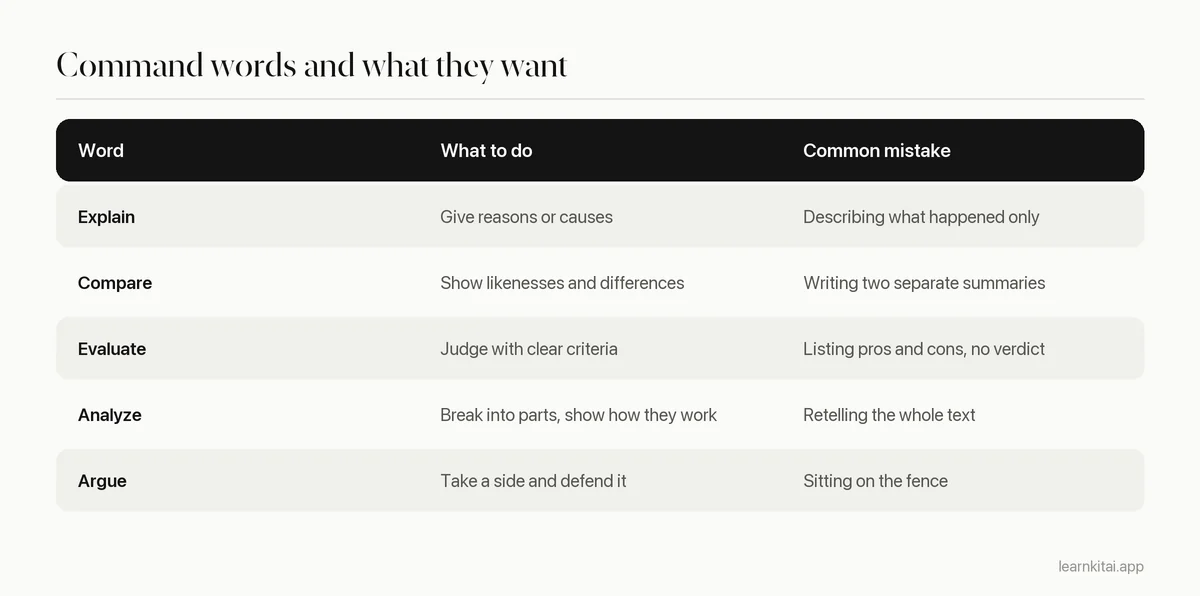
Command words tell you what kind of thinking the marker wants. Explain asks for reasons, compare asks for similarities and differences, evaluate asks for a judgment with criteria, and analyze asks you to break something into parts and show how they work.
Many students lose marks not for wrong facts but for answering a different question. The UNC Writing Center groups these words into three kinds: words that ask you to show information, words that ask you to show relationships, and words that ask you to interpret and defend a view. Underline the command word before you plan anything.
How should you manage time in an essay exam?
Split time by points, not by how much you know. Spend roughly the first quarter of each answer's time planning: thesis, main points and evidence. Write the rest in short paragraphs, and leave a few minutes to check.
The UNC guide suggests spending up to about a quarter of your time on planning for longer answers. That can feel like a lot when everyone around you is writing, but a planned answer is shorter, clearer and easier to mark. If a question is worth 40 percent of the exam, it gets about 40 percent of the time. When time runs short on the last question, switch to a clear outline in bullet points. Markers can often give partial credit for a well-structured plan.
A worked example
Prompt: Evaluate the claim that economic factors were the main cause of the French Revolution. You have 45 minutes. Here is how a prepared student spends the first ten.
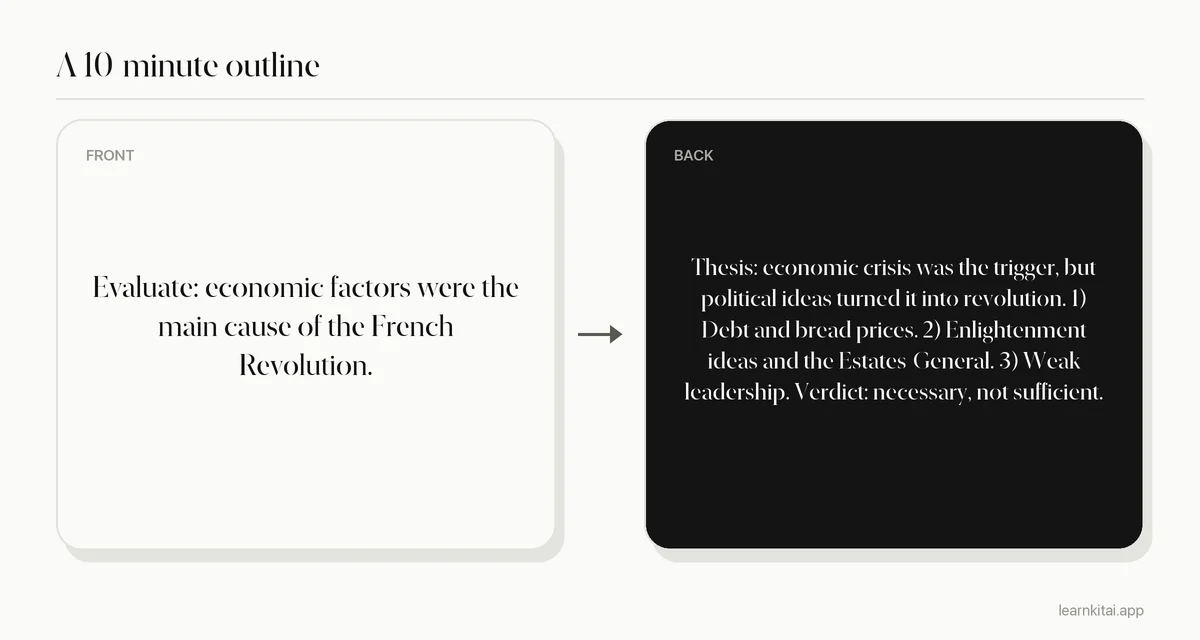
Notice that the thesis answers the command word directly with a judgment. Each point maps to a paragraph and comes straight from the evidence bank built during revision. The student is not inventing an argument in the exam. They are arranging one they rehearsed.
How do you write a strong thesis under time pressure?
Answer the prompt in one sentence that takes a position and hints at your reasons. A useful pattern is: claim, because reason one and reason two, although a limit. Rehearse this pattern during revision so it comes automatically.
A thesis is not a restatement of the question. Economic factors were important is too safe to argue with, so it gives your essay nowhere to go. Economic crisis triggered the revolution, but political ideas shaped what it became gives you a claim, a structure and a limit in one line. The marker immediately knows what your paragraphs will prove.
Practice by taking each predicted prompt and writing three possible theses in five minutes: one that agrees, one that disagrees and one that qualifies. Pick the one your evidence supports best. On exam day, you will often find that one of these rehearsed positions fits the real question with only small changes, which saves precious minutes at the start.
Common essay exam mistakes
- Writing everything you know. Relevance beats volume. Each paragraph should support the thesis.
- No thesis. A clear position in the first two sentences tells the marker where you are going.
- Vague evidence. Some evidence shows little. Name the case, date, figure or quotation.
- Ignoring the command word. A beautiful explanation earns little if the prompt asked you to evaluate.
- Spending too long on the first question. Stick to your time budget, then come back if time allows.
If your essay exam allows notes, combine this approach with our open book exam guide. For literature courses in particular, see how to study literature, and for the wider plan across all your exams, start with our finals guide.
Frequently asked questions
Should I memorize full essays before an exam?
Usually not. Memorized essays rarely fit the exact prompt. Memorize a thesis per theme, the main points and specific evidence, then practice adapting them to different wordings.
How long should an essay exam answer be?
It depends on time and points. A clear introduction with a thesis, two to four focused body paragraphs and a short conclusion is a strong structure for most 30 to 60 minute answers.
What if I do not know the answer to an essay question?
Pick the closest theme you prepared and write what you know that is genuinely relevant. Use the question's key terms, state a cautious thesis and support it with whatever evidence you can.
Is it okay to write in bullet points if I run out of time?
Yes, for the final part of an answer. A structured outline of your remaining points can earn partial credit and is far better than leaving the space blank.
Sources
- Essay Exams, The Writing Center, University of North Carolina at Chapel Hill (Groups essay key terms into information, relation and interpretation words; suggests up to about a quarter of time on planning longer answers.)
- Test-Enhanced Learning: Taking Memory Tests Improves Long-Term Retention, Psychological Science (Roediger and Karpicke, 2006) (61 percent versus 40 percent recall after one week for repeated testing versus repeated study.)
Keep reading
How to Study for Finals: A 3-Week Plan That Holds Up
Finals reward the student who starts with a plan, not the one who studies longest. Here is a three-week system for triage, testing and sleep.
Open Book Exam Prep: Why the Book Will Not Save You
Open book sounds easy until the clock runs out while you hunt for a page. Prepare as if the book were closed, then build a system to find things fast.
Predict Exam Questions Like the Person Who Writes Them
Your instructor leaves clues everywhere: objectives, repeated examples, old papers. Learn to read them, write the likely questions and answer them first.
Open Ended Questions: Study by Explaining, Not Spotting
Questions with no options to pick from force you to build the answer yourself. Here are 12 question stems, a marking method and a weekly routine.
Study Literature by Asking Better Questions of the Text
Literature exams reward arguments backed by evidence, not plot summaries. Here is how to read, collect quotes and practice for that.
Your AP Exam Study Plan: 12 Weeks to May 2027
AP exams run from May 3 to May 14, 2027. A 12-week plan built on unit weightings and released free-response questions beats a frantic April.