Study Habits That Stick: Why Streaks Beat Willpower
Strong study habits come from repetition in a stable context, not willpower. Tie a short session to a daily cue, plan it as an if-then rule, set a minimum so small you can always do it, and track a streak. Expect about two months to feel automatic, and do not panic over one missed day.
Most students do not lack motivation. They lack a system that works on the days motivation is gone. Good study habits are that system: a session that starts almost on its own, at the same time and place, because you have done it so many times that skipping feels strange.
This guide covers how habits actually form, why streaks help, and how to design a streak that bends instead of breaks. You will finish with a template you can fill in tonight.
How long does it take to build study habits?
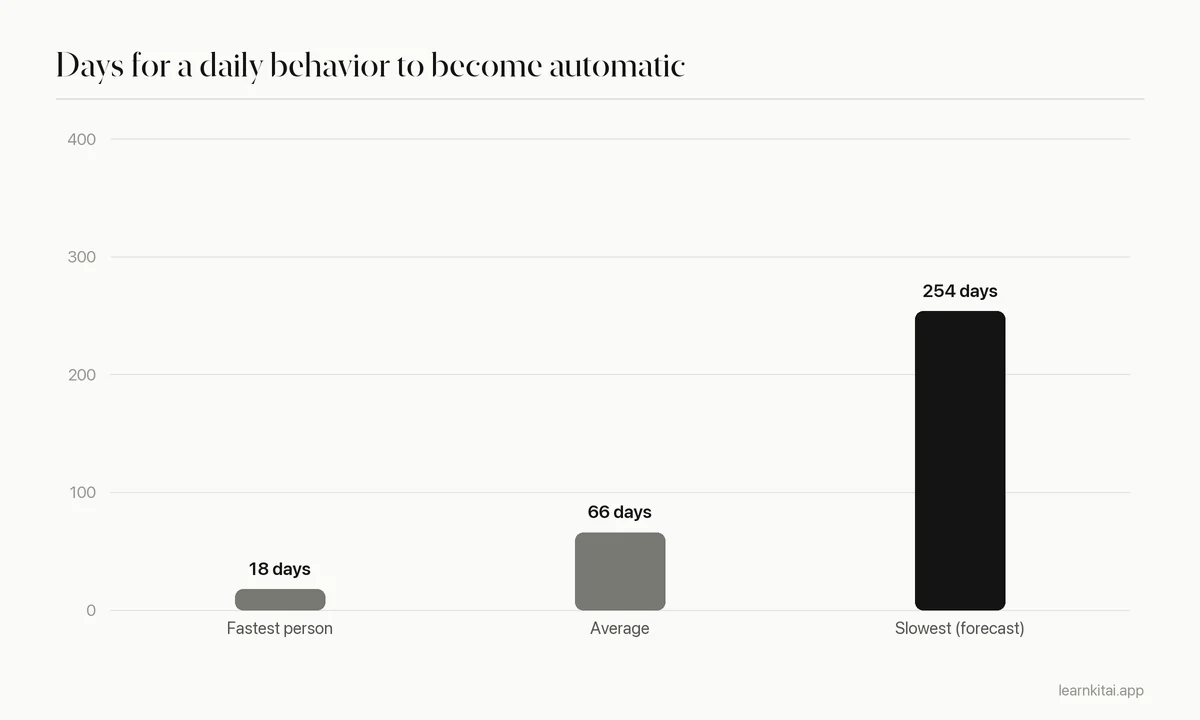
Longer than 21 days. In a well-known UCL study, people took 66 days on average for a daily behavior to feel automatic, with a range from 18 to 254 days. Plan for about two months of steady practice, with harder habits taking longer.
The 21-day figure is a myth. When researchers at University College London tracked 96 volunteers who repeated a new daily behavior in the same context, the average time to reach peak automaticity was 66 days. One person got there in 18 days. Another was forecast to need 254.
Two lessons follow. First, if your routine still feels like effort after three weeks, nothing is wrong. Second, a study habit is a bigger change than drinking a glass of water after breakfast, so give it time and make the daily version small.
Does missing one day break a habit?
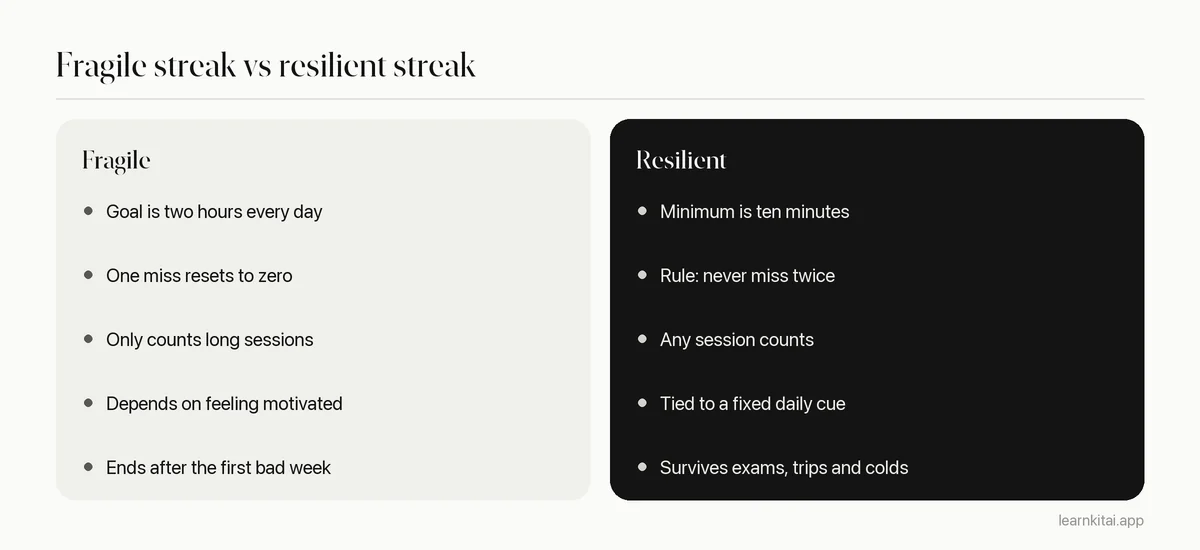
No. In the same study, missing a single chance to do the behavior did not materially change how the habit formed. What hurt was missing again and again. That is why the best streak rule is never miss twice, not never miss.
The BPS Research Digest summary of the study puts it plainly: one missed day had little effect, but many missed repeats, even spread out, lowered how automatic the habit became. Perfection is not required. Consistency is.
This is the problem with all-or-nothing streak counters. When a perfect 40-day run breaks, many people feel the streak is gone and stop entirely. The fix is to count streaks in a way that forgives single misses.
How do you build a study routine that sticks?
Anchor the session to something you already do daily, write it as an if-then plan, keep the minimum tiny, use the same place, and record each day. Context and repetition do the work, so make both as stable as you can.
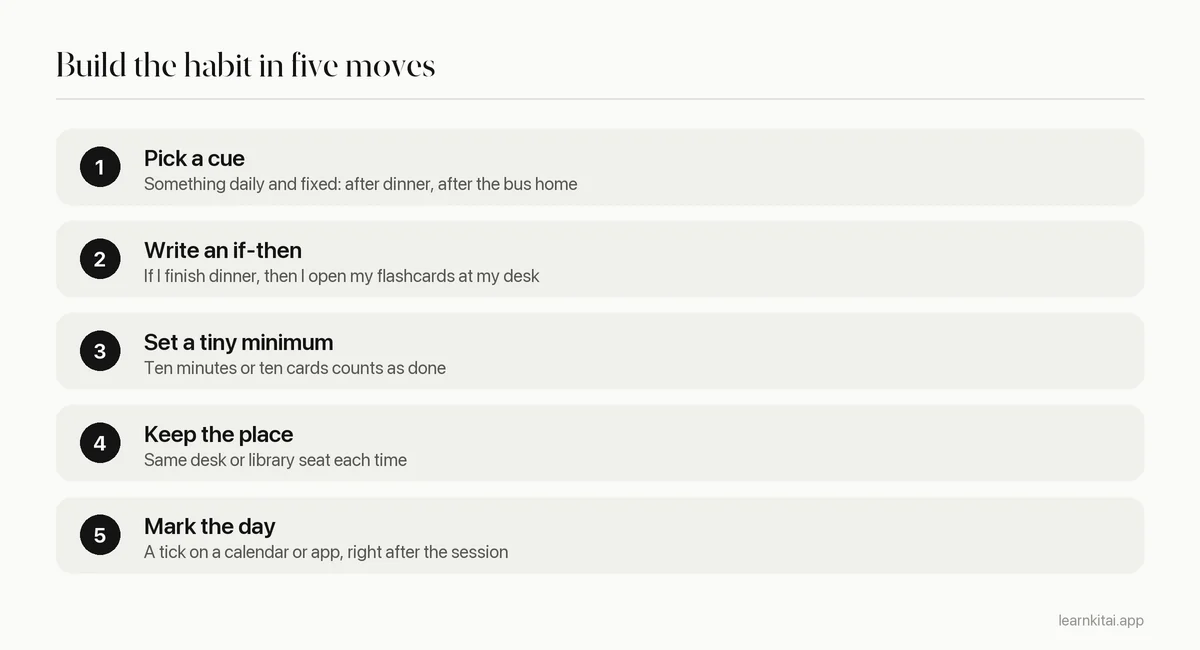
The if-then step has strong evidence behind it. Psychologists call it an implementation intention: a plan that names when, where and how you will act. A 2021 meta-analysis in Frontiers in Psychology cites an earlier review that found these plans had a medium to large effect on reaching goals (d = 0.65). The plan works because the cue triggers the action, so you do not have to decide each day.
The tiny minimum is what keeps the streak alive. On a good day, ten minutes turns into an hour. On a bad day, ten minutes is still a rep. Either way, the cue and the action stay linked.
If-then plans you can copy
- If I sit down on the bus home, then I review 15 flashcards.
- If I finish dinner, then I do one 25-minute block at my desk before any screens.
- If it is Sunday at 4 p.m., then I plan the week's study sessions.
- If I feel the urge to check my phone during a block, then I write the urge on my parking lot note and keep going.
- If I miss a day, then the next day I do the minimum before anything else.
What should a daily study session include?
Something active. A short daily session should mostly be retrieval: flashcards, a few practice questions, or writing down what you remember from class. Passive rereading feels productive but builds little. Active minutes compound into real progress.
A habit is only as useful as what you repeat. Ten minutes of rereading every day builds the habit but not much knowledge. Ten minutes of recall builds both. Daily flashcards also fit spaced repetition perfectly, because a little review every day spreads practice out. If you are not sure how much to do, see how many flashcards per day is realistic.
A first-month plan for new study habits
Here is a simple way to roll out a new routine without overloading yourself. The idea is to lock in the cue first and only then add volume. Each phase lasts about a week, but move on only when the current step feels easy.
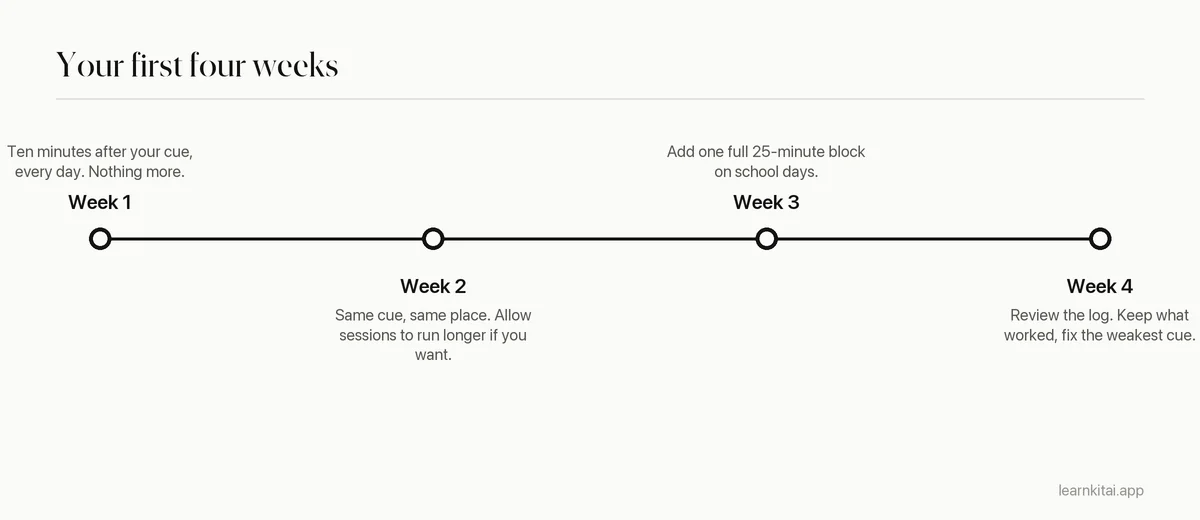
Notice what is missing: big goals. In the first month you are training the trigger, not the volume. Students who try to change everything at once, new wake time, new subjects, two-hour sessions, usually end up with no routine at all by week three. Students who protect a small daily slot often find that it quietly grows, because starting is the hardest part and the habit takes care of it.
At the end of the month, look at your log. Which days did you skip, and what happened right before? A pattern, like every Thursday after practice, points to a cue that needs a backup plan.
Mistakes that kill study streaks
- Starting too big. A two-hour daily target fails the first busy day. Start small and let sessions grow on their own.
- Floating sessions. Studying whenever you find time means you will rarely find it. Tie the session to a cue.
- Changing places every day. A stable context speeds up habit formation.
- Tracking hours instead of days. Early on, showing up matters more than duration.
- Quitting after a miss. One miss is noise. Two in a row is the signal to restart with the minimum.
Study habits are built in boring, repeated moments. Pick a cue, make the minimum small, forgive one miss, and keep going for two months. For the session itself, the Pomodoro technique gives structure, and our guide to stop procrastinating helps on the days you cannot start.
Frequently asked questions
Is it better to study every day or a few long days a week?
For most students, short daily sessions beat a few long ones. Daily practice builds the habit faster and spreads review over time, which helps memory. Longer weekend blocks can be added for projects.
Do habit tracking apps actually help?
They help if they make the habit visible and are quick to use. The tracking itself is not magic. Marking a calendar right after your session works just as well for many people.
What if my schedule changes every day?
Anchor to an event rather than a clock time, such as after your last class or after dinner. Events still happen on irregular days, so the cue still fires.
Should I reward myself for keeping a streak?
Small, immediate rewards can help early on, like a short walk or a favorite drink after the session. Over time, the habit should run on the cue alone, so do not make rewards so big that you depend on them.
Sources
- Busting the 21 days habit formation myth, UCL Research Department of Behavioural Science and Health (Average 66 days to automaticity; range 18 to 254 days)
- How are habits formed: Modelling habit formation in the real world, European Journal of Social Psychology (96 volunteers over 84 days; missing one opportunity did not materially affect habit formation)
- How to form a habit, BPS Research Digest (Single missed days had little effect; repeated misses lowered automaticity)
- A Meta-Analysis of the Effects of Mental Contrasting With Implementation Intentions on Goal Attainment, Frontiers in Psychology (Cites Gollwitzer and Sheeran (2006): implementation intentions effect d = 0.65)
Keep reading

Pomodoro Technique for Studying: 25 Minutes, Done Right
A kitchen timer, 25 minutes and a short break. Here is how to use the Pomodoro technique for real study tasks, what the research says and how to adapt it.
Stop Procrastinating on Studying: Fix the Feeling First
Procrastination is less about laziness and more about avoiding a bad feeling. Here is how to find your reason for delaying and start studying in minutes.
How to Focus When Your Mind Keeps Leaving the Room
Focus is not a trait you have or lack. It is the skill of noticing drift and coming back, and you can train it.

Spaced Repetition: Why Forgetting Is Part of the Plan
Reviewing right before you forget builds memories that last. Learn how long the gaps should be, with a ready schedule for exams one week to one semester away.
How Many Hours to Study? Start With This Simple Formula
The two-hours-per-credit rule is a good starting point, but how you use the hours matters more than the total. Here is how to set a number that fits you.