Cramming: What Actually Works the Night Before an Exam
If you must cram, triage first: list the topics most likely to score and skip the rest. Spend the evening testing yourself with past questions and flashcards, not rereading. Stop by about 11 pm, write a one-page sheet to glance at in the morning, and sleep at least seven hours so you can recall what you studied.
Every study guide says the same thing about cramming: do not do it. That advice is right, and also useless at 7 pm the night before a test you are not ready for. You cannot go back and space your study over three weeks. What you can do is spend the next few hours in the way that gives you the most marks tomorrow, and avoid the moves that make things worse.
This guide is for that evening. It explains why last-minute studying is weak, what still works, and a simple hour-by-hour plan.
Does cramming actually work?
For tomorrow, partly. For next month, barely. Massed study can get you through a test the next day, but you forget it fast, and spaced study beats it for most learners. Cramming is damage control, not a strategy.
In a flashcard study by Nate Kornell, spaced study beat massed study for 90 percent of participants, and spacing also beat cramming on the last day before the test. The catch is that massing feels effective. In the same research, 72 percent of learners believed massing had worked better after their first session. That feeling of fluency is what makes cramming so tempting.
So be clear about the goal tonight. You are not trying to learn the course. You are trying to make a limited set of high-value facts and methods available for one morning. If the course has a cumulative final later, you will need to relearn this material properly. Our guide on why you forget after exams explains why.
What should you study the night before an exam?
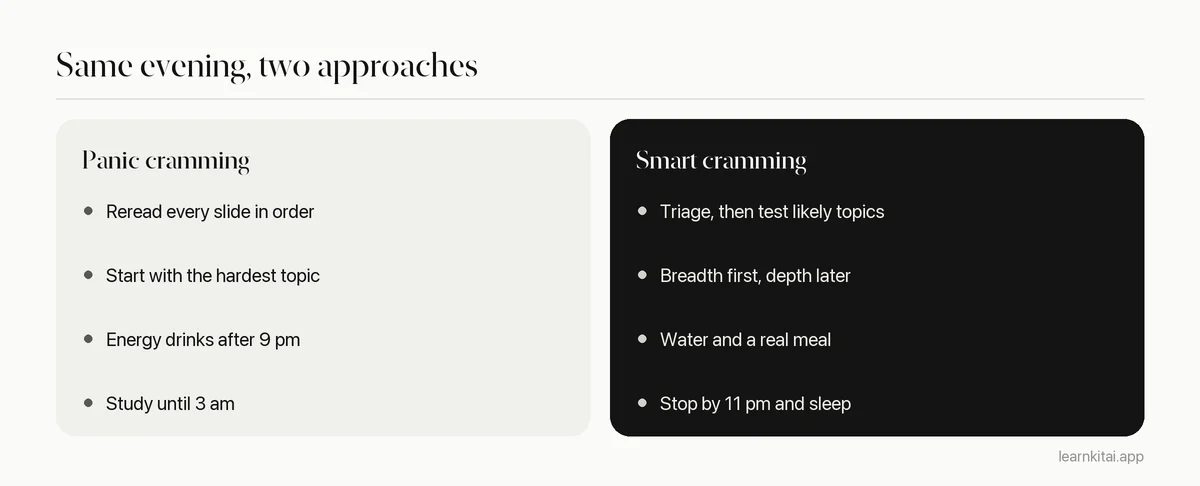
Study what is most likely to appear and what you can still fix. Use past papers, the review sheet or the topics your teacher stressed. Skip anything you cannot understand in 20 minutes. Points come from breadth on likely topics, not depth on a hard one.
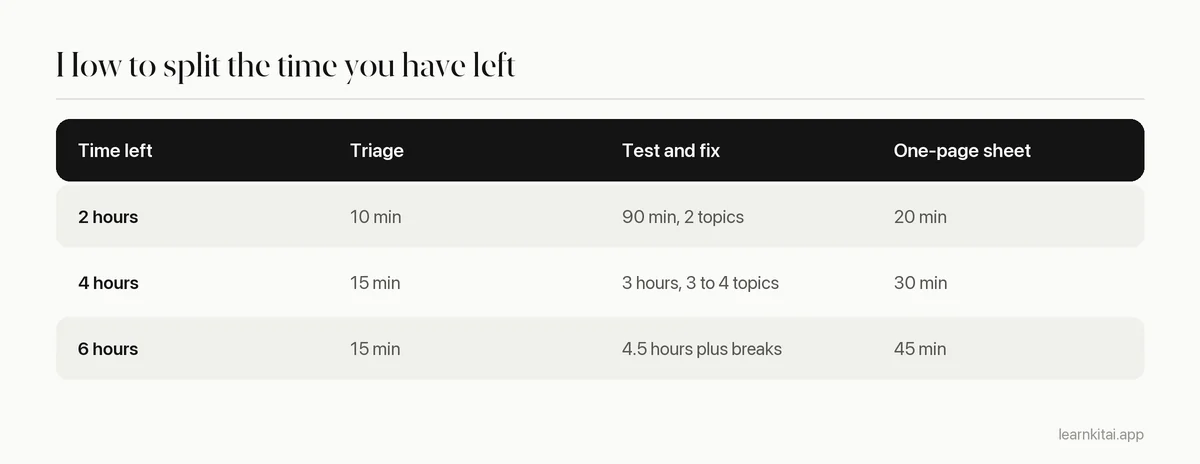
Spend the first 15 minutes on triage, not study. Open the syllabus or review sheet and list every topic. Mark each one with one of three labels.
- Bank: you know it fairly well. One quick test to confirm, then move on.
- Build: you half know it and it will probably appear. This is where your evening goes.
- Bin: you are lost on it, or it is unlikely to appear. Leave it. Accepting a few lost points is part of the plan.
Most students do the reverse. They start with the hardest topic, spend two hours stuck on it, and reach midnight having skipped the material they could have locked in. Breadth wins on a short timeline. If you want help guessing what will appear, see how to predict exam questions.
How do you cram effectively in one evening?
Test yourself instead of rereading. For each Build topic, try a few questions from memory, check, fix what you missed, and test again. Work in 40 to 50 minute blocks with short breaks, and end with a one-page sheet.
Retrieval practice is the strongest tool you have, and it works on short timelines too. In a classic study, students who read a passage once and then took three recall tests remembered 61 percent a week later, while students who reread it four times remembered 40 percent (Roediger and Karpicke, 2006). Rereading feels safe at night because it is easy. Testing is harder, and that is why it sticks.
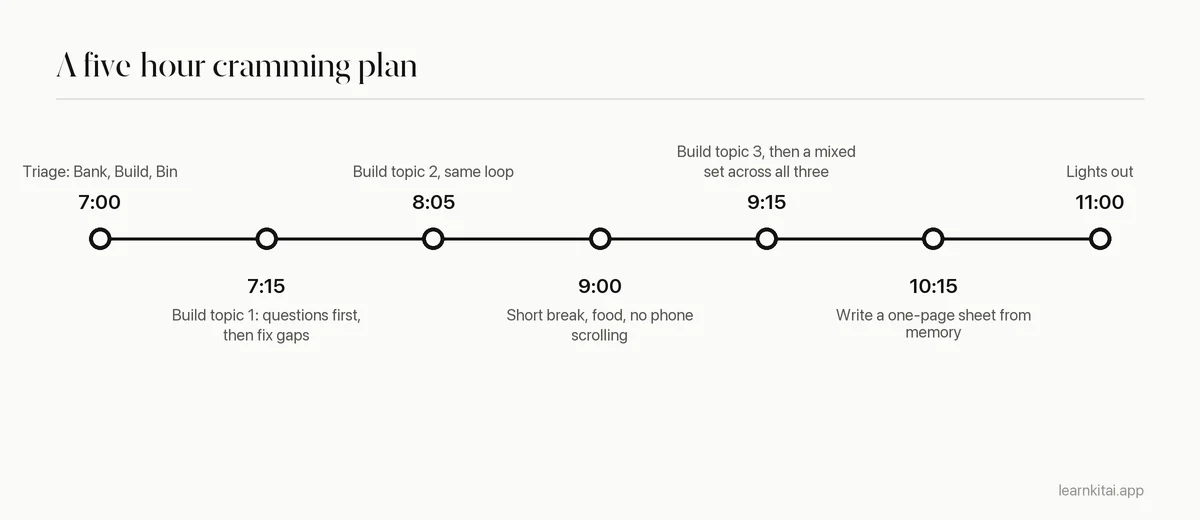
The one-page sheet at the end does two jobs. Writing it from memory is one more round of retrieval. And in the morning it becomes a five-minute warm-up instead of a frantic flip through 60 slides. Our guide to a one page study guide shows a layout that works.
If your notes are scattered across slides, PDFs and a recorded lecture, a summarizer can save you the first half hour. LearnKit can condense a lecture PDF into a short summary with key terms, which you can then turn into a handful of flashcards for the Build topics.
Is it better to pull an all-nighter or sleep?
Sleep. A tired brain struggles to retrieve information, and students who pull all-nighters tend to earn lower grades. Even five or six hours of sleep beats none. Set a hard stop time and keep it.
The CDC recommends seven or more hours of sleep for adults and eight to ten for teens. A survey at St. Lawrence University found that about two-thirds of students had pulled at least one all-nighter, and those who did tended to have lower GPAs. That link does not prove the all-nighter caused the lower grade, but nothing in memory research suggests skipping sleep helps you recall.
Think of it this way: the hours between 1 am and 6 am are the least productive study time you will ever have, and they come at the cost of the morning, when you need to be sharp. More on this in our guide to sleep and memory.
What should you do the morning of the exam?
Keep the morning calm and light. Eat a proper breakfast, read your one-page summary once, and answer a few easy warm-up questions so your memory is already retrieving before the paper begins. Avoid opening anything you have not studied.
- Eat something with protein, even if you are nervous.
- Read your one-page sheet once, slowly.
- Do three or four easy warm-up questions to get your brain retrieving.
- Do not open new material. It crowds out what you know and raises anxiety.
- Arrive early, and when the paper starts, write down any formula you are scared of forgetting.
How do you avoid cramming next time?
Schedule the next exam the day you get the syllabus. Count back about three weeks, plan three short practice sessions for each topic on separate days, and protect those sessions in your calendar as you would any other appointment.
Once the test is over, spend ten minutes on a simple plan for the next one. Put the exam date in your calendar, count back three weeks, and schedule three short sessions per topic. Our guide to building a study schedule walks through it, and the finals guide covers handling several exams at once.
Frequently asked questions
How many hours of cramming is too much?
Past about four or five focused hours in one evening, returns drop sharply and you start cutting into sleep. It is better to cover fewer topics well and sleep than to cover everything badly at 3 am.
Can I cram for a cumulative final?
Only partly. A cumulative final covers too much to learn in one night, so triage is even more important. Focus on the topics that appeared most on earlier tests and the review sheet, and accept that some will be skipped.
Should I study in the morning before the exam?
Only a short warm-up. Read your one-page sheet and do a few easy questions. Learning new material in the morning tends to confuse what you already know and raise anxiety.
Is it bad to cram for every test?
Yes, as a habit. Cramming can get you through a single test, but the material fades quickly, which hurts later courses and cumulative exams. Use it as an emergency plan, not a routine.
Sources
- Optimising learning using flashcards: Spacing is more effective than cramming, Applied Cognitive Psychology (Kornell, 2009) (Spacing beat massing for 90 percent of participants and also beat cramming; 72 percent believed massing worked better.)
- Test-Enhanced Learning: Taking Memory Tests Improves Long-Term Retention, Psychological Science (Roediger and Karpicke, 2006) (61 percent one-week recall after repeated testing versus 40 percent after repeated study.)
- About Sleep, Centers for Disease Control and Prevention (Sleep recommendations: 7 or more hours for adults, 8 to 10 for teens.)
- All-Nighters Equal Lower Grades, ScienceDaily / St. Lawrence University (About two-thirds of surveyed students reported an all-nighter; associated with lower GPA.)
Keep reading
How to Study for Finals: A 3-Week Plan That Holds Up
Finals reward the student who starts with a plan, not the one who studies longest. Here is a three-week system for triage, testing and sleep.
How to Study for an Exam in a Week, Day by Day
Seven days is enough to do well if you start with a diagnosis, revisit every topic every two or three days, and save the last day for rest.
Exam Day Tips: A Checklist From Wake-Up to Last Answer
The night before, the morning of, the first five minutes and the last ten. A calm, research-backed checklist for the day all your studying pays off.
Sleep and Memory: Why the All-Nighter Backfires
Sleep is when your brain files what you studied, and it gets you ready to learn the next day. What the research shows and how to plan study around it.
The Study Schedule That Works Backward From Exam Day
Most study plans fail because they start from today. Start from the exam date instead, count your real hours, and space every topic at least three times.