Study Group Activities That Beat Chatting Over Notes
The best study group activities make every member recall answers and explain them, not read notes together. Good options are vote then discuss rounds, swapping quizzes, blank page relays and teach-back turns. Keep each activity short, rotate who asks the questions, and finish by listing what the group still gets wrong.
A study group can be the most useful hour of your week or a pleasant chat with highlighters. The difference is structure. The study group activities below all share one rule: someone asks, everyone else answers from memory, and then you argue about the answer. That combination of recall and discussion is what makes groups worth the trip to the library.
Each activity takes 10 to 20 minutes, needs no special materials, and works for three to six people. At the end you will find a one hour plan. For the science behind quizzing, see our practice testing guide.
Do study groups actually help you learn?
They help when the group discusses questions everyone has first tried to answer alone. In a genetics course study, discussion raised correct answers and improved performance on a new question on the same concept, even in groups where nobody knew the answer at first.
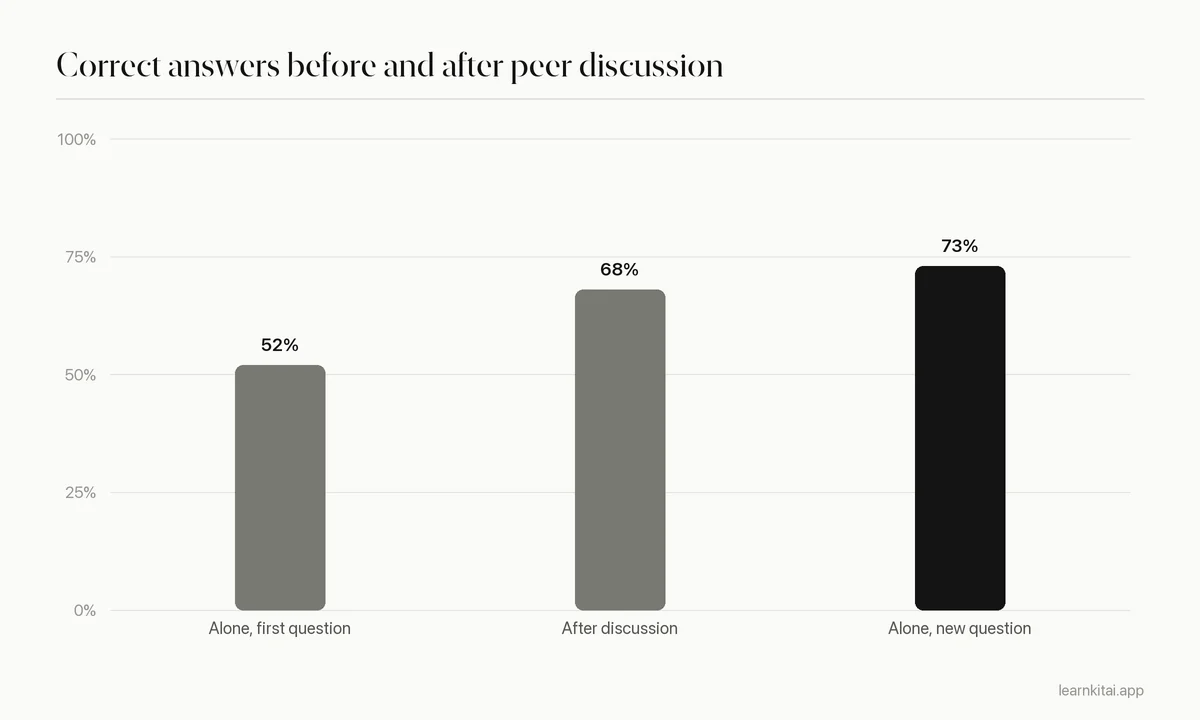
Michelle Smith and colleagues tested this in a large undergraduate genetics class, reported in Science in 2009. Students answered a concept question alone, discussed it with neighbors, and voted again. Then they answered a second, similar question alone. As summarized by educator Derek Bruff, an average of 52% got the first question right alone, 68% after discussion, and 73% on the new question answered alone. The authors concluded that peer discussion enhances understanding, even when none of the students in a group originally knows the correct answer.
What are the best study group activities?
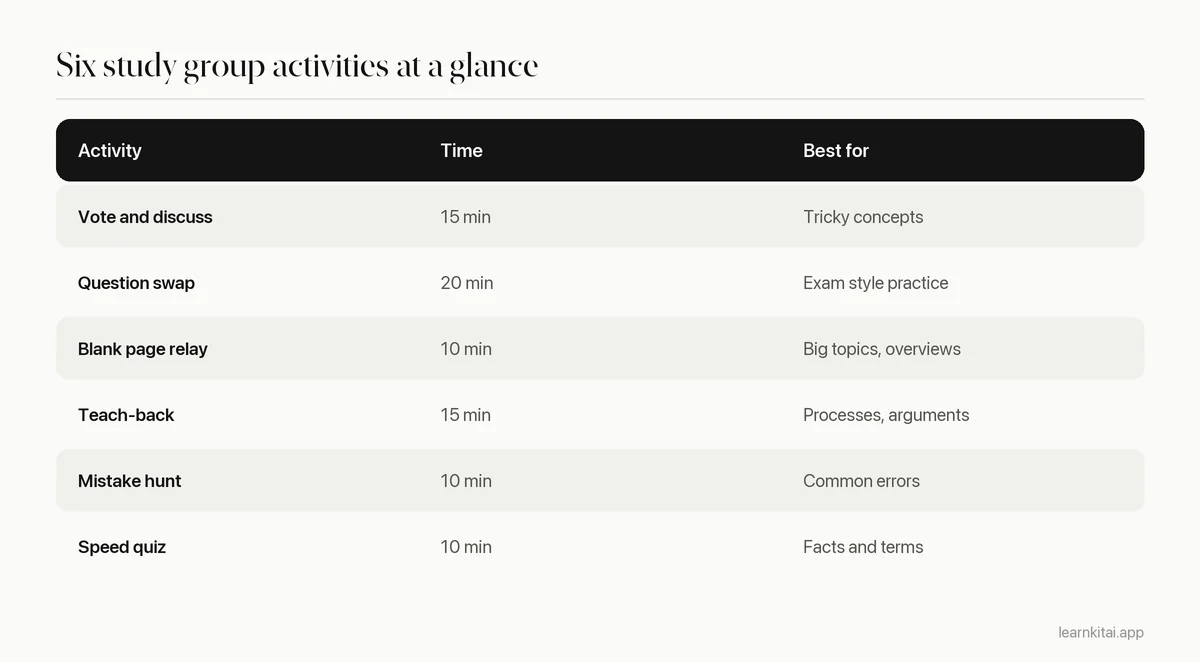
Activities where everyone commits to an answer before talking. Vote and discuss, question swaps, blank page relays, teach-back rounds, mistake hunts and a quick scored quiz all do this. Pick two or three per session.
1. Vote and discuss
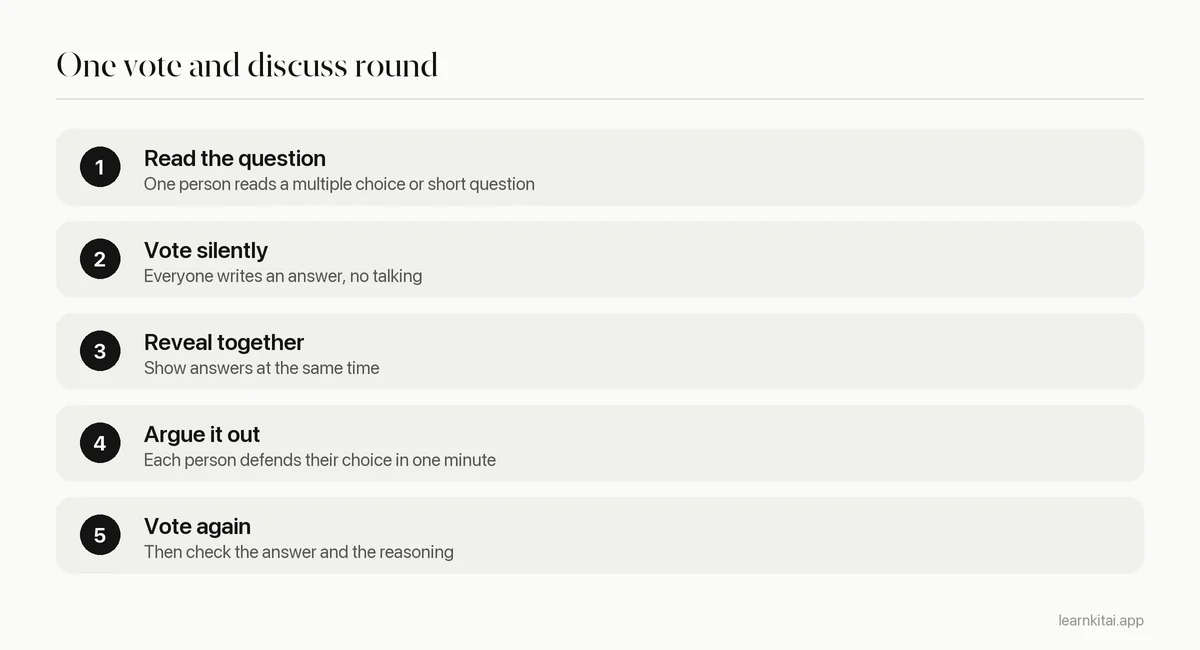
This is the format from the genetics study, adapted for a table, and it is the strongest of these study group activities for hard concepts. The silent vote is the key. It stops the most confident person from answering for everyone, and it gives each member a stake in the discussion.
2. Question swap
Before the session, each person writes five exam style questions with an answer key on a topic assigned to them. At the table, swap papers, answer for ten minutes, then the writer marks them. Writing questions for others is excellent practice in its own right. It is the same thinking as when you predict exam questions.
3. Blank page relay
Put one topic at the top of a big sheet. Each person has one minute to add something from memory, then passes it on. Keep going until the page stops growing, then open the notes and mark what is missing in a different color. It is the group version of the blurting method.
4. Teach-back
Assign each person a subtopic. They get three minutes to explain it without notes, and the group then asks two questions each. Explaining out loud reveals gaps fast, which is the idea behind the Feynman technique.
5. Mistake hunt
One person writes an answer or a worked solution with two deliberate mistakes. The others race to find and fix them. This trains the careful reading that catches errors on exams, and it is a fun way to review common traps.
6. Speed quiz
End with five minutes of rapid questions on terms and facts, one point per correct answer. Keep score on a sheet. A little competition keeps the energy up at the end of a long session, and the questions everyone misses go straight onto the group's to do list.
How should a one hour study group be structured?
Open with a short silent quiz, spend the middle on one or two discussion activities, and close with a speed quiz and a list of open questions. Assign topics and question writing before the session so no one arrives empty handed.
- 0 to 10 min: Silent five question quiz on last week's topic. Mark it together.
- 10 to 30 min: Vote and discuss on the three hardest concepts of the week.
- 30 to 45 min: Question swap or teach-back on this week's material.
- 45 to 55 min: Speed quiz on terms and facts.
- 55 to 60 min: Write down what is still unclear and who will look it up.
Writing question sets for every session is the part groups usually skip. You can share one source, such as the week's slides or a reading, and let LearnKit draft a quiz or flashcard deck from it, then have the group improve the weak questions together.
What makes study groups fail?
No plan, no recall and one dominant voice. Groups that reread notes together, let one person explain everything, or drift into off-topic chat lose most of the benefit.
- Rereading as a group. It feels social and productive but adds little. Every activity should start with someone answering from memory.
- The tutor trap. If one strong student explains everything, the others nod along. Rotate who asks and who answers.
- Too big. Beyond five or six people, most members wait more than they recall. Split into two tables.
- No follow-up. End each session with a written list of open questions, and start the next one by answering them.
Frequently asked questions
How many people should be in a study group?
Three to five is a good range. It is small enough that everyone answers often and large enough to bring different mistakes and ideas to the table.
Can study groups work online?
Yes. Use a shared document for the blank page relay, polls or chat for silent votes, and cameras on for teach-back. Keep sessions a little shorter, since attention fades faster on video calls.
What if everyone in the group gets an answer wrong?
That is useful information. Note the question, look up the answer together, and make sure each person can explain it before moving on. Then put it first on the next session's quiz.
Sources
- Why Peer Discussion Improves Student Performance on In-Class Concept Questions, Science (Smith, Wood, Adams, Wieman, Knight, Guild and Su, 2009) (Peer discussion improved understanding even when no one in a group initially knew the answer)
- Article: Smith et al. (2009), Derek Bruff, Agile Learning blog (Summary of the study's figures: 52% correct alone, 68% after discussion, 73% on the isomorphic question)
- The Critical Importance of Retrieval for Learning, Science (Karpicke and Roediger, 2008) (Repeated retrieval, not repeated studying, drove long term recall)
Keep reading

Practice Testing: The Study Habit That Beats Rereading
Testing yourself is not just a way to check what you know. It is one of the best-supported ways to learn. Here is how to do it well, week by week.
Quiz Yourself From Your Notes in 15 Minutes a Day
Your notes already contain the questions. Here is how to pull them out, five ways to test yourself, and a short daily routine that keeps old topics alive.
Predict Exam Questions Like the Person Who Writes Them
Your instructor leaves clues everywhere: objectives, repeated examples, old papers. Learn to read them, write the likely questions and answer them first.

The Blurting Method: Empty Your Head to Fill It
Write down everything you remember, then check what is missing. A simple revision method with a step-by-step routine, a worked example and four variations.

The Feynman Technique: Find Your Gaps by Teaching
If you cannot explain it simply, you have found what to study next. The four steps of the Feynman technique, a worked example and the traps that make it fail.