Study in a Second Language Without Translating Everything
When you study in a second language, use your first language to understand hard ideas and the course language to practice and remember them. Build a glossary of key terms before each lecture, ask AI to explain confusing parts in your first language, then quiz yourself in the language your exam uses.
You understood the lecture. Mostly. Then the professor said "the reaction is reversible under these conditions," and while you were working out "reversible," two more slides went by. When you study in a second language, you are doing two jobs at once: learning the subject and decoding the words. The trick is not to work harder at both. It is to split them apart, and AI is very good at helping with that split.
You have plenty of company. The Open Doors 2024 report counted 1,126,690 international students at US colleges in 2023/24, an all-time high and up 7% on the year before. Millions more study in English, French or German at home. This guide gives you one simple rule and a routine you can use every week.
Is it harder to study in a second language?
Usually, yes, at least at first. Students often say the main problems are unfamiliar words, telling similar words apart, and taking notes while listening. The good news: much of that load is vocabulary, and vocabulary can be learned ahead of time.
A study of 411 university students in Norway and Germany compared how well they understood lectures in English and in their first language. The gap in self-rated understanding was smaller than you might expect, but a considerable number of students still had difficulties with English-medium lectures. The problems they named most were unfamiliar vocabulary, distinguishing the meaning of words, and taking notes while listening.
Notice what is not on that list: being unable to understand the ideas. The bottleneck is usually words and speed, not intelligence or subject skill. That is good news, because words are something you can prepare before you walk into the room.
Should you translate everything into your first language?
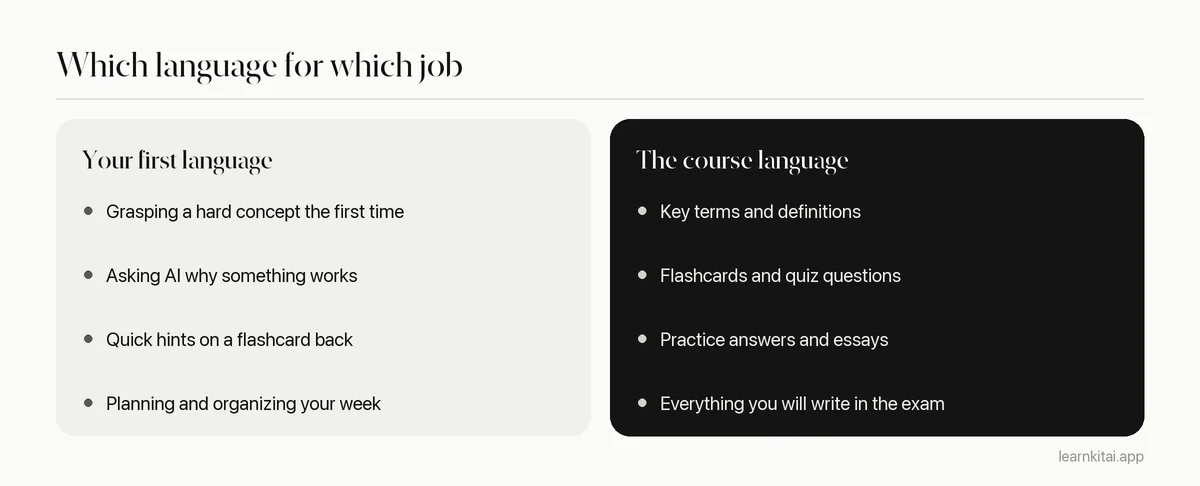
No. Translate to understand, not to memorize. If your exam is in the course language, the terms and phrasing you need are in that language. Use your first language as a bridge when stuck, then return to the course language to practice.
Full translation feels safe, but it creates a second set of notes in a language your exam will not use. On test day you then have to translate back, under time pressure, and technical terms often do not map one-to-one. The better rule is simple: understand in either language, practice in the exam language.
How can AI help you understand lectures in another language?
Use AI before the lecture to build a glossary of likely terms, during review to simplify dense passages, and after to quiz you. Preparing the words in advance frees your attention for the ideas while the lecture is happening.
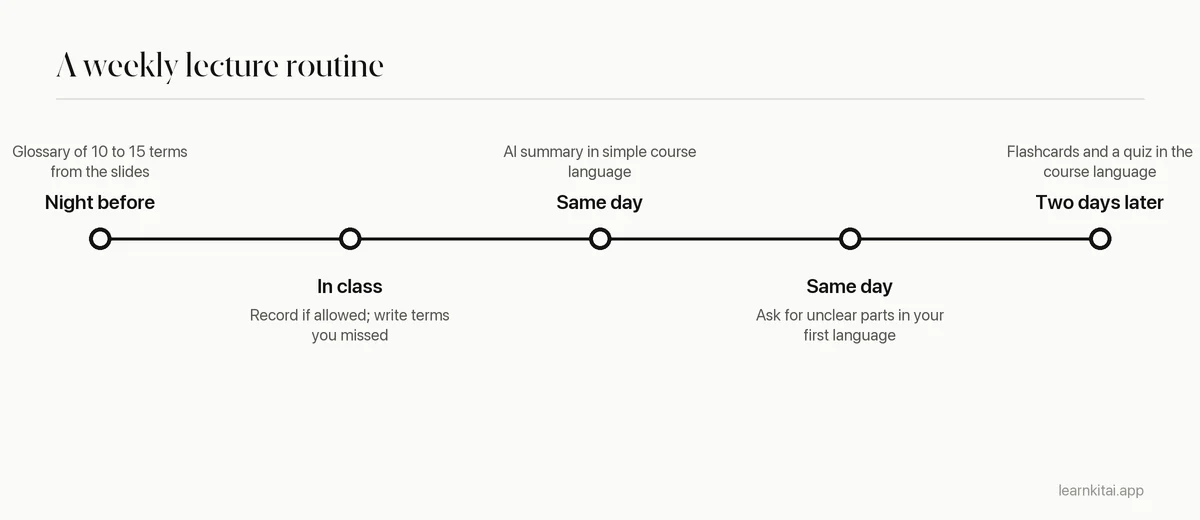
The glossary step does the most for the least effort. If you have seen "reversible," "equilibrium" and "catalyst" the night before, you hear them as familiar words instead of puzzles. If your instructor posts slides early, paste them into an AI tool and ask for the key terms. For a way to capture the lecture itself, see notes from a lecture recording.
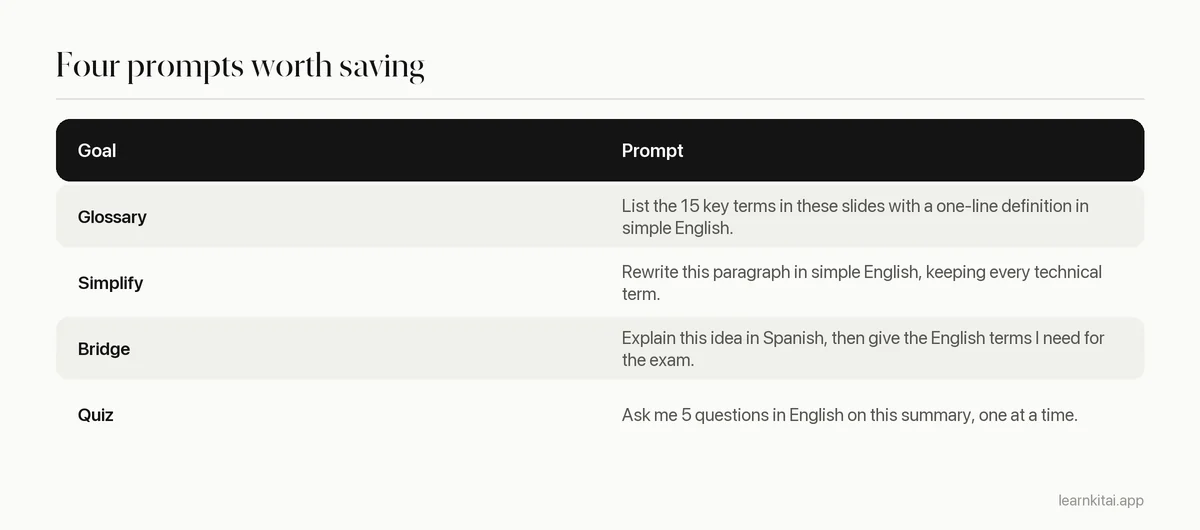
Look at the "Simplify" prompt closely. It asks for simpler sentences but keeps the technical terms. That way you learn the real vocabulary of the subject in a gentler setting, rather than a dumbed-down version you cannot use on the exam. Swap Spanish for your own language in the "Bridge" prompt.
A worked example
Mina is from Seoul and takes Introductory Economics in English. On Sunday night she pastes Monday's slides into an AI tool and gets 14 terms, including "elasticity," "marginal cost" and "deadweight loss." She reads them twice and says each one out loud. In the lecture, she recognizes all but two. That evening she asks for a simple English summary, then asks for "deadweight loss" to be explained in Korean with a small example. On Wednesday she quizzes herself in English. Her total extra time is about 40 minutes a week, and the lecture stops feeling like a race. That is what it looks like to study in a second language with a plan instead of a dictionary open in every tab.
How do you remember subject terms in another language?
Make flashcards with the term in the course language on the front and a plain definition in that same language on the back, plus an optional short hint in your first language. Review them on a spaced schedule.
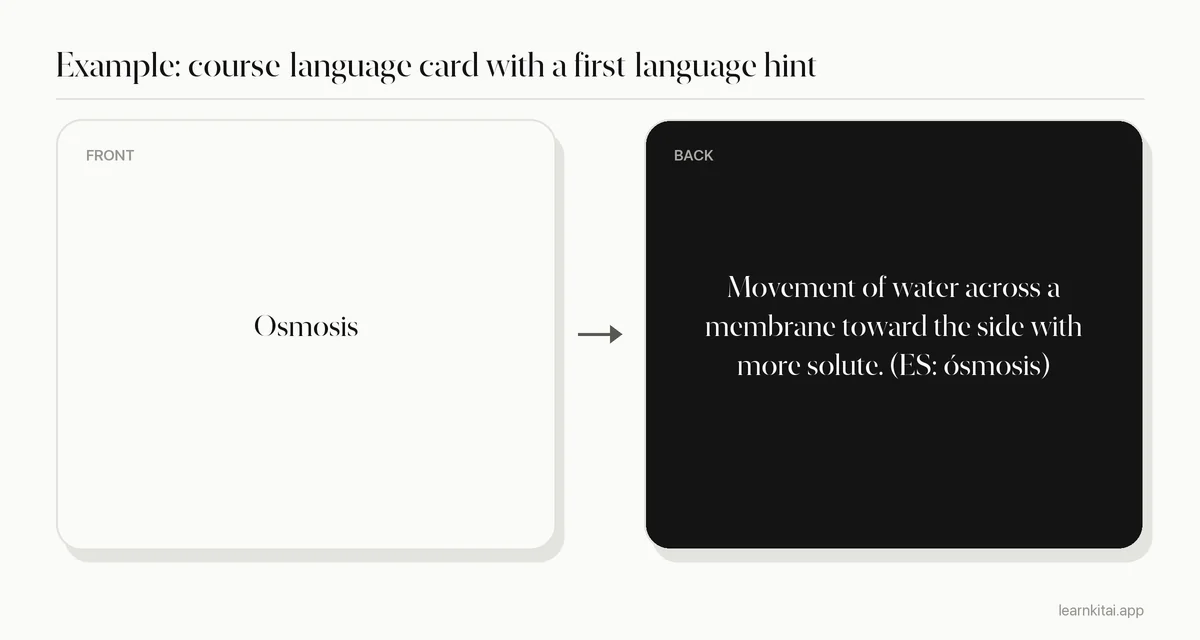
The first-language hint is a safety net, not the answer. Try to recall the course-language definition first. Over a few weeks you will notice you stop needing the hint, which means the term now lives in the language you will be tested in. For more on building word cards that last, see vocabulary flashcards and how to learn vocabulary fast.
LearnKit can make these cards for you from your slides, notes or a recorded lecture, so you spend your time recalling terms instead of typing them out.
Writing essays and exams in a second language
Writing is where language load peaks. Prepare model phrases for your subject: how to introduce evidence, compare two views, or state a limitation. Ask AI to show you several ways to phrase each, then practice writing short answers with them. In timed exams, short clear sentences beat long complex ones you might lose control of.
Common mistakes
- Translating whole lectures and studying only the translation.
- Skipping the pre-lecture glossary because "I will look it up later."
- Using AI translations of technical terms without checking the course textbook.
- Avoiding speaking in seminars, which slows your fluency in the subject's language.
- Comparing your speed to native speakers in week one instead of to yourself in week ten.
Studying in a second language is harder at the start and gets easier faster than most people expect, especially once the vocabulary is under control. Let AI carry the translation and preparation load so your attention goes to the subject. For more ideas, read how to use AI to study.
Frequently asked questions
Should I take notes in my first language during lectures?
Quick notes in whatever language is fastest are fine in the moment. Convert the key points and terms into the course language when you review, since that is what you will need in the exam.
Can I ask to write exams in my first language?
Some institutions allow a dictionary or extra time for non-native speakers, but writing in another language is rare. Ask your international student office early in the term about what is available.
Is AI translation accurate for technical subjects?
It is often good for general meaning but can pick the wrong technical term. Check key terms against your textbook or course glossary, and ask your instructor when two sources disagree.
How long does it take to get comfortable with lectures in a second language?
It varies with your starting level and the subject. Many students notice a clear change within a few weeks once they prepare vocabulary before each class. Track the number of new terms per lecture to see your progress.
Sources
- Open Doors 2024 Report press release, Institute of International Education and US Department of State (1,126,690 international students in the US in 2023/2024, a 7% increase.)
- Lecture Comprehension in English-Medium Higher Education, Glenn Ole Hellekjær, Hermes Journal of Language and Communication Studies, 2010 (411 students in Norway and Germany; main difficulties were unfamiliar vocabulary, word meaning and note-taking.)
Keep reading

AI for Studying: Make It Quiz You, Not Think for You
AI can make you a stronger student or a more dependent one. The difference is whether it does the thinking or makes you do it.
Vocabulary Flashcards That Survive Real Conversations
Most word cards train recognition and stop there. Here is how to build vocabulary flashcards that let you actually say the word when you need it.
Learn Vocabulary Fast by Learning the Right Words First
Speed in vocabulary comes from choosing frequent words, testing yourself past the first right answer, and meeting words again in reading.
Lecture Recording Notes Without Rewatching It All
A recording is not a second lecture. Use it as a search tool for gaps, and you can turn a 50-minute class into solid notes in a fraction of the time.
AI Academic Integrity: Where Help Ends and Cheating Starts
The tool is rarely the problem. What you submit as your own thinking is. A simple test for staying honest while studying with AI.