Vocabulary Flashcards That Survive Real Conversations
Good vocabulary flashcards test one meaning of one word, put it inside a short example sentence, and come in two directions: a recognition card and a harder production card. Learn the most frequent words first, add a steady number each day, and review on a spaced schedule instead of cramming.
Most vocabulary flashcards fail for a boring reason: they test the wrong direction. You see perro, you think dog, you flip the card and feel good. A week later you try to say dog in Spanish and nothing comes. Recognizing a word and producing it are two different skills, and a deck that only trains the first one leaves you stuck in real conversations. This guide shows you how to build cards that train both, how many words to add each day, and how to review so the words are still there next month.
How many words do you actually need?
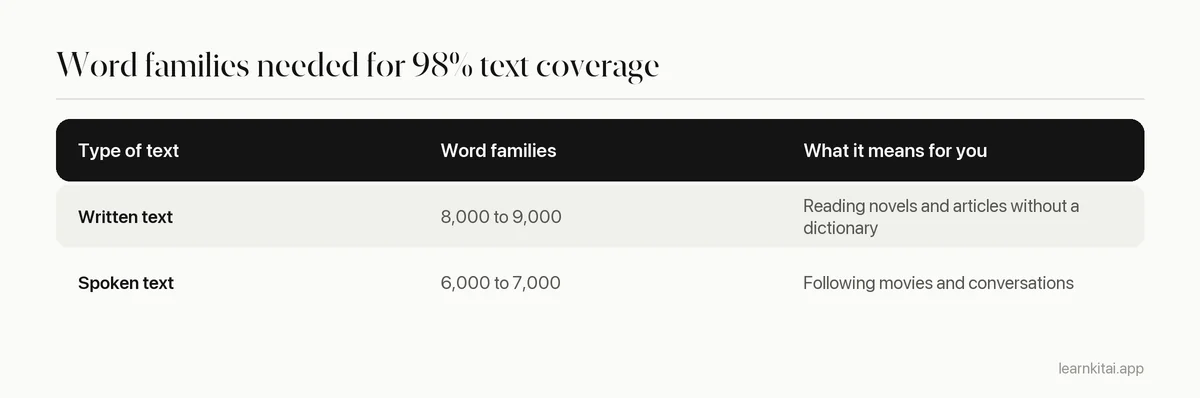
It depends on your goal. Paul Nation estimated that reading unassisted takes about 8,000 to 9,000 word families and following speech about 6,000 to 7,000, at 98% coverage. A much smaller core of frequent words covers most everyday language, so start there.
Those numbers come from a 2006 study by Paul Nation at Victoria University of Wellington, which used frequency lists built from the British National Corpus. A word family groups a base word with its common forms, so decide, decided and decision count as one family. The figures sound huge, but they hide good news. Frequent words appear again and again, so the first few thousand families do most of the work.
The practical rule is simple. Pick words from a frequency list or from material you really read and hear, not from the back of a random textbook chapter. A rare word you will meet once a year is a poor use of a card. If you want the bigger picture on choosing words, see how to learn vocabulary fast.
Should a card go from English to the new language or the other way?
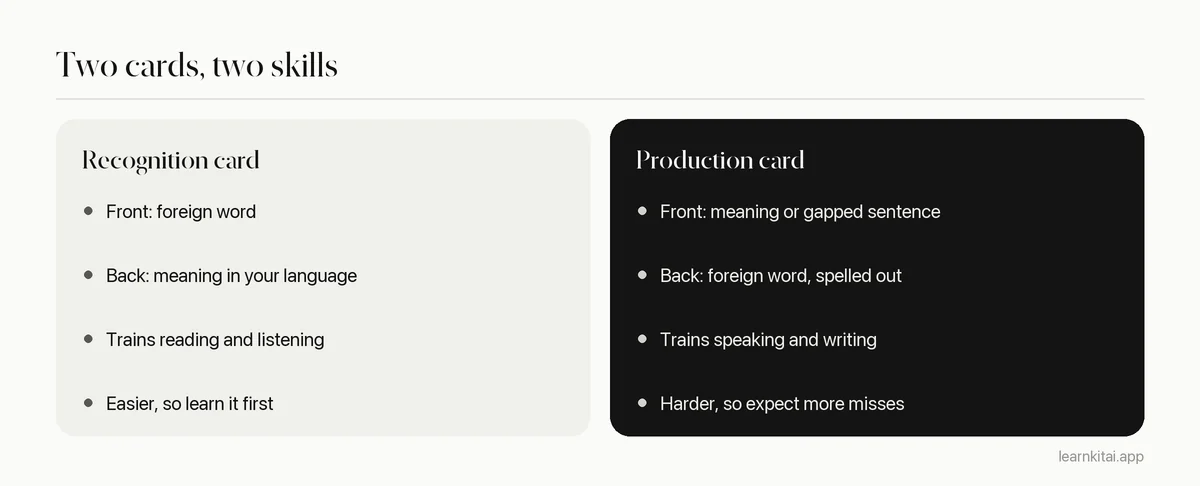
Both, but not on the same card. Recognition (new word to meaning) is easier and usually comes first. Production (meaning to new word) is harder and is what you need to speak and write. Make two cards for important words and expect the production card to lag behind.
A recognition card shows the foreign word and asks for the meaning. A production card shows the meaning, or better a sentence with a gap, and asks you to produce the foreign word. Production feels slower and you will miss it more often. That is the point. The effort of pulling the word out of memory is what makes it available later, the same idea behind active recall.
What goes on a good vocabulary card
A strong card is small and specific. Use this checklist when you write one:
- One sense per card. Run a company and run a marathon are two cards, not one.
- A short example sentence. Context tells your brain how the word behaves, not just what it means.
- Grammar you will need. Gender and article for nouns, irregular forms for verbs.
- Pronunciation. Audio if your app supports it, a simple respelling if not.
- A picture for concrete nouns. An image of a ladder beats the English word ladder on the front.
- A common partner word. Learn make a decision, not just decision.
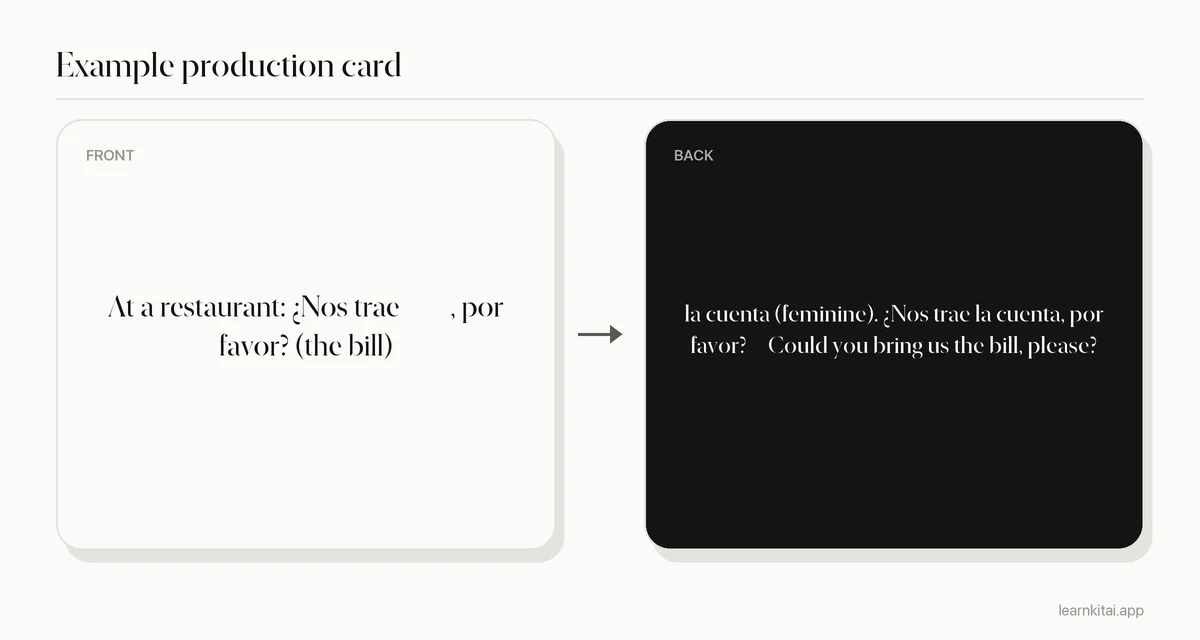
Notice that the front is a full sentence with one gap. This is a cloze card, and it is one of the best formats for words because you practice the word in the place you will actually use it. You can read more about the format in cloze deletion flashcards.
How many new words should you add per day?
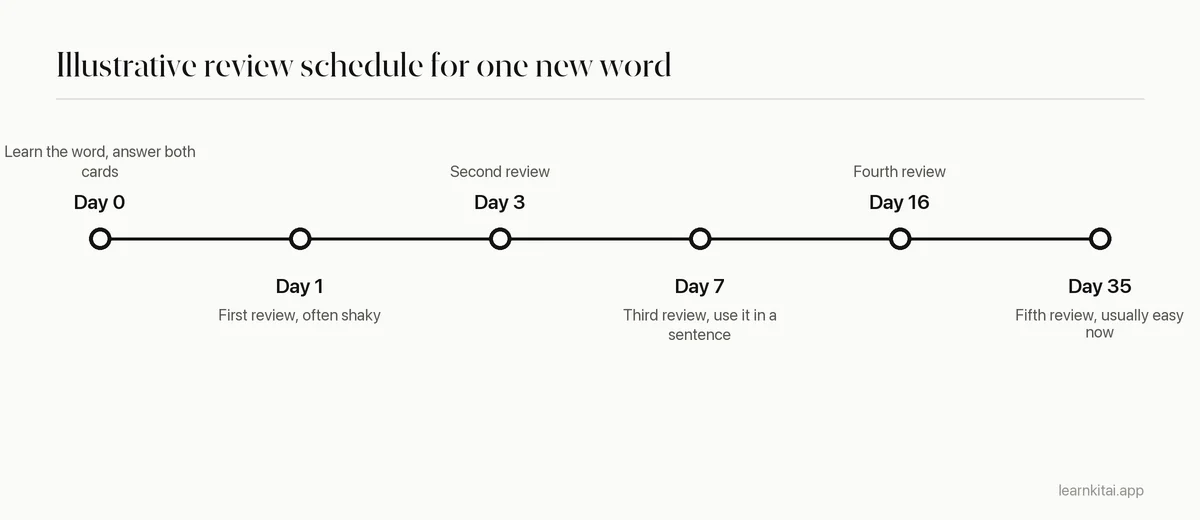
A steady 10 to 20 new words a day is a sensible starting point for most learners. Each new card creates reviews for weeks, so pick a number you can keep up on a busy day, then adjust after two weeks based on how long reviews take.
New cards feel cheap, but every one of them brings a tail of future reviews. Twenty new words today means extra reviews tomorrow, again in a few days, and again next week. Students who add 100 words on a motivated Sunday often quit by Thursday, buried under the reviews. If your daily review time creeps past half an hour, stop adding new cards for a few days. The article on how many flashcards per day walks through the math.
Why does spacing beat cramming for new words?
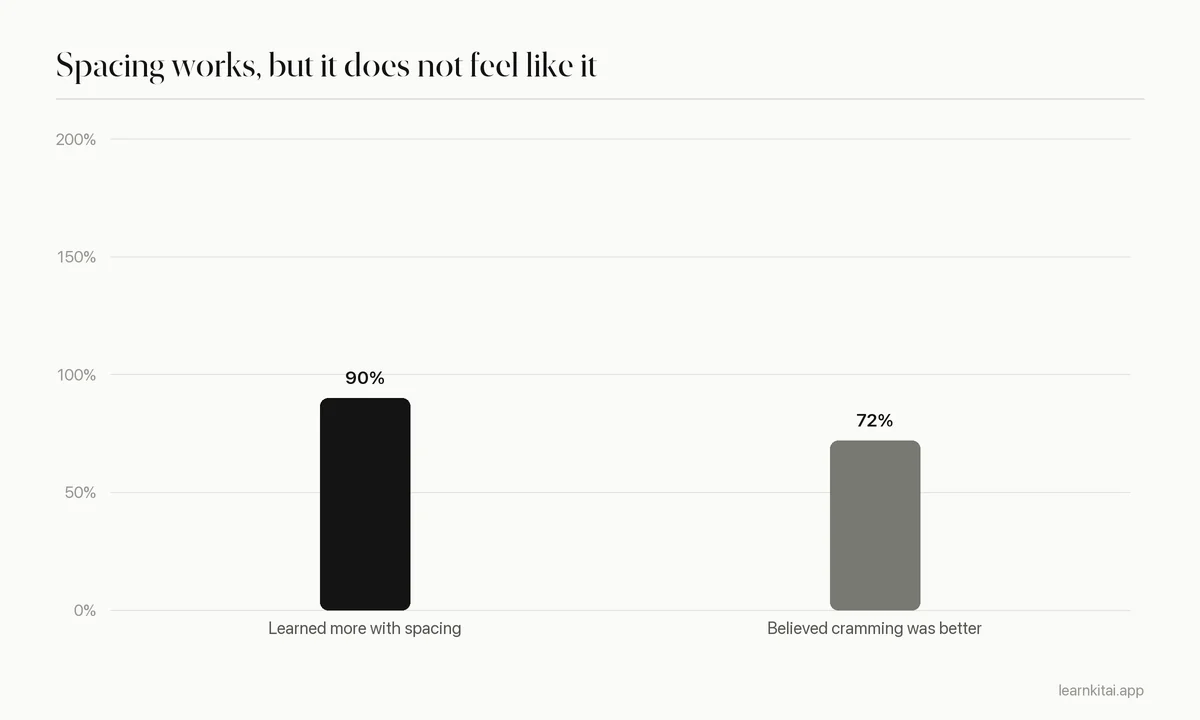
Spaced reviews force you to retrieve a word after you have started to forget it, which strengthens memory more than repeating it while it is fresh. In one flashcard study, spacing helped 90% of learners, yet 72% believed cramming had worked better.
That finding comes from a 2009 study by Nate Kornell in Applied Cognitive Psychology, in which people learned GRE-style word pairs with digital flashcards. Studying one large deck, where each card came back only after many others, beat splitting the same words into four small decks that repeated quickly. Spacing was also better than cramming the day before the test. The trap is that cramming feels better, because the answer is fresh each time you see it.
For vocabulary this means one practical habit: keep your words in one big deck and let a scheduler decide what comes back when. Do not sort cards into tiny themed piles and drill each pile until it feels smooth. For the full theory, read spaced repetition explained.
Common mistakes with vocabulary flashcards
- Writing a list of five translations on the back, so you never know which one you were supposed to recall.
- Only making recognition cards, then wondering why speaking feels impossible.
- Copying words you do not understand yet. Meet a word in context first, then make the card.
- Keeping cards you keep failing without fixing them. Add an image, a memory hook or a better sentence.
- Never using the word outside the app. Say your example sentence out loud, or write a new one.
Can AI make vocabulary flashcards for you?
Yes, for a first draft. Paste a word list, an article you are reading or a video transcript, and an AI tool can produce cards with definitions and example sentences. Check each card against a good dictionary, because AI sometimes picks the wrong sense of a word with several meanings.
The fastest workflow is to collect words from real input, such as a news article or a show you are watching, and then let a tool draft the cards. LearnKit can turn a pasted text or a web page into a short flashcard set, which you then edit: keep one sense per card, fix the example sentences and add the production direction where it matters.
Whatever tool you use, the rules stay the same: frequent words first, one meaning per card, both directions for words you need to say, and short daily reviews instead of weekend marathons. For the general rules of card writing that apply to every subject, see how to make effective flashcards.
Frequently asked questions
Should I put pictures on vocabulary flashcards?
For concrete nouns and actions, yes. A picture on the front skips your native language and links the new word straight to the thing itself. For abstract words like hope or although, a short example sentence works better than a forced image.
Is it better to learn words in context or from lists?
Meet words in context first, then use cards to keep them. Lists are fine for choosing which words to learn, but a word studied only as a list item is hard to use. Putting the word inside a sentence on the card gives you a bit of both.
What should I do with words I keep forgetting?
Treat repeated misses as a signal to rewrite the card. Add an image, a vivid example sentence or a sound-alike memory hook, or split a word with several meanings into separate cards. If two similar words keep getting mixed up, make a card that asks you to tell them apart.
Do I need to write vocabulary flashcards by hand?
No. Paper cards and apps both work, and writing by hand can help you notice spelling. Digital cards win on scheduling, audio and the ability to keep thousands of words in one deck without losing track of reviews.
Sources
- How Large a Vocabulary Is Needed for Reading and Listening?, Canadian Modern Language Review (Nation, 2006), hosted by Victoria University of Wellington (8,000 to 9,000 word families for written text and 6,000 to 7,000 for spoken text at 98% coverage.)
- Optimising learning using flashcards: Spacing is more effective than cramming, Applied Cognitive Psychology (Kornell, 2009) (Spacing beat massing for 90% of participants learning word pairs; 72% believed massing had been more effective.)
Keep reading
How to Make Flashcards That Still Work Three Weeks Later
Most flashcards fail before you ever study them, because of how they are written. Seven rules, real before and after cards, and a study routine that keeps them working.

Cloze Deletion: Fill-in-the-Blank Cards Done Right
Cloze cards are the fastest way to turn notes into flashcards, and the easiest to get wrong. Rules, examples and the exact Anki syntax.
How Many Flashcards per Day? Count Reviews, Not Cards
The right number of new flashcards depends on the reviews they create later. A simple formula, a budget table and the warning signs that you are adding too many.
Learn Vocabulary Fast by Learning the Right Words First
Speed in vocabulary comes from choosing frequent words, testing yourself past the first right answer, and meeting words again in reading.
Minimum Information Principle: Small Cards, Big Recall
One flashcard, one fact. Here is why splitting fat cards into tiny ones makes reviews faster and memories stronger, with worked examples.