Learn Vocabulary Fast by Learning the Right Words First
The fastest way to build vocabulary is to learn the most frequent words first, test yourself on each word until you have recalled it correctly several times on different days, and meet the words again in easy reading. Choosing the right words matters as much as the method you use to learn them.
Most people who try to learn vocabulary fast pick the wrong measure of speed. They count how many new words they see each day. What matters is how many words you can still use a month later, and how much of a real text those words let you understand. Both depend on two choices: which words you learn, and how you practice them.
This guide is for second language learners and for native speakers preparing for exams with heavy vocabulary. It covers how to pick words, what it means to know one, a recall routine that keeps words for good, and a daily plan you can start today.
How many words do you need to know to read comfortably?
Research by Paul Nation suggests readers need to know about 98 percent of the words in a text for unassisted comprehension. For English, that takes roughly 8,000 to 9,000 word families for written text and 6,000 to 7,000 for spoken English.
A word family is a base word plus its common forms, so decide, decided, decision and undecided count as one family. In Nation's study of vocabulary size, 98 percent coverage means about one unknown word in fifty. At 95 percent, one word in twenty is unknown, and only a minority of readers in earlier research reached adequate comprehension.
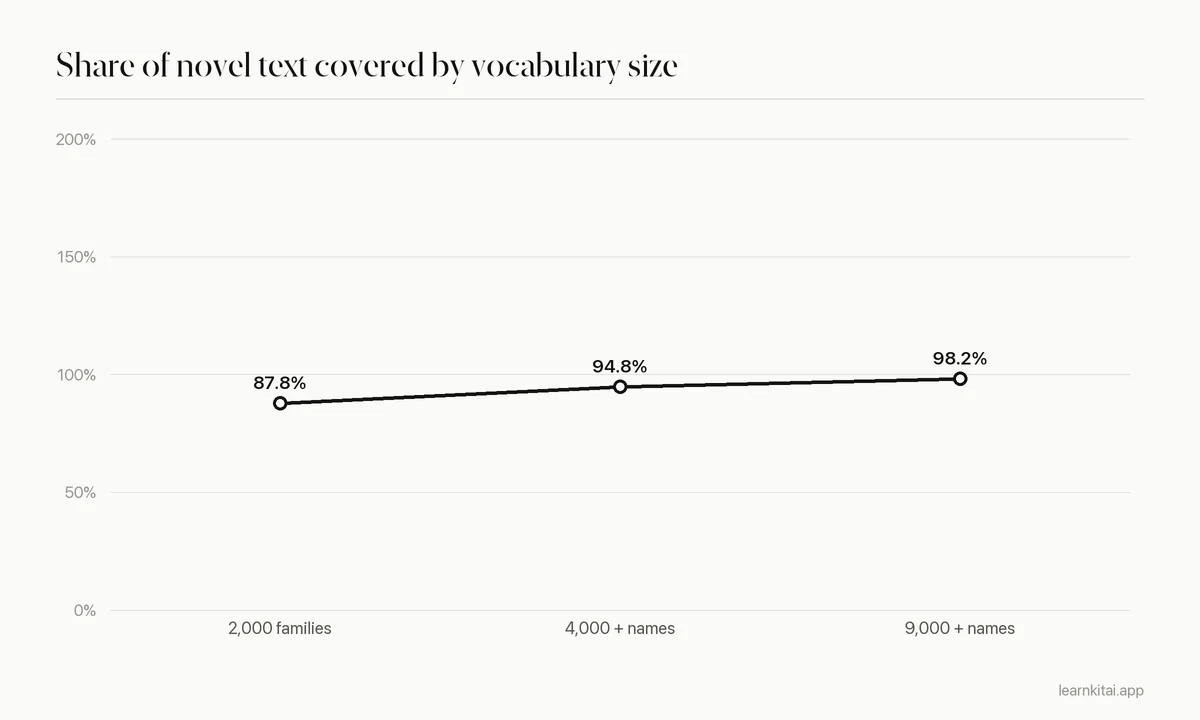
The encouraging part is how front loaded the payoff is. Across five classic novels, Nation found that the most frequent 2,000 word families already covered almost 88 percent of the running text. Each extra thousand after that adds less coverage, which is why the order you learn words in matters so much.
Which words should you learn first?
Learn the most frequent words in the language first, then the words that are frequent in your field or exam. A frequency list or a graded reader series will give you the order. Rare words can wait, because you will meet them too seldom to justify the effort now.
Use a frequency list for your language and work through it in order, skipping words you already know. Once you pass the first few thousand, switch to words from your own reading, your textbook or your exam word list. A word you met in context and wanted to understand is worth more than a random entry from a dictionary.
How to learn vocabulary so it actually sticks
Test yourself instead of rereading lists, keep testing a word after the first correct answer, and space the reviews out over days and weeks. Recall from memory is what strengthens a word; looking at it again mostly feels productive.
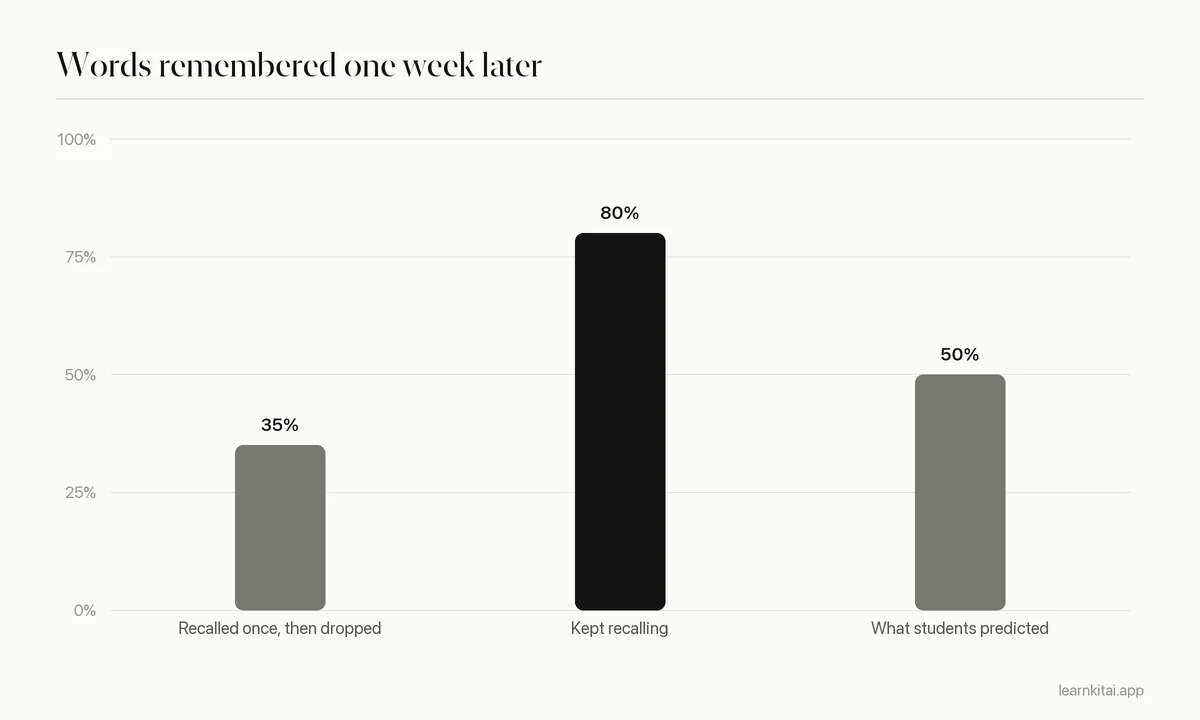
One experiment makes the case clearly. Students learned foreign language word pairs. In some conditions a word was dropped from practice as soon as it was recalled once. In others, students kept recalling it. A week later, the first group remembered about 35 percent of the words and the repeated recall group about 80 percent, as Karpicke and colleagues summarize. The striking detail: every group predicted it would remember about half. Students could not feel the difference.
In practice, that means three rules. Hide the answer and produce it before you check. Do not retire a word after one success; let it come back on a later day. And let the gaps grow as the word gets easier. A flashcard app with spaced repetition handles that timing, and a paper box system like the Leitner system works just as well if you prefer cards in your hand.
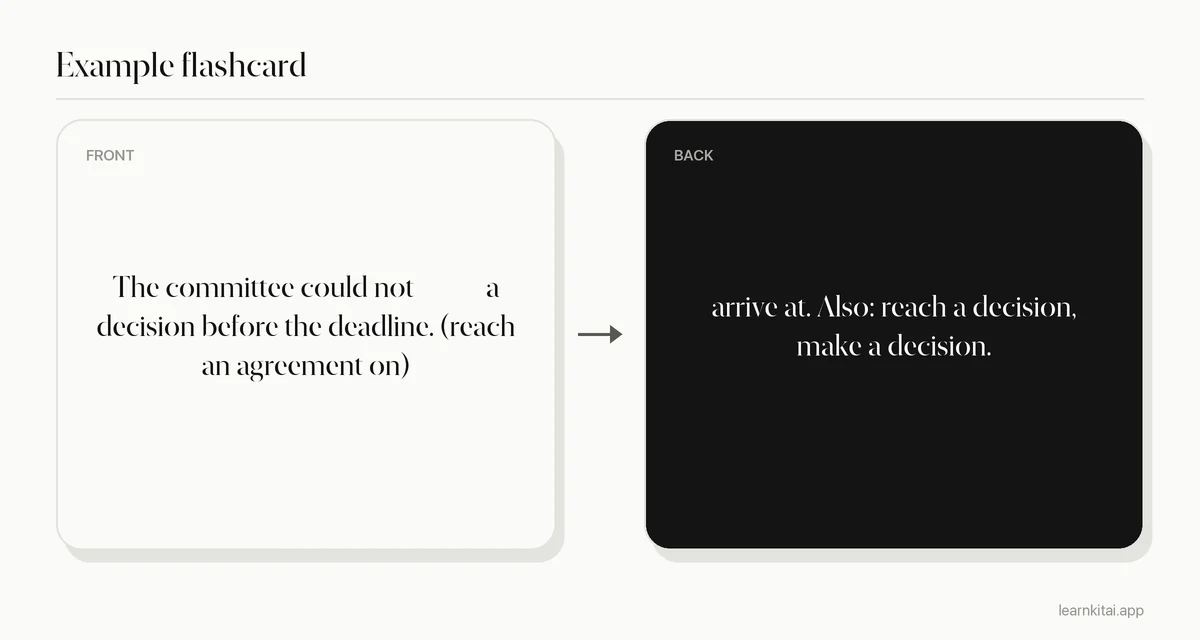
Notice that the card asks you to produce the word inside a sentence. That trains meaning and use together. For more card formats, including picture cards and two-way cards, see our guide to vocabulary flashcards.
Can you learn words just by reading?
Yes, but slowly, and only when the text is easy enough. Reading where you already know about 98 percent of the words lets you guess new ones from context. Combine easy reading with deliberate card practice for the fastest growth.
Reading and card practice do different jobs. Cards give you a word quickly. Reading shows you the word in many sentences, which teaches you how it behaves. If you read texts that are too hard, every page becomes a dictionary hunt and you stop. Graded readers and familiar topics keep the unknown words rare enough to learn from.
How do you learn vocabulary for an exam in your own language?
For exams like the SAT, GRE or a subject final, learn word roots and prefixes first, then study exam words in short phrases. Roots let you decode words you have never seen, which helps on test day as much as the words you drilled.
Native speakers already know the high frequency words, so the challenge shifts to rarer, academic ones. Many of these share Latin and Greek parts. If you know that bene means good and mal means bad, you can make a fair guess at benevolent and malign even without a card for them. Spend a week on the most common roots and prefixes before you open a long exam word list.
Then treat exam words like any other vocabulary: recall them in a sentence, space the reviews, and look for them in real reading such as long-form journalism. Subject terms deserve the same care. A biology or economics term you can define and use in a sentence is worth more on an essay than one you only recognize on a list.
A daily plan to learn vocabulary fast
Spend about twenty to thirty minutes a day: review due cards first, add a fixed number of new words, and read something easy. Keep the new word count small enough that tomorrow's reviews stay under fifteen minutes.
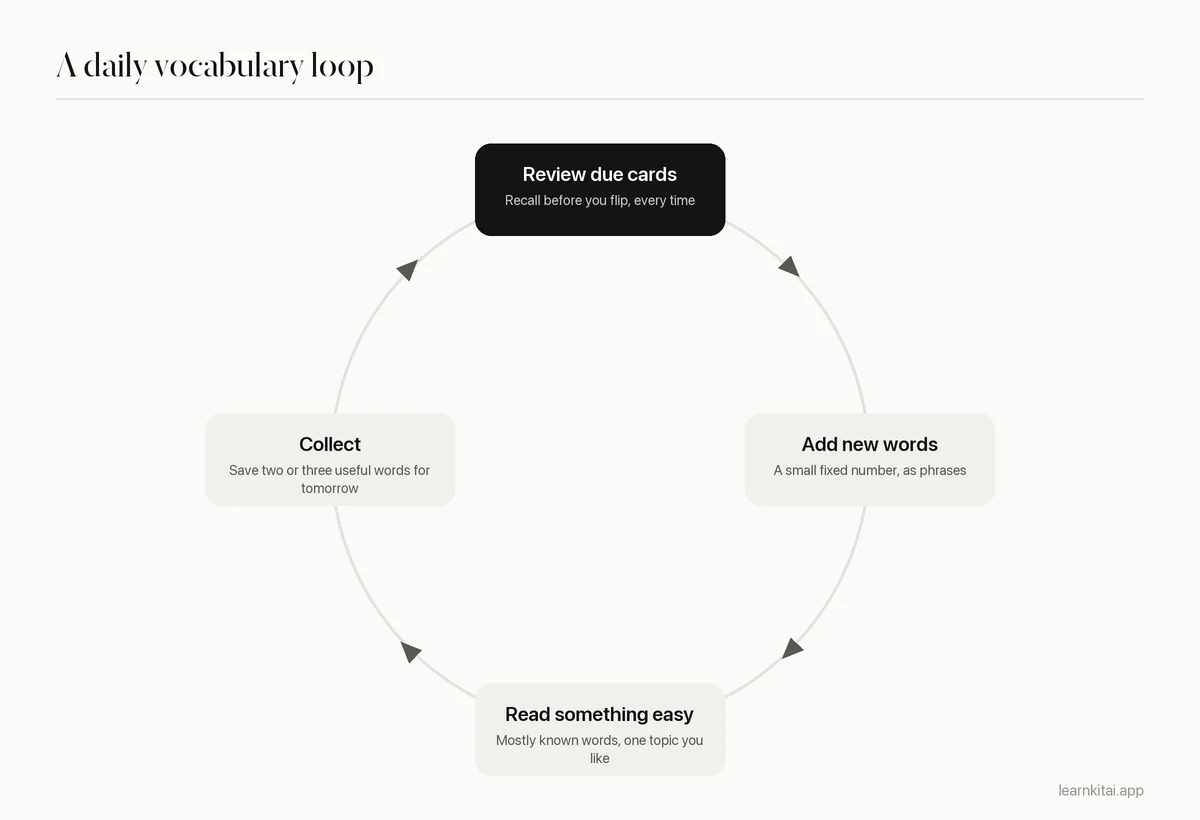
There is no magic number of new words per day. Start small, around ten, and watch your review time. If reviews start to take more than fifteen minutes, slow down for a few days. Steady small batches beat a burst of fifty that you abandon in week two.
- Do not learn long alphabetical lists. Neighbors like adapt and adopt interfere with each other.
- Do not write both a translation and a long definition on the same card. Keep the back short.
- Do say the word aloud. Sound is part of knowing it.
- Do reuse new words in a sentence of your own the same day.
If you are studying a whole subject in a second language, vocabulary is only part of the job. Our guide on studying in another language covers reading textbooks and lectures, and our subject guides overview shows how these recall habits carry across courses.
Frequently asked questions
How many new words can I learn per day?
The right number is whatever keeps your daily reviews short, and for many people that means starting around ten. New words create reviews for weeks afterward. If you fall behind, pause new words until you catch up.
Is it better to learn words with translations or definitions?
Beginners usually learn faster with short translations. As you advance, simple definitions and example sentences in the target language help you think in it. Either way, keep the answer short and test yourself before you look.
Do vocabulary apps work?
They work when they make you recall the word and schedule reviews over time. Apps that only show you words or let you pick from easy options feel smooth but build weaker memory. Check that the app asks you to produce answers, not just recognize them.
How do I remember words I keep forgetting?
Give them a stronger hook. Make a vivid image that links the sound to the meaning, write a personal sentence, or pair the word with its opposite. Then let the card come back sooner than usual for a while.
Sources
- How Large a Vocabulary Is Needed For Reading and Listening?, The Canadian Modern Language Review (I.S.P. Nation, 2006), via Victoria University of Wellington (98% coverage needs 8,000 to 9,000 word families for written text and 6,000 to 7,000 for spoken; 2,000 families cover 87.83% of five novels, 9,000 plus proper nouns 98.24%.)
- Metacognitive strategies in student learning: Do students practise retrieval when they study on their own?, Memory (Karpicke, Butler and Roediger, 2009) (Repeated recall gave about 80% retention after a week versus 35% when items were dropped after one correct recall; all groups predicted about 50%.)
Keep reading

Vocabulary Flashcards That Survive Real Conversations
Most word cards train recognition and stop there. Here is how to build vocabulary flashcards that let you actually say the word when you need it.

Spaced Repetition: Why Forgetting Is Part of the Plan
Reviewing right before you forget builds memories that last. Learn how long the gaps should be, with a ready schedule for exams one week to one semester away.

The Leitner System: Five Boxes That Schedule Your Reviews
A shoebox, some dividers and one simple rule give you spaced repetition without an app. Here is a ready-to-use five-box schedule and how to adapt it to your exam date.
Study in a Second Language Without Translating Everything
Studying in a second language means learning the subject and the words at once. AI can split those jobs apart if you use the right rule.

How to Study Science: Think Like the Exam, Not the Textbook
Science asks for four kinds of knowledge at once: terms, mechanisms, problem skills and data. Here is how to study each one, and how they fit together.

Study Economics by Drawing the Graph Before the Words
Economics is a set of models told three ways: in words, graphs and numbers. Learn to switch between them and exam questions get much easier.