How to Summarize a Research Paper in Three Passes
To summarize a research paper, read it in passes: first the title, abstract, headings and conclusion, then the figures and main text without the fine details. Then write five lines in your own words: the question, the method, the main finding with a number, the key limitation and why it matters. Check each line against the paper.
Research papers are not written to be read from the first word to the last. They are written to be searched, skimmed and checked. If you read them like a textbook, a single paper can eat an evening and leave you unsure what it found. This guide shows you how to summarize a research paper with a three-pass reading method used by many researchers, a five-line template that works for most empirical papers, and a worked example of a real study. It also covers where AI helps and where it can mislead you.
Why are research papers so hard to summarize?
They are dense, full of field-specific terms and written for experts, and the main point is spread across the abstract, results and discussion. Most students read them start to finish, get lost in the methods, and never step back to ask what question the paper answered.
There is also a lot of them. Worldwide output of science and engineering articles reached 3.3 million in 2022, according to the U.S. National Science Foundation. No one reads every paper fully, not even professors. Learning to decide quickly how deeply to read is part of the skill.
What is the three-pass method for reading a paper?
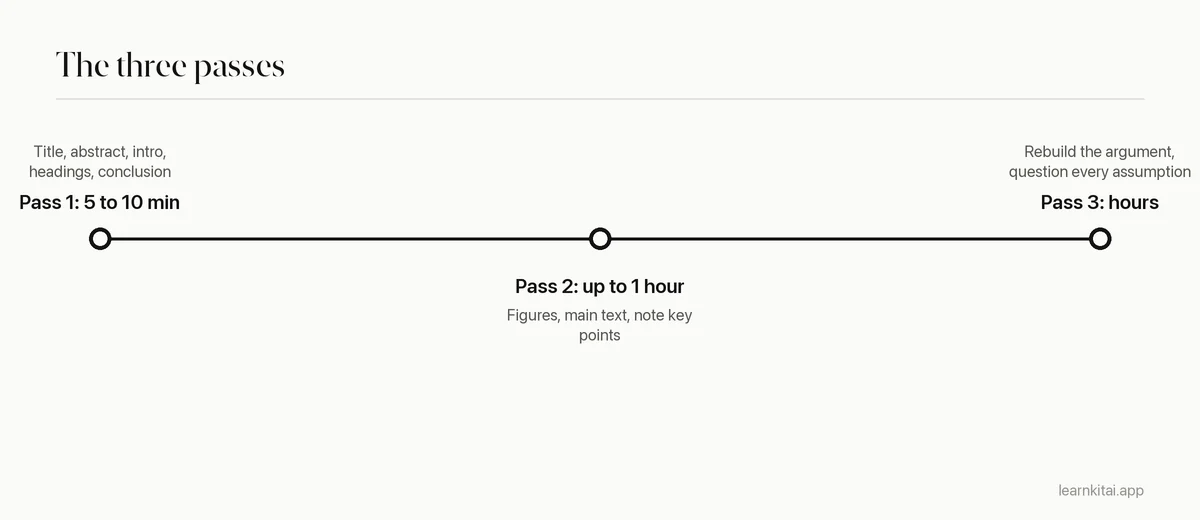
It is an approach described by computer scientist S. Keshav: a five to ten minute first pass for the big picture, a second pass of up to an hour for the content without the details, and an optional third pass for deep understanding. You stop when you have what you need.
Keshav set it out in a short and widely shared guide, How to Read a Paper. The first pass covers the title, abstract and introduction, the section headings, the conclusions and a glance at the references. After it, he says you should be able to answer five questions he calls the five Cs: category, context, correctness, contributions and clarity. The second pass adds the figures and main text, ignoring details like proofs. The third pass is for when you must understand the paper in depth, such as for a review or a thesis.
For most course readings, two passes are enough. Do the first pass, decide if the paper matters for your assignment, then do the second pass on the ones that do.
How to summarize a research paper in five lines
After the second pass, close the paper and write five lines in your own words. This template fits most empirical papers in the sciences and social sciences:
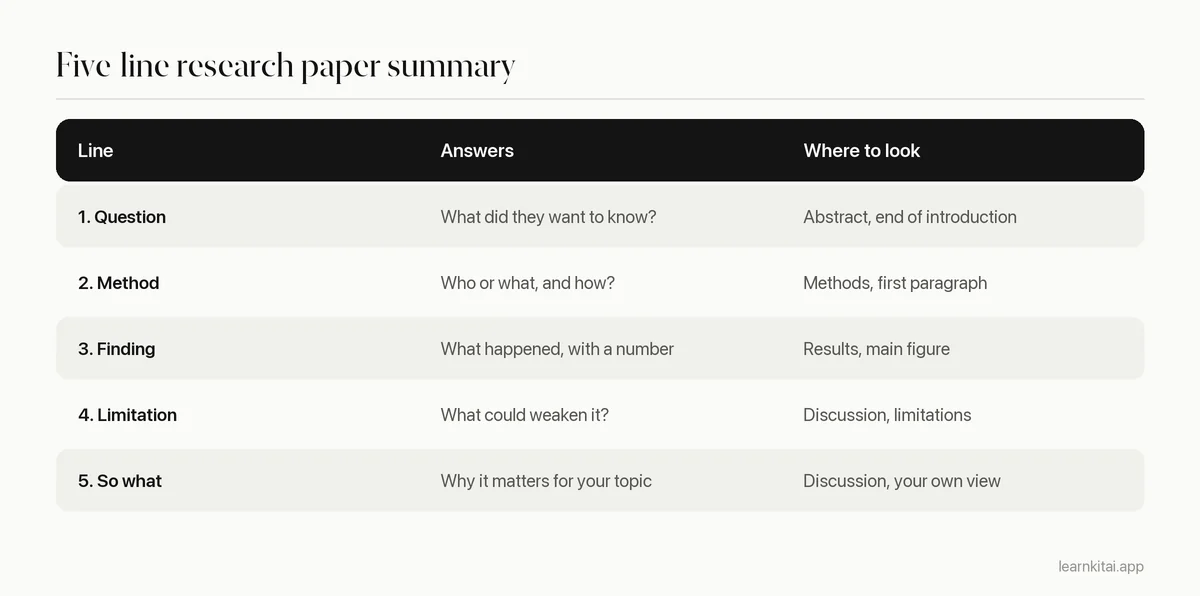
Line three is where most summaries go vague. The intervention was effective tells you nothing. Students who tested themselves recalled 56% after a week, versus 42% for those who restudied tells you size and direction. Always copy at least one key number, and check it against the paper.
What does a good research paper summary look like?
It is short, specific and in your own words. It names the question, the design, the main result with a number, one real limitation, and why it matters. Anyone who reads it should understand what the paper found without opening it.
Here is a five-line summary of a well-known memory study, Roediger and Karpicke (2006), written with the template:
- Question: Does taking a memory test improve long-term retention more than studying the material again?
- Method: College students read short prose passages, then either restudied them or took recall tests without feedback, and had a final test 5 minutes, 2 days or 1 week later.
- Finding: Restudying won on the 5-minute test (81% vs 75%), but testing won after 1 week (56% vs 42%).
- Limitation: Short passages in a lab setting, so results may differ for full courses and other kinds of material.
- So what: Tests are a way to learn, not only a way to measure, which supports quizzing yourself instead of rereading.
That is about 100 words. Notice that the limitation is specific to this study, not a generic more research is needed. Finding a real limitation is the clearest sign you understood the method. This kind of summary also turns easily into questions, which is the subject of open ended questions for studying.
How is your summary different from the abstract?
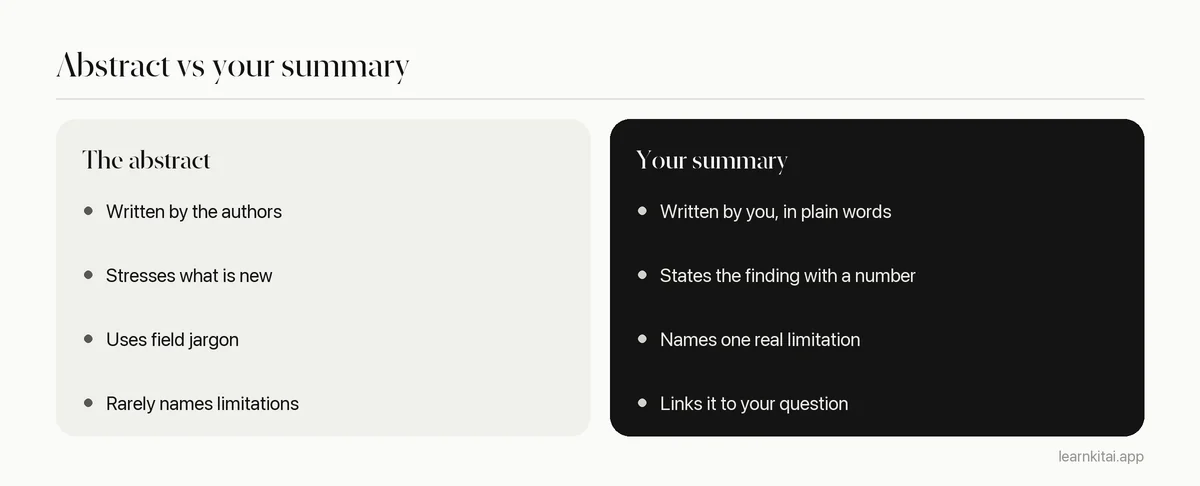
The abstract is the authors selling their paper; your summary is you judging it. Abstracts rarely mention limitations, use the field's jargon, and stress what is new. Your summary should add the weakness, use plain words, and say why the paper matters for your question.
Copying or lightly rewording the abstract is also a common route to accidental plagiarism. If you are unsure where the line is, read summary vs paraphrase.
Can AI summarize a research paper for you?
AI can draft a useful summary of a paper you give it, especially for a first pass. It can also misstate results and invent references. In a 2024 test, 28.6% to 91.4% of the references different chatbots produced for literature searches were fabricated, so never take citations from a chatbot without checking.
That figure comes from Chelli and colleagues in the Journal of Medical Internet Research. The risk is much lower when the tool summarizes a PDF you upload, because it works from that text, but numbers and the direction of findings still slip. A practical approach is to use an AI summary as your first pass, then do the second pass yourself and fill in the five-line template from the paper, not from the AI. LearnKit can summarize an uploaded paper and generate questions on it, which works well as a check after you have written your own summary. More on checking outputs is in how to summarize a PDF with AI.
Common mistakes
- Reading the methods in full detail before you know what the paper found.
- Summarizing the introduction, which is mostly other people's work.
- Writing the results were significant without saying what changed and by how much.
- Skipping the figures, which often carry the main result.
- Listing limitations the authors mention without asking which one matters most.
Once you can summarize a research paper in five lines, a literature review stops being a pile of PDFs and becomes a table of questions, methods and findings you can compare. For the wider method that applies to textbooks and other long readings, start with how to summarize a chapter, and for news features and essays see how to summarize an article fast.
Frequently asked questions
How long should a research paper summary be?
For your own notes, five lines or about 100 to 150 words is usually enough. Assignments may ask for a specific length, such as a 250-word summary or a one-page critique, so follow the brief and start from the five lines.
Should I read the whole paper before summarizing it?
Not always. For many course readings, the first two passes give you enough to summarize accurately. Read the full methods and supplementary material only when you need to judge the study in detail, for example in a critical review.
How do I summarize a review article instead of a study?
Swap the template lines: the question becomes the scope of the review, the method becomes how the authors chose and combined studies, and the finding becomes their main conclusions and how strong the evidence is. Note any areas the authors say are still unclear.
Sources
- How to Read a Paper, S. Keshav, University of Waterloo (2016 version, hosted by Harvard CS161) (Three-pass method: first pass about five to ten minutes, second pass up to an hour, third pass many hours for beginners; the five Cs.)
- Publications Output: U.S. Trends and International Comparisons, National Science Foundation, National Center for Science and Engineering Statistics (2023) (Worldwide S&E publication output reached 3.3 million articles in 2022.)
- Hallucination Rates and Reference Accuracy of ChatGPT and Bard for Systematic Reviews: Comparative Analysis, Journal of Medical Internet Research (Chelli et al., 2024) (Fabricated reference rates of 28.6% (GPT-4), 39.6% (GPT-3.5) and 91.4% (Bard).)
- Test-Enhanced Learning: Taking Memory Tests Improves Long-Term Retention, Psychological Science (Roediger and Karpicke, 2006) (Worked example: restudy 81% vs testing 75% at 5 minutes; testing 56% vs restudy 42% at one week.)
Keep reading
How to Summarize a Chapter So You Never Reread It
Most chapter summaries are just shorter copies of the book. The closed-book method turns summarizing into practice that sticks, so you can study from your page instead of the chapter.
Summarize PDF Files With AI and Catch What It Gets Wrong
AI can shrink a 60-page PDF in seconds. Here is a workflow that keeps the speed and catches the errors before they end up in your notes.
Summary vs Paraphrase: Same Source, Different Jobs
A paraphrase keeps every idea of one passage. A summary keeps only the main ones. Here is how to tell which one your assignment, or your study session, needs.
Summarize an Article Fast: Read Less, Keep More
Reading every word of a long article is the slow way to summarize it. A three-pass method gets you the main points in a fraction of the time.
AI Hallucinations in Study Notes: A 10-Minute Error Check
AI notes can sound perfect and still be wrong. Learn where errors hide and a quick routine to catch them before they reach your exam.