Your AP Exam Study Plan: 12 Weeks to May 2027
Start about 12 weeks before your first AP exam. Use the course's official unit weightings to decide where time goes, review one or two units a week with practice questions, and practice released free-response questions with the scoring guidelines every week. Finish with two full timed practice exams and light review in May.
The 2027 AP exams run over two weeks, from Monday, May 3 to Friday, May 14, according to the College Board exam calendar. Each exam is scored from 1 to 5, and many colleges give credit or placement for a 3 or higher. A good AP exam study plan turns that date into a weekly routine, so you are not trying to review a whole year of content in late April.
Below is a 12-week plan, a way to use official unit weightings to decide where your time goes, and how to handle two, three or more APs at once.
When should you start studying for AP exams?
About 12 weeks before your first exam is a good target, which means early February for a May 3 start. Your class covers new content until spring, so early review is light: one or two old units a week alongside current work.
Starting early is not about long hours. It is about revisiting units several times with gaps in between. In a large study of spacing, Cepeda and colleagues found that the best gap between reviews grows as the test date gets further away. A unit you reviewed in February and again in April will hold up far better in May than one you studied twice in the same week.
How to build an AP exam study plan from unit weightings
Every AP course publishes how much of the exam each unit is worth. These ranges are the most useful planning tool you have, and few students use them. Here are the official weightings for AP Biology as an example, from the College Board's course at a glance.
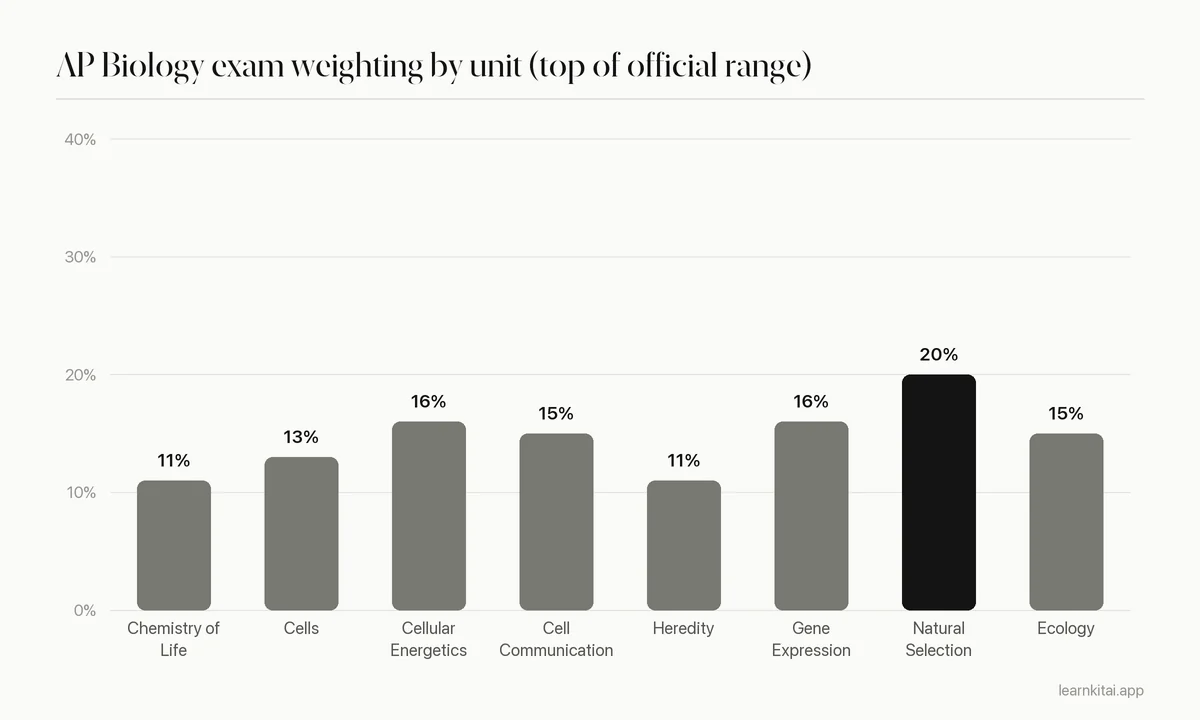
Natural Selection can be worth up to 20 percent of the exam, nearly double Heredity at up to 11 percent. If both are weak spots, Natural Selection gets more of your time. Combine weight with how weak you feel on each unit, and you have a priority list. Find the same table for your course in its course and exam description.
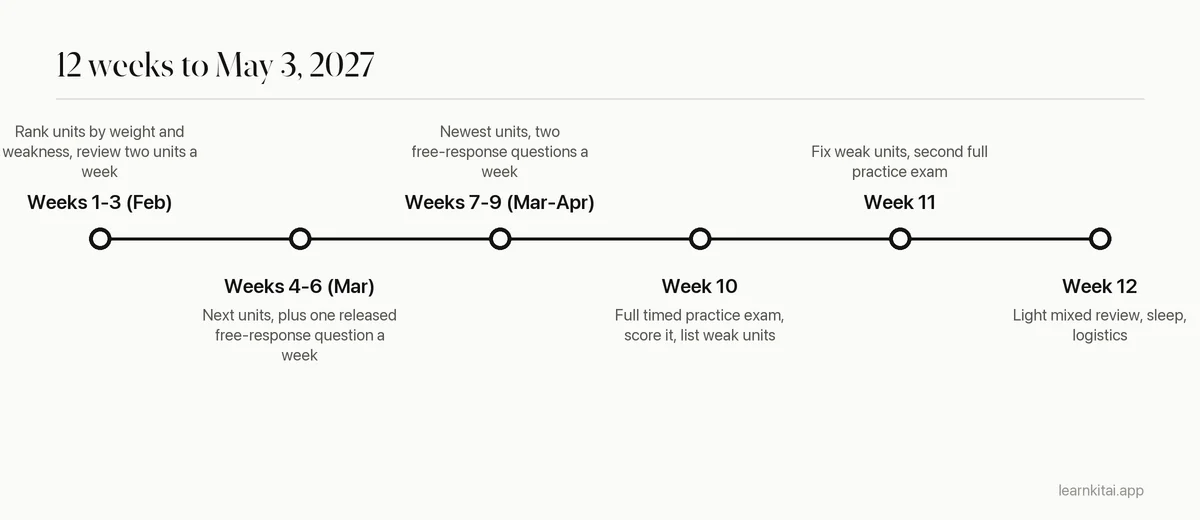
What does a 12-week AP study plan look like?
Weeks 1 to 6 review old units with practice questions. Weeks 7 to 9 add weekly free-response practice and cover the newest units. Weeks 10 and 11 are full timed practice exams and fixing gaps. The final week is light review and rest.
Each unit review should start with questions, not notes. Try ten multiple choice questions on the unit from memory, check them, then reread only what you missed. AP Classroom progress checks are good for this if your teacher has assigned them. Practice testing is one of the two highest-rated study methods in a major review by Dunlosky and colleagues, alongside spacing.
How do you practice AP free-response questions?
Use released questions and the official scoring guidelines. Answer under a timer, then score yourself line by line against the guidelines. Compare with sample responses to see what earned points, and rewrite one answer per week.
The College Board posts past free-response questions, scoring guidelines and, for many years, sample student responses on AP Central. The AP Biology page, for instance, has recent questions with scoring guidelines and chief reader reports. Those reports explain where students commonly lost points, which is gold for planning.
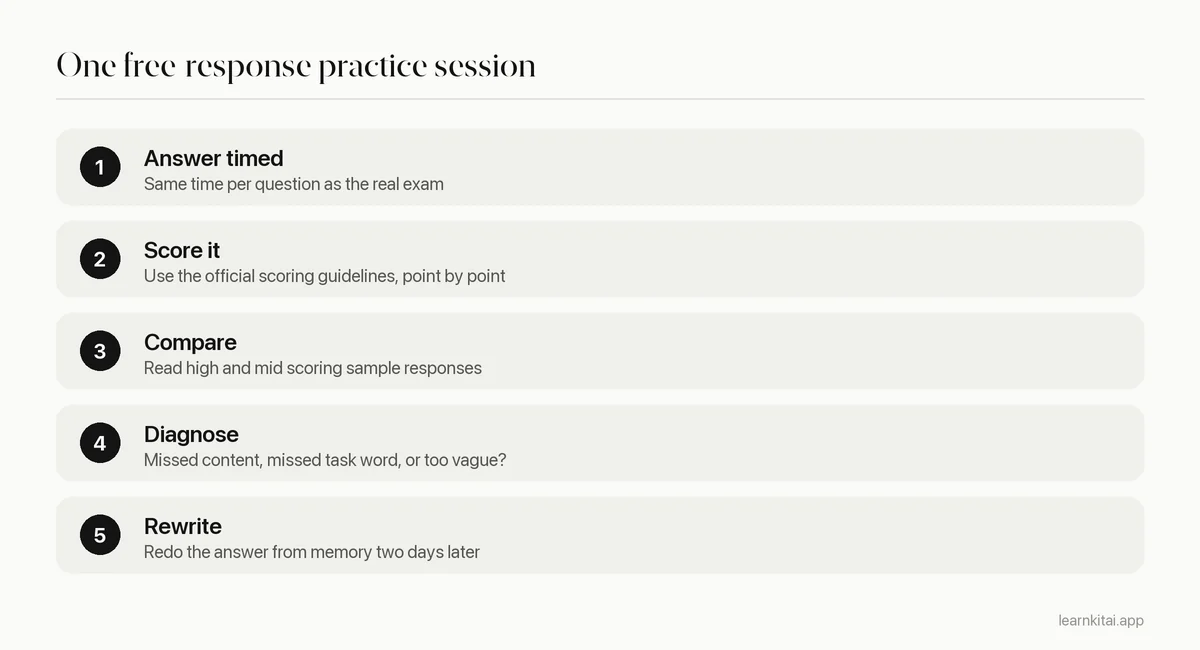
Self-scoring feels awkward at first, but it teaches you how points are actually given. Many students lose free-response points not for wrong ideas but for vague wording, such as saying something affects a process without saying how. LearnKit can generate open questions with sample answers from your notes, which is a useful warm-up between released questions.
How do you study for multiple AP exams at once?
Rotate them. Give every AP at least two short sessions a week, put two different APs on each study day, and give extra sessions to the exam that comes first or feels weakest. Do full practice exams on weekends.
Here is a worked example. Priya is taking AP Biology, AP US History and AP Calculus AB, with the exams spread across both weeks. She has about eight hours a week for AP review on top of homework.
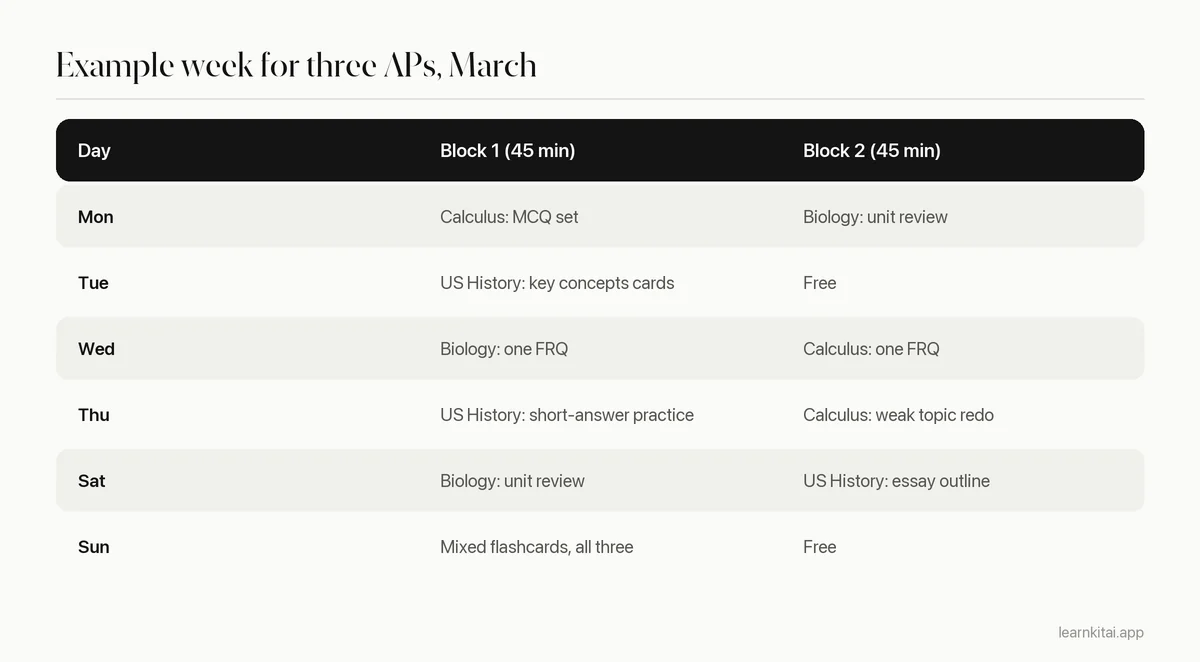
Each AP appears three or four times a week, which spaces the practice naturally. In April, Priya swaps one weekday block for a full timed practice exam each weekend, rotating subjects. For the general method behind this, see our guide to building a study schedule, and for juggling many exams at once, our finals guide.
What AP score should you aim for?
Aim for the score your target colleges accept for credit or placement. Many give credit for a 3 or higher, but selective schools and some majors ask for a 4 or 5. Look up the policies before you set your weekly hours.
Your target changes how you plan. According to the College Board's page about AP scores, scores run from 1 to 5 and many colleges grant credit or placement for a 3 or above, but each college sets its own policy. If the colleges on your list only reward a 5 in a subject, that exam deserves more of your weekly blocks than one where a 3 is enough.
Use your first full practice exam in week 10 as a reality check. If you are already comfortably above your target, move some time to a weaker subject. If you are well below, focus on the highest-weighted units and on the free-response tasks where the scoring guidelines show you lost the most points.
What should you do in the last week?
Ease off. The final week of any AP exam study plan is for short mixed review, your error log and sleep, not new content or extra full-length exams. Confirm logistics early so nothing surprises you on the day.
- Review your error log and the units you marked weakest.
- Do short mixed sets, not new full exams, in the final two days.
- Confirm exam times and rooms with your AP coordinator.
- Sleep normally. A rested brain recalls more than a crammed one.
- Use a calming routine if nerves hit. Our test anxiety guide has one.
Frequently asked questions
Is a 12-week plan necessary for every AP exam?
Not always. If you have kept up all year and scored well on unit tests, six to eight weeks of focused review may be enough. Twelve weeks is a safe default when you take several APs or have weak units.
How many practice exams should I take before the AP exam?
Two full timed practice exams per subject is a good target, spaced a week apart. Score each one and spend more time fixing the misses than taking more exams.
What score do I need on an AP exam to get college credit?
It depends on the college. Many U.S. colleges grant credit or placement for a 3 or higher, but some require a 4 or 5. Check each college's AP credit policy.
Should I self-study for an AP exam without taking the class?
It is possible for some subjects, but plan for more time. Use the course and exam description as your syllabus, follow the unit weightings, and practice released free-response questions from the start.
Sources
- AP Exam Calendar, College Board (2027 AP exams run from May 3 to May 14, 2027.)
- About AP Scores, College Board (AP scores range from 1 to 5; many colleges grant credit or placement for 3 and above.)
- AP Biology Course at a Glance, College Board (Unit exam weightings, from 8 to 11 percent (Chemistry of Life, Heredity) up to 13 to 20 percent (Natural Selection).)
- AP Biology Past Exam Questions, College Board AP Central (Released free-response questions, scoring guidelines, sample responses and chief reader reports.)
- Spacing Effects in Learning: A Temporal Ridgeline of Optimal Retention, Psychological Science (Cepeda et al., 2008) (Optimal gap between reviews grows with the test delay.)
Keep reading
How to Study for Finals: A 3-Week Plan That Holds Up
Finals reward the student who starts with a plan, not the one who studies longest. Here is a three-week system for triage, testing and sleep.
The Study Schedule That Works Backward From Exam Day
Most study plans fail because they start from today. Start from the exam date instead, count your real hours, and space every topic at least three times.
Test Anxiety: How to Steady Your Mind Before the Exam
Nerves before a test are normal. When they start to crowd out what you know, a few research-backed moves can give your memory room to work again.

Practice Testing: The Study Habit That Beats Rereading
Testing yourself is not just a way to check what you know. It is one of the best-supported ways to learn. Here is how to do it well, week by week.
How to Study Biology: Learn the Story, Not Just the Words
Biology looks like a mountain of vocabulary. It is really a set of cause-and-effect stories. Learn them as stories and the words follow.