How to Study Biology: Learn the Story, Not Just the Words
To study biology well, learn processes as cause-and-effect stories instead of word lists, decode terms with Greek and Latin roots, and draw key diagrams from memory. Test yourself with short flashcards and why questions, space your reviews over days, and practice exam command words like describe, explain and evaluate.
Open a biology textbook at random and count the bold words on one page. Ten is common. Twenty is not rare. It is easy to conclude that biology is a memory contest, and to spend every evening drilling definitions. But exams rarely ask "What is a ribosome?" on its own. They ask what happens to a cell when something goes wrong. Learning how to study biology means learning the stories that connect the words, so the words have somewhere to live.
This guide covers how to handle biology vocabulary, how to learn processes so you can explain them, how to remember it all for longer, and how to answer the question types biology exams love. If you take several sciences, start with our pillar guide on how to study science for the shared foundations.
What makes biology different from other sciences?
Biology has more new vocabulary than most sciences, spans many levels from molecules to ecosystems, and is built on processes with many steps. It uses less math than chemistry or physics but asks you to explain causes and effects in words.
Chemistry and physics lean on a few rules applied many ways. Biology has more moving parts. A single exam might ask about DNA replication, the cardiac cycle and a food web, each with its own vocabulary and logic. What ties it together is a small set of big ideas: structure fits function, energy flows, information is stored and passed on, systems respond to change, and populations evolve. When a detail feels random, ask which big idea it belongs to.
How do you learn biology terms without drowning?
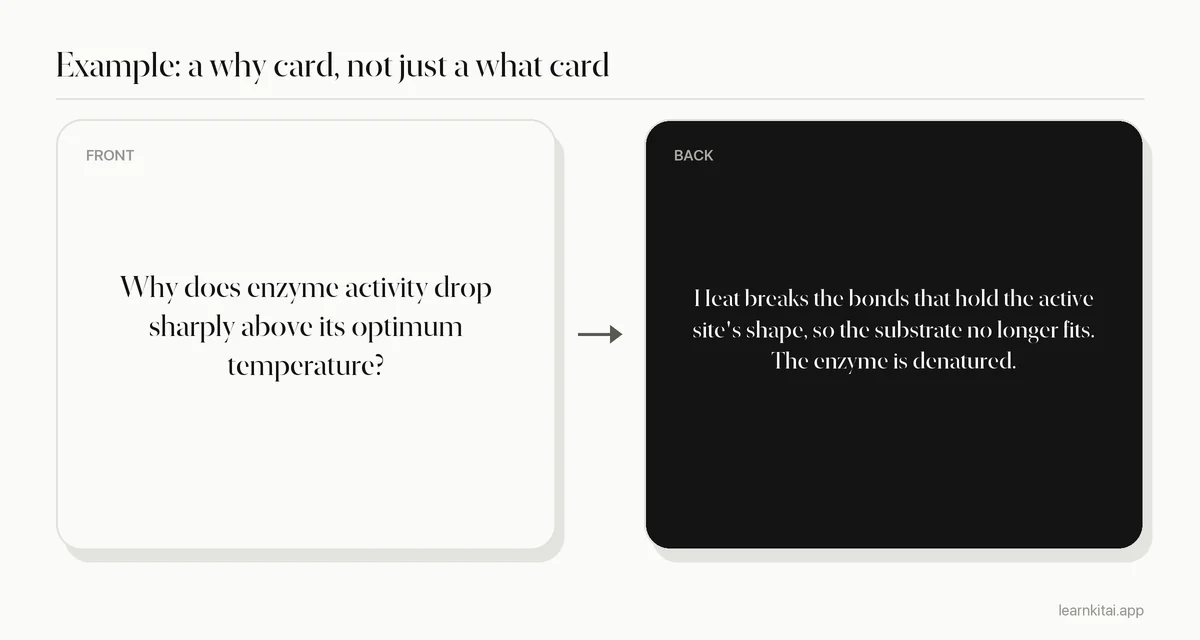
Learn the word roots, not just the words. A few dozen Greek and Latin parts unlock hundreds of terms. Then make short flashcards with one term per card, and always attach the term to the process it belongs to.
Biology names are often descriptions in disguise. Glyco- means sugar and -lysis means splitting, so glycolysis is sugar splitting. Hypo- means under and hyper- means over, so hypotonic and hypertonic describe less and more solute. Endo- means inside, exo- outside, -cyte cell. Once you know thirty or forty roots like these, new terms stop looking like random strings.
- Keep a running root list at the back of your notebook, adding each new prefix or suffix you meet.
- When you meet a new term, first try to decode it from roots, then check.
- Make one card per term, with a short definition and the process it belongs to.
- Review cards daily in small batches rather than all at once on Sunday.
Short, one-idea cards are easier to recall and easier to fix. Our guide to making effective flashcards explains why. Biology also has a lot of structure you need to see, which is where image flashcards for anatomy help.
How do you understand biological processes instead of memorizing them?
Turn each process into a story with a trigger, a sequence of steps, a result and a reason. Then ask what would happen if one step failed. If you can answer that, you understand it well enough for exam questions that change a condition.
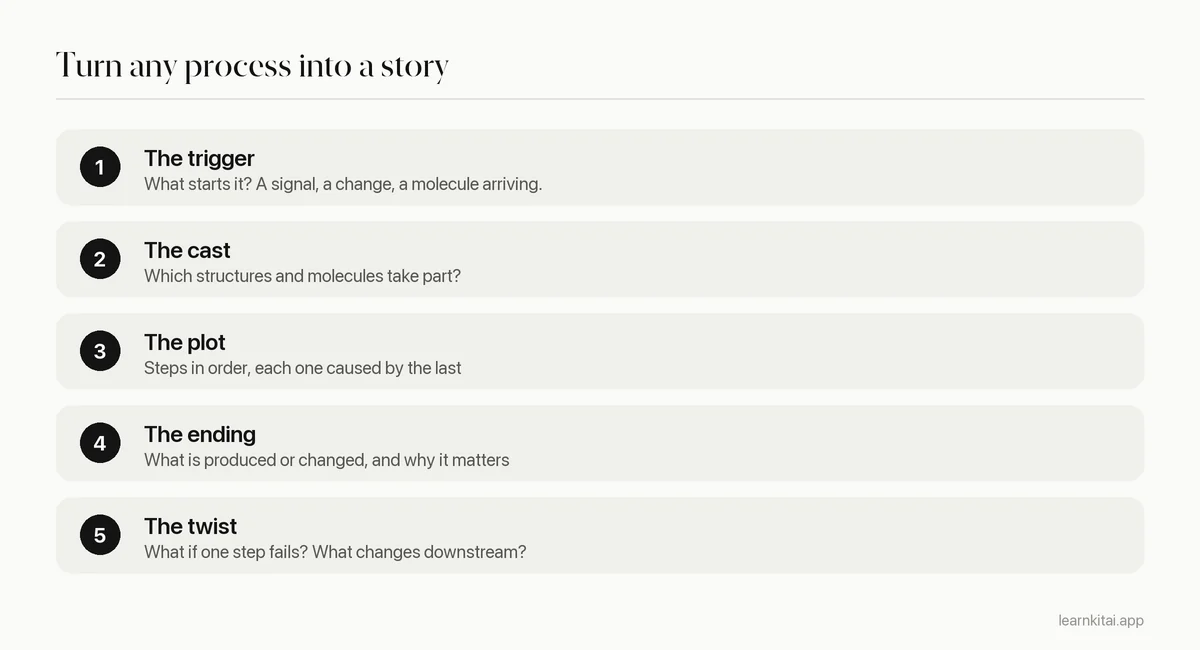
Try it with blood sugar control. Trigger: blood glucose rises after a meal. Cast: pancreatic beta cells, insulin, liver and muscle cells. Plot: beta cells release insulin, insulin signals cells to take up glucose, the liver stores glucose as glycogen. Ending: blood glucose falls back to normal. Twist: if cells stop responding to insulin, glucose stays high. That last step is exactly the kind of question exams ask, and it is the heart of elaborative interrogation: asking why and what if until the logic is clear.
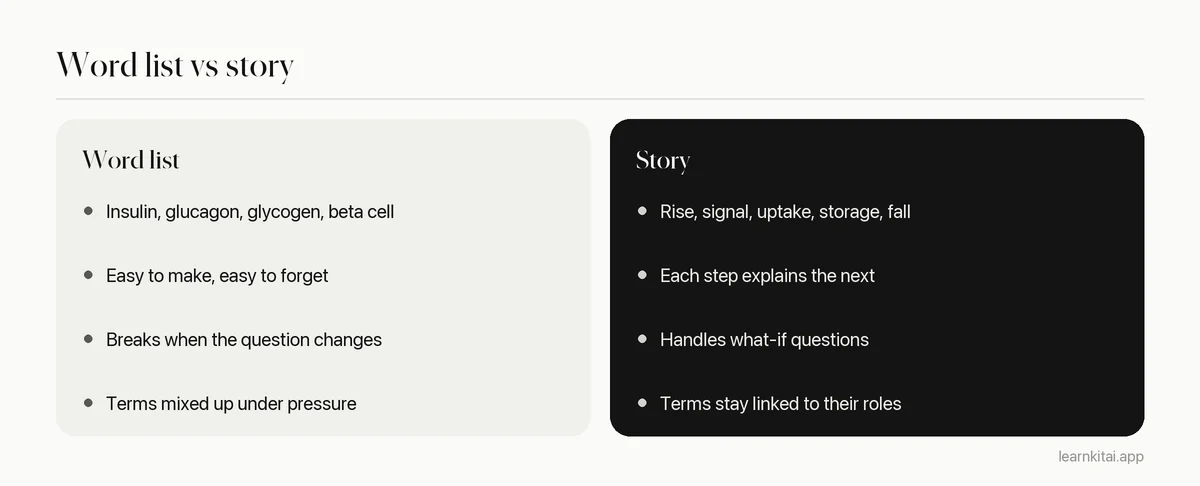
Draw the story too. A quick flowchart or labeled sketch, done from memory, gives you a second route back to the idea. Pairing words with images like this is called dual coding, and biology is full of chances to use it.
What is the best way to memorize biology?
Test yourself instead of rereading, and space the tests out. Close the book and write or say everything you remember, then check. Repeating this over several days builds much stronger memories than reading the chapter again.
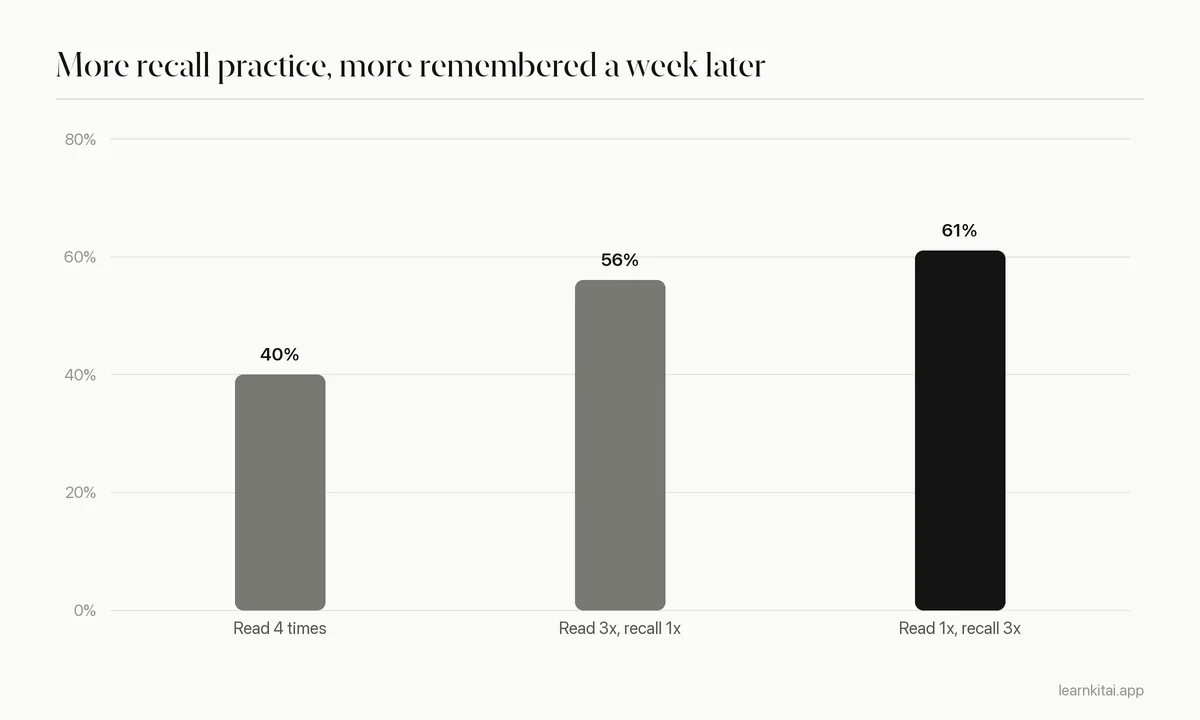
In one well-known experiment, students who read a passage once and then practiced recalling it three times remembered far more a week later than students who reread it four times. The more recall tests students took, the more they kept, even though the rereaders felt more confident.
Recall even beats building concept maps with the book open, a favorite biology study method. In a study of about 200 students reading science texts, the group that practiced recall showed about 50 percent better retention a week later than the concept-mapping group. Concept maps are still useful, but draw them from memory, not from the page. To decide when to review, see spaced repetition.
How to study biology topic by topic
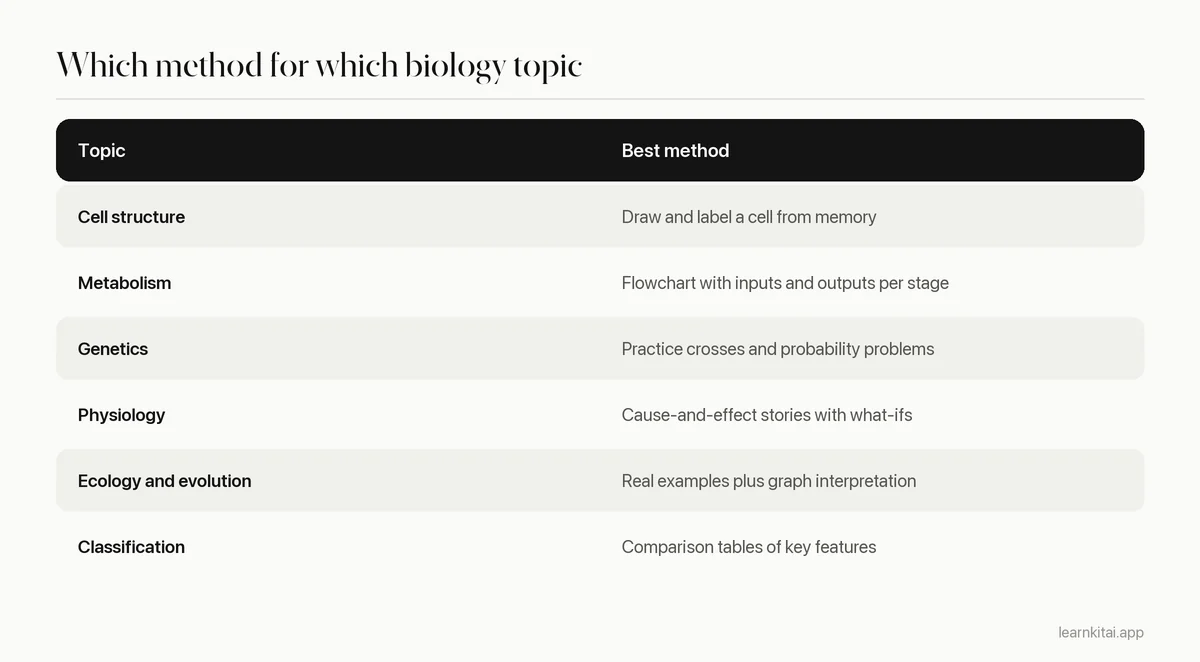
Genetics is the odd one out. It behaves more like math or chemistry, with problems you have to solve rather than explain. Treat it that way: worked example, then mixed problems with the book closed. Our chemistry guide covers that style of practice, and how to study anatomy goes deeper on the spatial side of biology.
How do you answer biology exam questions well?
Read the command word first. Describe asks what happens, explain asks why, compare asks for both similarities and differences, and evaluate asks for a judgment with evidence. Match your answer to the word and use correct terms in full sentences.
- Describe: state the pattern or steps. For a graph, give the trend and quote numbers with units.
- Explain: give the reason, usually with "because" or "this causes." One cause, one effect, per sentence.
- Compare: use paired sentences: "Mitosis produces two identical cells, while meiosis produces four varied cells."
- Evaluate: weigh strengths and limits, then make a judgment you can defend.
Practicing written answers is where many students fall short, because flashcards train short recall, not full explanations. Open questions with sample answers fill that gap. LearnKit can turn your biology notes or a photo of a textbook page into open questions, so you write an answer first and compare it with a model one.
Biology rewards students who see the connections, and that is the real answer to how to study biology. Decode the words, tell the stories, draw them from memory, and test yourself across days. The vocabulary that once felt endless becomes the cast of a few dozen stories you know well.
Frequently asked questions
How long does it take to learn a biology chapter?
It depends on the chapter and your level, but plan for more than one sitting. A first session to understand and draw the main processes, then two or three short recall sessions over the next week, usually works better than one long day.
Should I rewrite my biology notes?
Rewriting by copying is mostly passive. If you rewrite, do it from memory and then check, which turns note-making into recall practice. A one-page summary per topic written this way is far more useful than neat copies.
Is biology mostly memorization?
There is a lot to remember, but exams increasingly test understanding: explaining processes, interpreting data and predicting outcomes. Memorizing terms is the starting point, not the finish line.
How do I study biology diagrams?
Cover the labels and name each part from memory, then redraw the whole diagram on a blank page. Add one line per structure about what it does. Repeat a few days later until you can draw it without checking.
Sources
- Test-enhanced learning: Taking memory tests improves long-term retention, Roediger and Karpicke, Psychological Science, 2006 (Experiment 2 one-week recall: 40% (study four times), 56% (one test), 61% (three tests).)
- Learning science: Actively recalling information from memory beats elaborate study methods, ScienceDaily (Purdue University) (Karpicke and Blunt, about 200 students: retrieval practice gave about 50% better retention after a week than concept mapping.)
Keep reading

How to Study Science: Think Like the Exam, Not the Textbook
Science asks for four kinds of knowledge at once: terms, mechanisms, problem skills and data. Here is how to study each one, and how they fit together.

How to Study Anatomy: Learn the Map Before the Streets
Anatomy feels like thousands of names. Learn the layout first, decode the Latin, and test yourself with images, and it starts to fit together.
How to Study Chemistry: See It, Draw It, Write It
Chemistry asks you to think on three levels at once. Here is a routine that trains all three, plus a practice plan for problems.

Elaborative Interrogation: Ask Why to Make Facts Stick
A single question, why is this true, can turn a loose fact into one you remember. How to use elaborative interrogation, with prompts for every subject.

How to Make Flashcards That Still Work Three Weeks Later
Most flashcards fail before you ever study them, because of how they are written. Seven rules, real before and after cards, and a study routine that keeps them working.