GCSE Revision: A Month-by-Month Plan for Summer 2027
Start light GCSE revision in autumn with weekly flashcard reviews of each topic you finish in class. Use mocks in winter to find weak spots, run a full subject rotation with past papers from March, and in the exam period revise for each paper in the days before it. Test yourself rather than rereading notes.
If you are in Year 11, your GCSE exams begin on Monday 10 May 2027 and the last paper on the common timetable is on Friday 18 June 2027, according to the JCQ key dates. That might feel far away. It is not, once you count nine or ten subjects. Good GCSE revision is less about how many hours you put in at Easter and more about what you do in the months before.
This guide gives you a month-by-month plan, a weekly rotation for many subjects, and the techniques that make each hour count. Always check your own exam board timetable and your school's candidate timetable for individual paper dates.
When should you start GCSE revision?
Start light revision in the autumn of Year 11. A short weekly review of topics you have already covered in class is enough at first. Build up to full past papers from around March, when most of the course content is finished.
The reason to start early is spacing. In a large study of more than 1,350 learners, Cepeda and colleagues found that the best gap between study sessions depends on how far away the test is. For a test a year away, the ideal gap was about 5 to 10 percent of that time, which means revisiting topics every few weeks. Revising a topic once in October, again in January and again in April beats three sessions crammed into May.
GCSE revision month by month
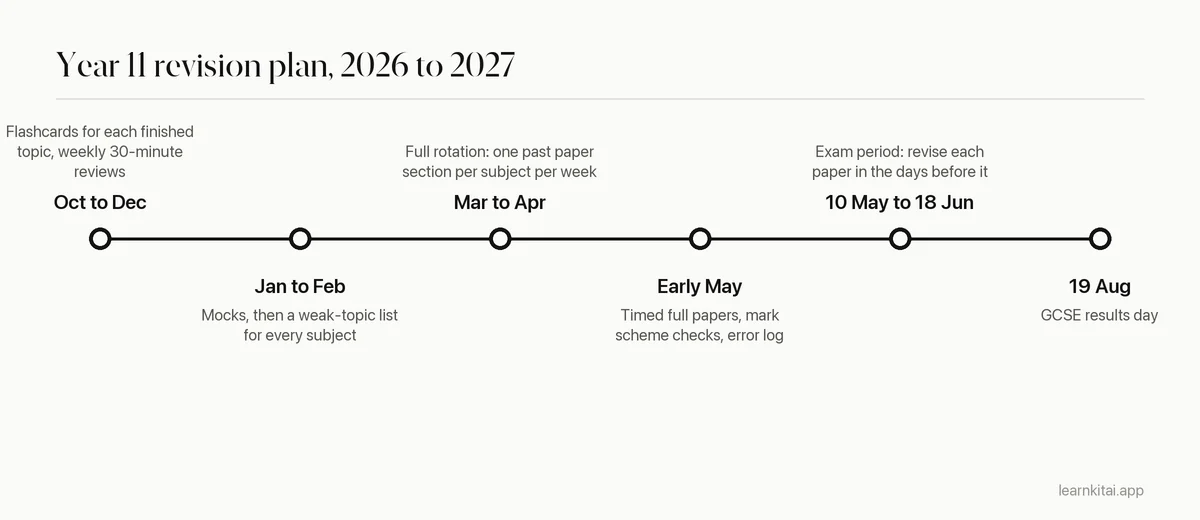
October to December: build as you go
Every time you finish a topic in class, make a small set of flashcards for it: key terms, formulas, quotations, dates. Once a week, spend 30 minutes reviewing cards from every subject. This feels too easy to matter. It is some of the most valuable revision you can do, because it means you never have to relearn a topic from scratch. Our guide on how to make flashcards shows how to keep them short.
January to February: use your mocks
Mock exams are not just practice. They are a free diagnosis. When the marked papers come back, list every topic where you dropped marks in each subject. Sort the misses: did you not know it, misread the question, or run out of time? Our guide on how to review a graded exam gives you a 30-minute routine for this.
March to April: the full rotation
Now most content is taught, and revision becomes your main homework. Rotate subjects so each one gets at least two sessions a week, and do past paper questions every week. Exam boards publish past papers and mark schemes on their websites. Mark your answers with the mark scheme, not by feel. Mark schemes show you exactly what examiners reward, which is often more specific than you expect.
How do you make a GCSE revision timetable for nine subjects?
Rotate them. Give each subject two or three sessions a week, put two or three different subjects on each day, and give extra sessions to the subjects where your mock grades were weakest. Keep one evening free.
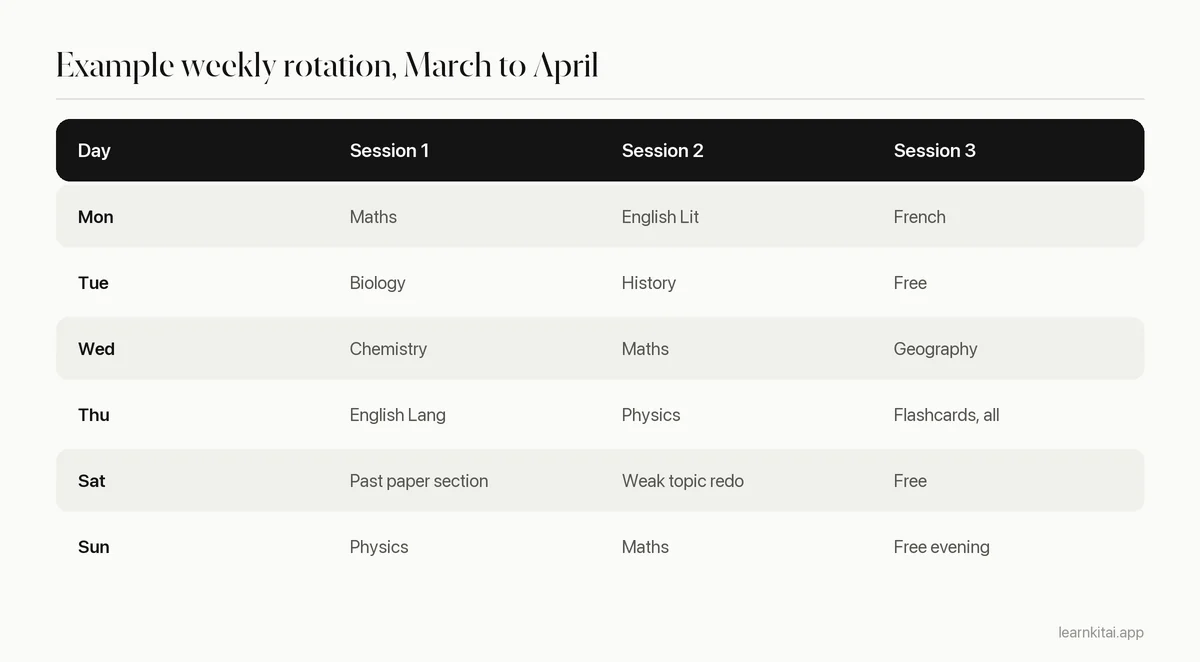
Each session is 30 to 45 minutes. Maths appears three times because it is two or three papers and was this student's weakest mock. Friday is off on purpose. A plan you can keep for eight weeks beats a heroic one that collapses after two. For a general method, see how to build a study schedule.
What are the best GCSE revision techniques?
Self-testing and spacing. Use flashcards, past paper questions and blank-page recall. Avoid spending most of your time rereading or highlighting, which research rates as low value. Check every answer against a mark scheme.
A major review of study methods by Dunlosky and colleagues rated practice testing and spreading study over time as the most useful techniques. Rereading, highlighting and summarizing were rated low. For GCSEs, that translates into a simple loop.
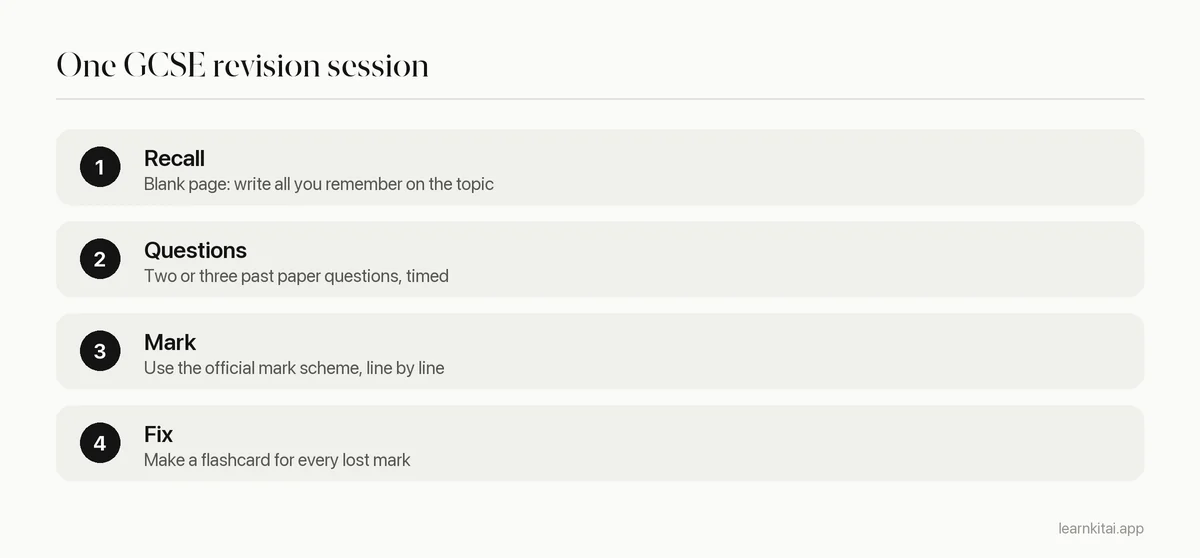
The blank-page step is called the blurting method, and it is fast: five minutes tells you what you really know. If making cards takes too long, you can generate them. LearnKit turns a photo of a textbook page, a revision guide PDF or your class notes into flashcards you can review on your phone.
What grade do you need, and what does it mean?
GCSEs are graded 9 to 1, with 9 the highest. The bottom of a grade 4 lines up with the bottom of the old grade C, and the bottom of a grade 7 lines up with the bottom of the old grade A.
According to Ofqual, where employers or colleges used to ask for at least a C, the equivalent is now at least a 4. Check the grades your sixth form or college needs for the courses you want, and use that to decide which subjects get extra time. A subject where you sit just below a needed grade is usually the best place to invest.
How should you revise during the exam period?
Revise paper by paper. In the two or three days before each exam, focus on that paper's topics with past questions, flashcards and your error log. Keep the evening before light and get a full night of sleep.
Once exams begin, revise paper by paper. In the two or three days before each paper, focus on that paper's topics: past questions, flashcards, and your error log. The evening before, do a light review and sleep. Do not stay up late. If anxiety is a problem, our test anxiety guide has techniques that work on the day.
Common GCSE revision mistakes
- Making beautiful notes. Copying out the revision guide in colored pens takes hours and tests nothing.
- Only revising favorite subjects. Your weakest subject usually has the most marks to gain.
- Skipping the mark scheme. Without it, you cannot tell a full-mark answer from a half-mark one.
- Leaving past papers until May. Start them in March so you have time to fix what they reveal.
GCSEs are many exams in a row, so the planning lessons from our finals guide apply here too: rank subjects by risk, test yourself, and protect sleep.
Frequently asked questions
How many hours a day should I revise for GCSEs?
In autumn, 30 minutes a few times a week is enough. From March, one and a half to three hours on school days and a bit more at weekends works for most students. Focus on finished sessions, not hours.
Is it too late to start revising in April?
No, but you need to prioritize. Use mock results to pick weak topics, do past paper questions every day, and focus on subjects where a small gain changes your grade.
Should I use revision guides or my class notes?
Either works as a source. What matters is turning them into questions. Use guides or notes to make flashcards and to check answers, not just to reread.
How do I revise for English Literature quotations?
Pick a small set of short, flexible quotations for each text and character, put them on flashcards with the theme they support, and practice using them in timed paragraphs.
Sources
- Key dates in the examination cycle, June 2027 examination series, Joint Council for Qualifications (JCQ) (First exam 10 May 2027, final GCSE exam 18 June 2027, contingency day 23 June 2027, GCSE results 19 August 2027.)
- GCSE 9 to 1 grades: a brief guide for parents, Ofqual (Bottom of grade 4 comparable to bottom of old C; bottom of grade 7 comparable to bottom of old A.)
- Spacing Effects in Learning: A Temporal Ridgeline of Optimal Retention, Psychological Science (Cepeda et al., 2008) (Optimal gap about 5 to 10 percent of a one-year test delay.)
- Which Study Strategies Make the Grade?, Association for Psychological Science (Practice testing and distributed practice rated high utility.)
Keep reading
How to Study for Finals: A 3-Week Plan That Holds Up
Finals reward the student who starts with a plan, not the one who studies longest. Here is a three-week system for triage, testing and sleep.
The Study Schedule That Works Backward From Exam Day
Most study plans fail because they start from today. Start from the exam date instead, count your real hours, and space every topic at least three times.
Test Anxiety: How to Steady Your Mind Before the Exam
Nerves before a test are normal. When they start to crowd out what you know, a few research-backed moves can give your memory room to work again.
The Blurting Method: Empty Your Head to Fill It
Write down everything you remember, then check what is missing. A simple revision method with a step-by-step routine, a worked example and four variations.
How to Make Flashcards That Still Work Three Weeks Later
Most flashcards fail before you ever study them, because of how they are written. Seven rules, real before and after cards, and a study routine that keeps them working.