Turn Notes Into Flashcards in 20 Minutes After Class
To turn notes into flashcards, go through your notes the same day, mark every definition, process, example and comparison, and rewrite each as a question with one short answer. Fill gaps before you write cards, keep one fact per card, add a few why questions, and test yourself once before you close the notebook.
Lecture notes have a quiet problem: they feel like studying, but reading them back is mostly recognition. You nod along, everything looks familiar, and the exam still surprises you. The fix is to turn notes into flashcards, so the same material asks you questions instead of just sitting there. This guide gives you a 20-minute routine to do it after each class, a table of which note types become which cards, and the mistakes that waste the effort.
Why bother turning notes into questions?
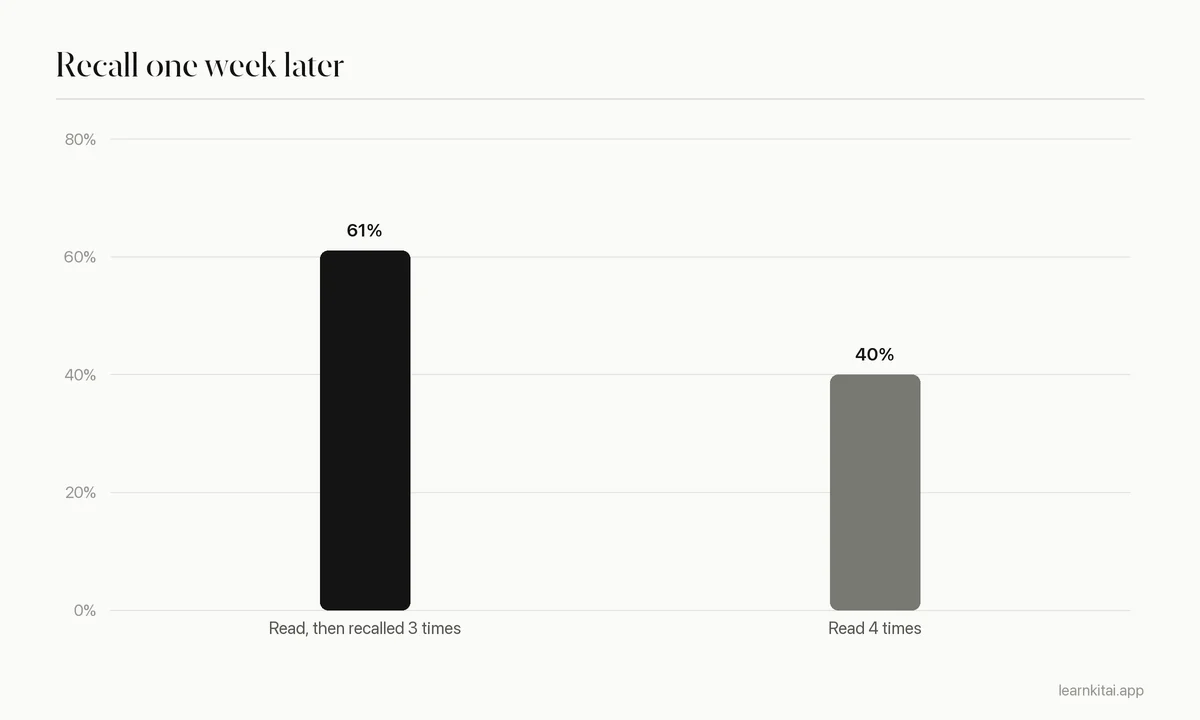
Because answering questions builds memory far better than rereading. In a classic study, students who practiced recalling a passage remembered 61% of it a week later, while students who only reread it remembered 40%, even though they had read it four times as often.
That result comes from Roediger and Karpicke's 2006 experiments on test-enhanced learning. The repeated-study group read the passage about 14 times in total. The repeated-testing group read it only about 3 times, but spent the rest of the session trying to recall it. Rereading won on a test five minutes later. A week later, testing won by a wide margin. Your lecture notes work the same way: rereading gives you a short-term glow, recall gives you something that lasts. The background is in why rereading does not work.
Another study points the same way. In Karpicke and Blunt's 2011 work with 200 students, the group that practiced retrieval retained about 50% more a week later than a group that built concept maps with the text open. Making cards is useful, but answering them is where the learning happens.
When should you make the cards?
The same day as the lecture, ideally within a few hours. Your memory of what the professor meant is still fresh, so you can fix gaps and unclear shorthand. Wait a week and half your abbreviations will look like code you cannot read.
Batching all your cards before an exam sounds efficient, but it means you start reviewing late and you write cards from notes you no longer understand. A short session after each class spreads the work out and gives spaced repetition time to do its job.
The 20-minute routine to turn notes into flashcards
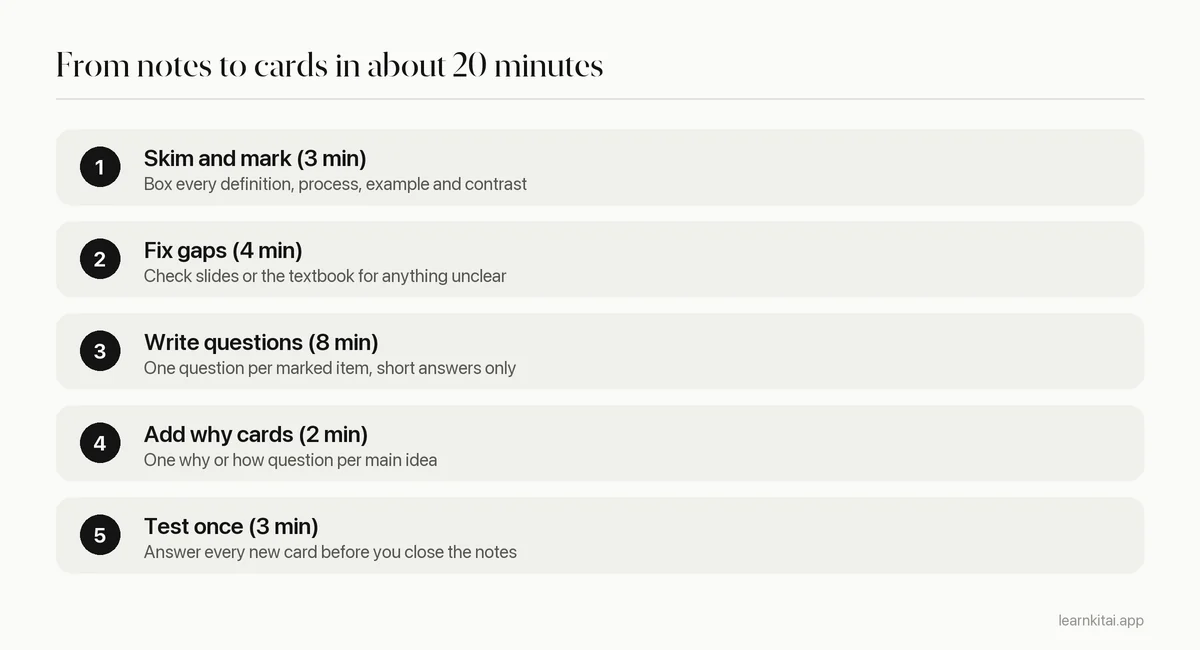
If you take notes in the Cornell format, step three is already half done. The left cue column is meant for questions, so you can lift them straight onto cards. See Cornell notes if you want to set your notebook up that way.
Which parts of your notes make good flashcards?
Definitions, steps in a process, named examples, comparisons, formulas and labeled diagrams all convert well. Long explanations and stories do not convert directly; pull the key claims out of them first, then write one card per claim.
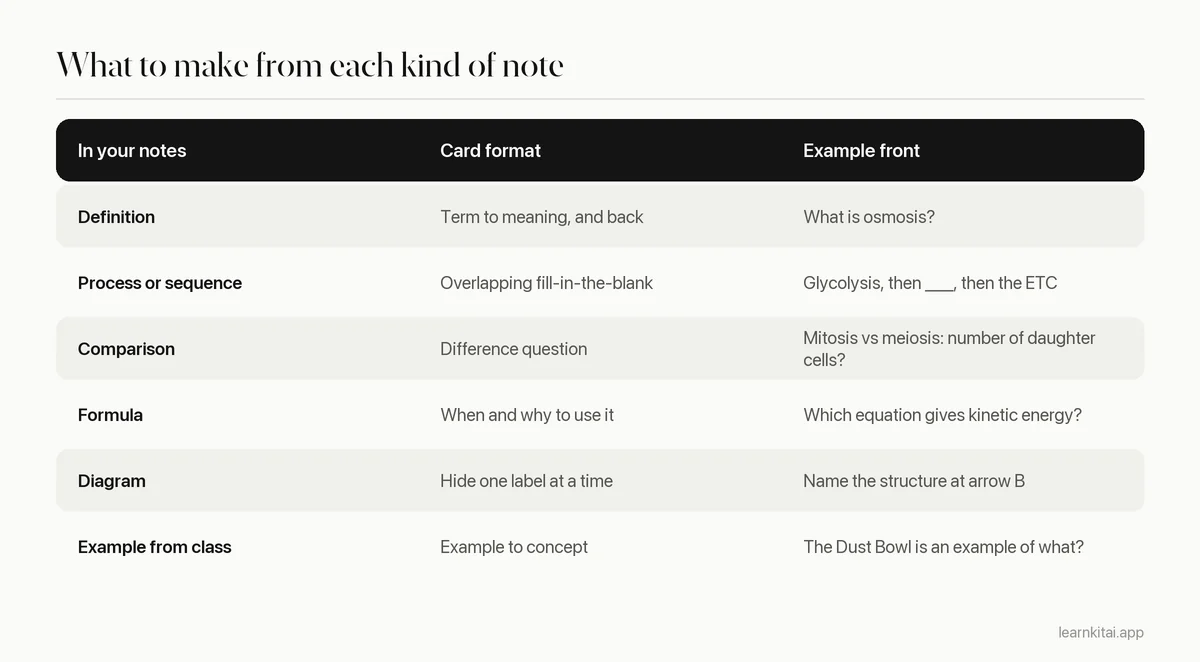
Keep each card to one fact. If the back of a card has a list, split it. The reasoning, and a worked example, are in the minimum information principle. For diagram-heavy subjects, the method in anatomy flashcards works for any labeled figure.
What if your notes are messy or incomplete?
Fix the notes before you write cards. Fill gaps from the slides or textbook, rewrite shorthand in plain words, and mark anything you still do not understand as a question for your professor. A card built on a misunderstanding just helps you memorize the mistake.
Here is a real-looking example. Your notes say: light dep rxns, thylakoid, ATP + NADPH, water split. That is four facts in shorthand. After a quick check of the slides, you write four cards. One of them looks like this:
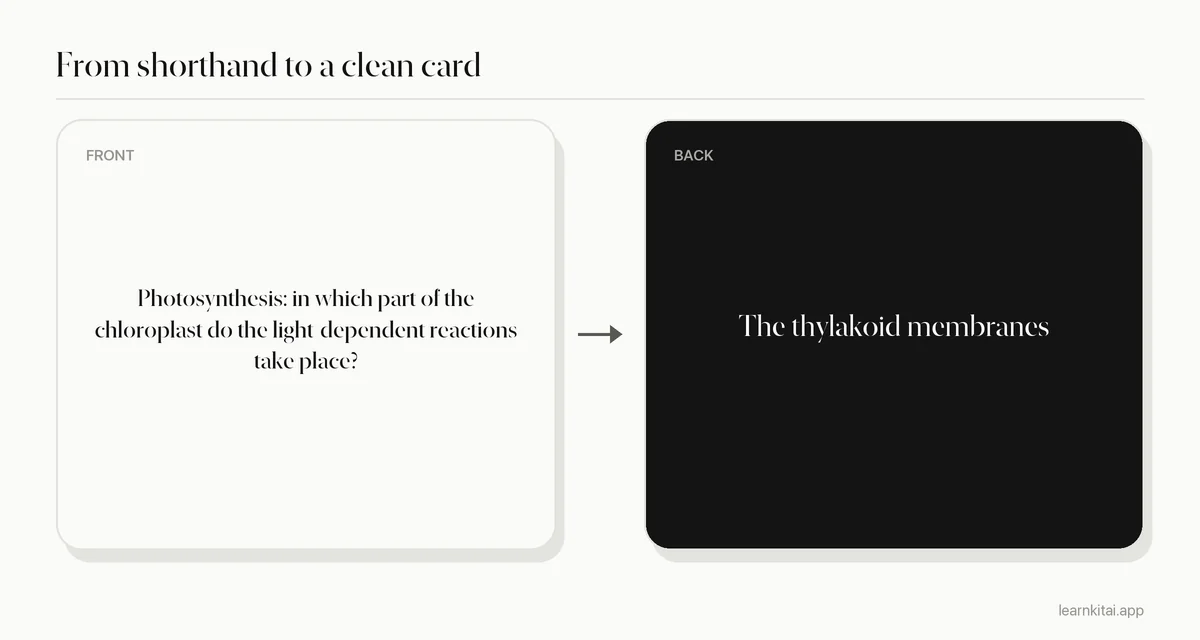
The other three ask what the reactions produce, which molecule is split, and why splitting water matters for the plant. Notice that each front names the topic, so the card still makes sense when it shows up alone in three weeks.
Can AI turn your notes into flashcards for you?
Yes, and it saves most of the typing. Paste typed notes, upload a PDF of the slides or snap a photo of a handwritten page, and an AI tool will draft question and answer cards. You still need to read each card, delete trivia and split anything that asks for two facts.
AI is good at the mechanical part of the routine and weak at judging what your professor emphasized. A practical split is to let the tool draft the cards, then spend your saved time on step five, the self-test. LearnKit accepts notes, PDFs, photos of pages and lecture recordings, and turns them into flashcards or a short quiz in one step.
How should you review the cards after you make them?
Answer every new card once on the day you make it, again the next day, and then let the gaps grow to a few days, a week and longer. Keep all lectures for one course in a single deck so old topics keep coming back while you add new ones.
Making cards is the setup. The payoff comes from short, spaced reviews over the rest of the term. A scheduler in a flashcard app handles the timing for you; with paper cards, a simple box system does the same job, as explained in the Leitner system. Two habits matter most. First, answer out loud or in writing before you flip, so you cannot fool yourself. Second, when you miss a card, look at why. A wrong answer often points to a gap in the notes themselves, which is the best moment to fix them.
- Day of the lecture: make the cards and answer each one once.
- Next day: a quick pass through the new cards, five minutes at most.
- Later in the week: the scheduler mixes them with older lectures.
- Before the exam: you are reviewing, not learning for the first time.
Students who turn notes into flashcards every week often find that exam prep shrinks to a few focused sessions, because most of the material has already been tested many times. Students who wait until the last week end up writing cards and learning them at the same time, which is the most stressful way to do both.
Mistakes that waste the effort
- Copying whole sentences from your notes onto the back of a card.
- Writing cards for every line, including things you already know cold.
- Making cards and never testing yourself on them until exam week.
- Skipping the why cards, so you can recite facts but not explain them.
- Keeping cards in separate decks per lecture, which stops reviews from mixing topics.
Once the routine becomes a habit, notes stop being a pile you dread rereading and become a question bank that grows each week. If you prefer quick quizzes to cards, the same ideas apply in how to quiz yourself from notes, and the full rules for card writing live in how to make effective flashcards.
Frequently asked questions
How many flashcards should one lecture produce?
It varies with the subject, but a dense science lecture often yields far more cards than a discussion-based seminar. Instead of aiming for a number, card what you would be upset to forget on the exam. If you are producing so many that reviews pile up, raise the bar for what earns a card.
Should I handwrite my notes or type them if I plan to make flashcards?
Either works. Handwriting tends to make you summarize as you go, which helps understanding. Typed notes are faster to paste into a flashcard tool. Pick the method that keeps you paying attention in class.
Is making the flashcards itself a form of studying?
A little, because you have to process and reword the material. But most of the benefit comes from answering the cards later, spread over days and weeks. Do not treat a finished deck as finished studying.
What should I do with slides that are just bullet points?
Treat each bullet as a prompt to ask what it means. Look up anything you cannot explain, then write a question whose answer is the idea behind the bullet, not the bullet text itself.
Sources
- Test-Enhanced Learning: Taking Memory Tests Improves Long-Term Retention, Psychological Science (Roediger and Karpicke, 2006) (Experiment 2: 61% recall after one week with repeated testing vs 40% with repeated study; passage read about 3.4 vs 14.2 times.)
- Learning science: Actively recalling information from memory beats elaborate study methods, ScienceDaily (Purdue University release on Karpicke and Blunt, Science, 2011) (200 students; retrieval practice group showed about 50% better retention a week later than concept mapping.)
Keep reading
How to Make Flashcards That Still Work Three Weeks Later
Most flashcards fail before you ever study them, because of how they are written. Seven rules, real before and after cards, and a study routine that keeps them working.
Minimum Information Principle: Small Cards, Big Recall
One flashcard, one fact. Here is why splitting fat cards into tiny ones makes reviews faster and memories stronger, with worked examples.
Cornell Notes: The Page That Quizzes You Back
A Cornell page is not just a neat layout. Its left column turns your notes into a built-in self-test you can run in ten minutes.
Quiz Yourself From Your Notes in 15 Minutes a Day
Your notes already contain the questions. Here is how to pull them out, five ways to test yourself, and a short daily routine that keeps old topics alive.
Flashcards From PDF: Turn a Chapter Into 30 Good Cards
A PDF chapter can become a focused deck in under an hour, by hand or with AI. Where to look for card material, how to handle scanned files, and how to check the result.