How to Study Anatomy: Learn the Map Before the Streets
Study anatomy from the outside in: learn the regions and big landmarks first, then the structures inside each one. Decode Latin roots so names explain themselves, learn muscles with a fixed four-fact template, and test yourself daily on blank diagrams and flashcards, spacing reviews across weeks rather than rereading the atlas.
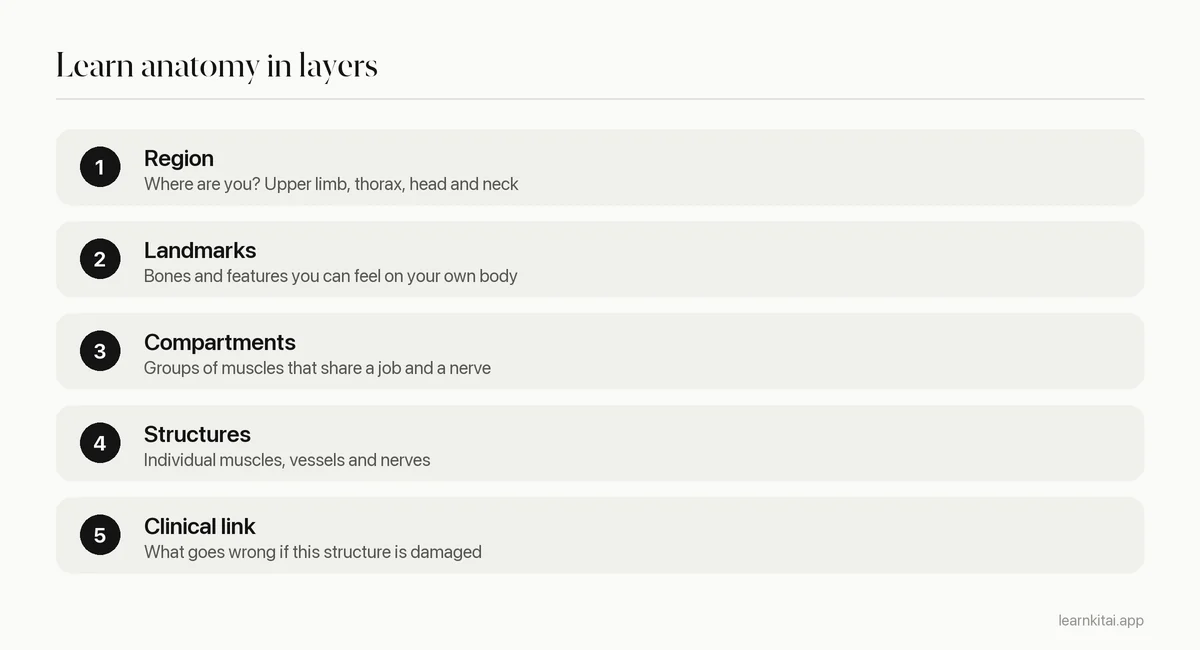
Anatomy is often the first course where the sheer number of names feels impossible. Every muscle has an origin, an insertion, a nerve and an action, and each bone has a dozen named bumps. Most students respond by rereading the atlas and hoping. A better plan for how to study anatomy is to treat it like learning a city: first the map, then the neighborhoods, then the streets.
This guide is for undergraduate, nursing, physical therapy and medical students. It covers how to build the map, how to make names explain themselves, a card template for muscles, and how to test yourself so the details hold until the practical exam. It is about study technique only, not clinical advice.
Why does anatomy feel so overwhelming?
Anatomy combines a huge vocabulary, three dimensional relationships and unfamiliar Latin and Greek names. Students often try to learn every detail at once and in isolation, so nothing has a place to attach. Building the big layout first gives later details somewhere to go.
The problem is rarely memory capacity. It is order. If you learn the branches of a nerve before you know which compartment of the arm it runs through, the branches are just words. Once you know the arm has a front compartment that flexes and a back compartment that extends, a lot of detail starts to predict itself.
How to study anatomy names without rote memorization
Learn the common Latin and Greek roots. Most anatomical names describe shape, position, size, number of heads or action, so once you know the roots, a name like flexor digitorum superficialis tells you what the muscle does and where it sits.
Anatomical names are descriptions, not random labels. Spend your first week learning about thirty roots and you will save hours later. Biceps brachii means two-headed muscle of the arm. Flexor digitorum superficialis means the shallow muscle that flexes the fingers. The name does half the memory work for you.
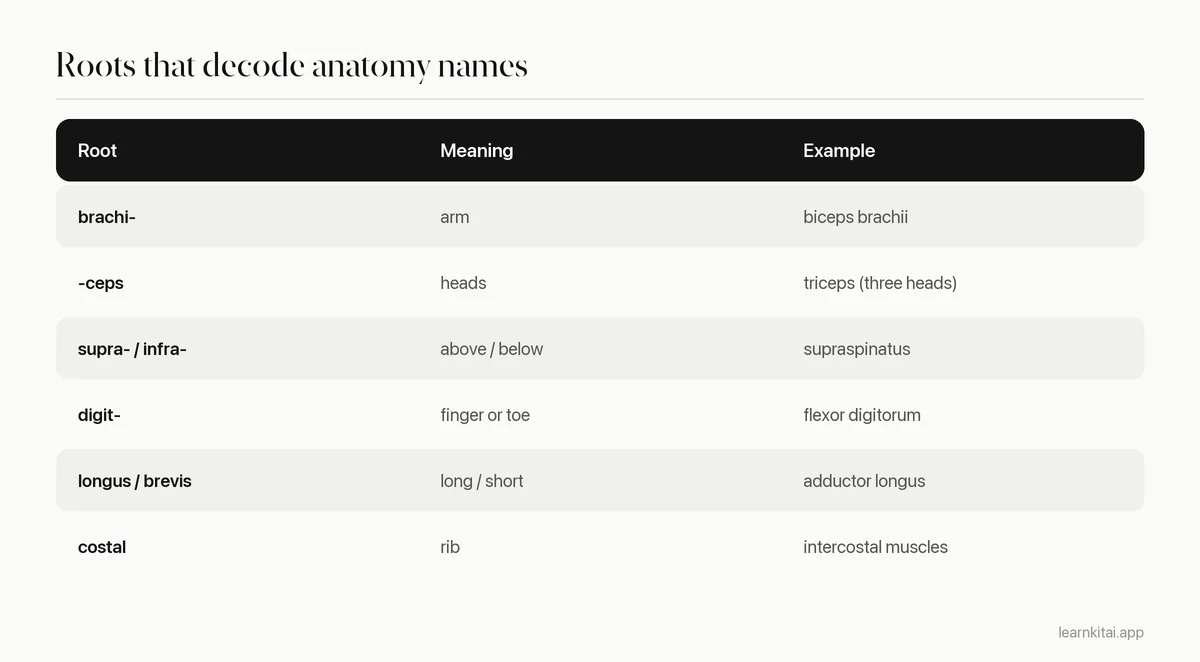
Make a running root list in the back of your notebook. Every time a new name confuses you, break it into parts and add any new root. After a few weeks the list stops growing, which is a nice sign of progress.
What is the best way to memorize muscles?
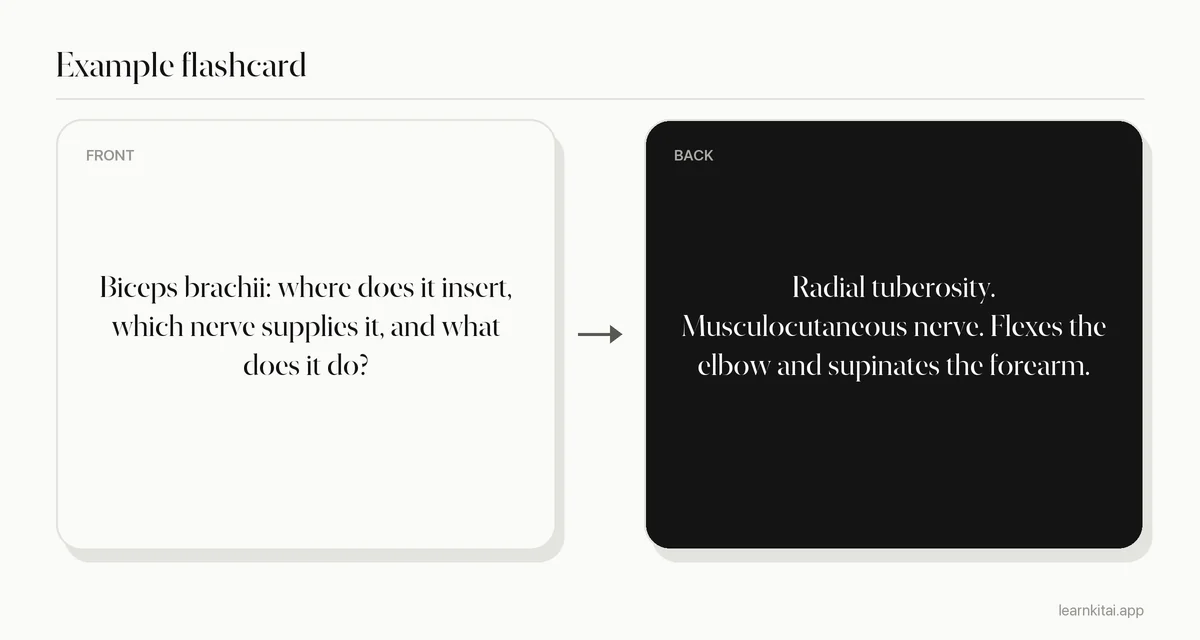
Use the same four facts for every muscle: origin, insertion, innervation and action. Learn the attachments first, then work out the action from where the muscle pulls, rather than memorizing the action as a separate fact.
A fixed template keeps cards consistent and makes gaps obvious. Write one card per fact rather than one card with all four, so you know which part you are missing. Then use logic to link them: a muscle that crosses the front of the elbow and attaches to the radius will flex the elbow, and if it attaches in a way that twists the radius, it will also supinate the forearm.
For structures where location is the point, such as foramina or branches of an artery, image cards work better than text. Cover a label on a diagram and ask yourself what it is. Our guide to anatomy flashcards shows how to set these up so each card hides one label at a time.
How much should you test yourself in anatomy?
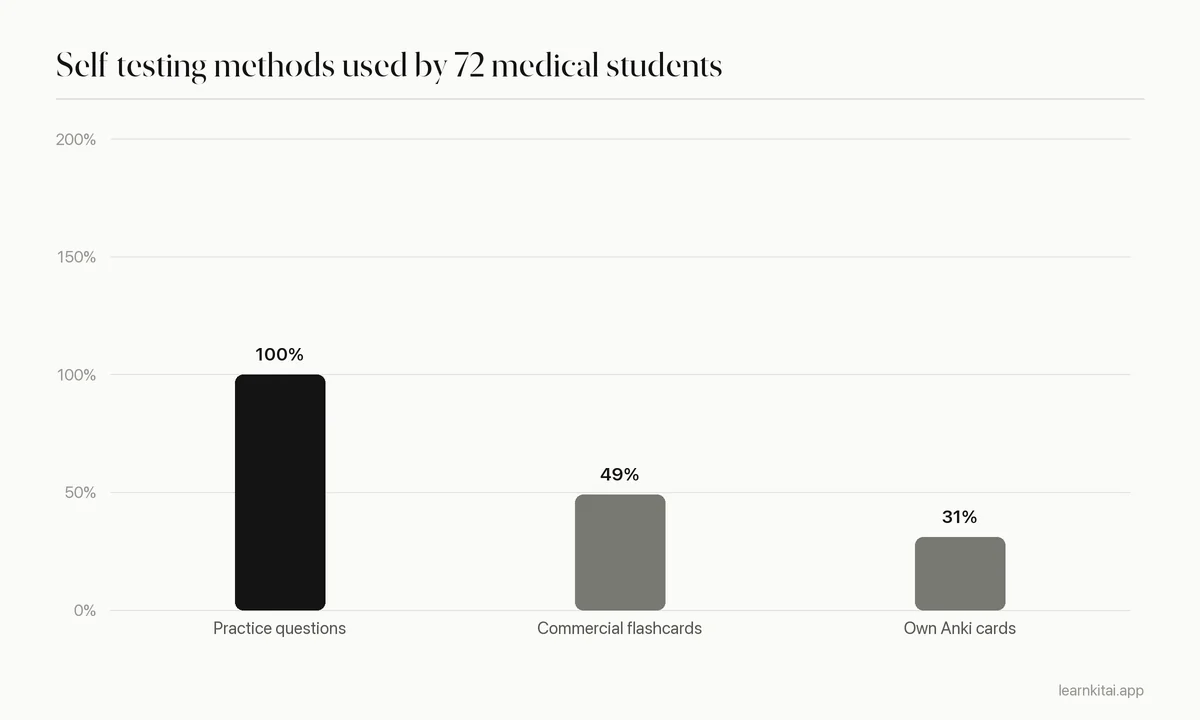
Most of your study time should be self-testing: labeling blank diagrams, answering flashcards and doing practice questions. In one medical school study, the number of practice questions and unique Anki cards students used each predicted higher licensing exam scores.
In a survey of 72 medical students at one school, every student used practice questions, about half used a commercial flashcard deck and 31 percent made their own cards in Anki. After controlling for prior grades and test anxiety, each extra 445 practice questions or 1,700 unique Anki cards was linked to about one more point on the licensing exam. The study is correlational, but it fits a large body of evidence on retrieval practice. You can read it in Perspectives on Medical Education.
Keep going after you get a card right. In an experiment on vocabulary pairs, students who kept retrieving items after their first correct answer recalled about 80 percent a week later, while those who dropped items after one success recalled about 35 percent, as Karpicke and colleagues describe. For anatomy, that means one correct label is not the finish line. See our pillar guide on active recall for the full method.
A weekly anatomy routine
Preview the region before the lecture, build cards the same day, label blank diagrams the next day, and finish the week with a mixed practice session that includes older regions. Short daily sessions beat a weekend marathon.
Knowing how to study anatomy is less about one clever trick and more about a rhythm you can keep. The routine below spreads each region over several short contacts, so you meet every structure four or five times in a week instead of once in a long session.
- Before lecture: ten minutes on the region map and the main bones.
- Same day: turn the lecture into cards, one fact per card, using the four-fact template.
- Next day: print or sketch a blank diagram and label it from memory, then check.
- Lab day: say each structure's name, nerve and action out loud as you find it.
- End of week: a mixed quiz across this week and earlier regions.
Keep daily card counts realistic so reviews do not pile up. Our guide on how many flashcards per day gives a simple way to set a number you can keep up for a whole term.
What are the most common anatomy study mistakes?
Rereading the atlas, learning details before the layout, writing huge cards with every fact on them, and studying regions once and never returning. Each one feels like work but leaves you blank in the practical.
- Coloring without testing. Coloring books help you notice structures, but you still need to label them blind.
- Learning only from one atlas view. Practicals rotate specimens. Look at each structure from at least two angles.
- Ignoring the nerve. Innervation patterns explain whole compartments, so learn them early.
- Skipping old regions. Mix in last month's region every week, or it fades before the final.
Anatomy rewards the same habits as other science courses, just at higher volume. For the broader approach, see our guide on how to study science, and our biology guide if you are taking both.
Frequently asked questions
How long does it take to learn anatomy?
It depends on the course depth, but expect it to take the whole term rather than a few cram weeks. Steady daily sessions build the layered map that makes later regions faster. Most students find the second half of the course easier once the roots and patterns are familiar.
Should I use an atlas or a textbook to study anatomy?
Use both for different jobs. The textbook explains relationships and function, and the atlas shows what structures look like. Learn from the textbook, then test yourself on atlas images with the labels covered.
Are 3D anatomy apps worth it?
They help with spatial relationships, especially in the head, neck and pelvis. Use them to explore, then turn what you see into labeling and recall practice. Watching a model rotate is still passive unless you quiz yourself on it.
How do I prepare for an anatomy practical exam?
Practice under similar conditions: timed stations, specimens or images you have not seen before, and pins on one structure at a time. Name the structure, then add one fact about it, such as its nerve or action.
Sources
- Student-directed retrieval practice is a predictor of medical licensing examination performance, Perspectives on Medical Education (Deng, Gluckstein and Larsen, 2015) (72 students; 100% used practice questions, 49% commercial flashcards, 31% Anki; each extra 445 questions or 1,700 unique Anki cards linked to about one more Step 1 point.)
- Metacognitive strategies in student learning: Do students practise retrieval when they study on their own?, Memory (Karpicke, Butler and Roediger, 2009) (Describes repeated retrieval leading to about 80% recall after one week versus 35% when items were dropped after one correct recall.)
Keep reading

How to Study Science: Think Like the Exam, Not the Textbook
Science asks for four kinds of knowledge at once: terms, mechanisms, problem skills and data. Here is how to study each one, and how they fit together.
Anatomy Flashcards: Hide the Label, Not the Picture
Anatomy exams ask you to name what you see. Image occlusion cards train exactly that, and one good diagram can feed a dozen of them.

How to Study Biology: Learn the Story, Not Just the Words
Biology looks like a mountain of vocabulary. It is really a set of cause-and-effect stories. Learn them as stories and the words follow.

Active Recall: Why Closing the Book Beats Rereading
Rereading feels productive but fades fast. Here is how to study by pulling answers out of memory, with a session plan, examples and the mistakes to avoid.
Pharmacology Study Tips: Learn Drug Classes, Not Drugs
Hundreds of drug names shrink to a few dozen classes once you learn stems, prototypes and the mechanism behind each side effect.

Learn Programming Concepts by Predicting Before You Run
Watching tutorials feels like learning to code. Predicting output, tracing variables and rewriting from memory is what actually builds the skill.