Study Literature by Asking Better Questions of the Text
To study literature well, read with a pencil and mark patterns and puzzles, then turn each observation into a question and a claim about meaning. Organize short quotes by theme, test yourself on them, and practice writing quick essay plans under time limits. Plot summary earns few marks; interpretation backed by evidence earns most.
Many students prepare for a literature exam by rereading the book and their notes. Then the question asks how the writer presents guilt, and a summary of the plot is all that comes out. To study literature for marks, you need a different kind of preparation: noticing how a text works, building arguments about it, and having the evidence ready to hand.
This guide works for high school English, AP Literature and university courses. It covers a reading method, a worked example of close reading, a theme grid for quotes, recall practice and a plan for the weeks before an exam.
What do literature exams actually test?
They test whether you can make an argument about a text and support it with close analysis of specific words, images and structure. Knowing the plot is assumed. Marks come from interpretation, evidence and how clearly you connect the two.
That changes what studying should look like. Rereading builds familiarity with what happens. It does little to help you explain why a writer made a choice. In one survey of 177 college students, 84 percent listed rereading as a study strategy, far more than any other method, according to Karpicke, Butler and Roediger. For literature, the time is better spent producing ideas and quotes from memory.
How should you read a novel or play for a course?
Read once for the story without stopping too much, then reread key passages with a pencil. Mark patterns, such as repeated words or images, and problems, such as moments that seem strange or contradictory. Those marks become your essay material.
The writing center at the University of North Carolina suggests looking for patterns and problems as you read: repeated images, words or events, and details that seem odd or unexplained. A simple margin code makes this fast. Use a P for a pattern, a question mark for a puzzle, a T for a theme and a C where a character changes. Keep it to a few marks per page, or nothing will stand out.
How to study literature through close reading
Pick a short passage, list what you notice about word choice, imagery and structure, group those notes into a pattern, ask what the pattern suggests, and state it as a claim you could defend. Four small steps turn a passage into an argument.
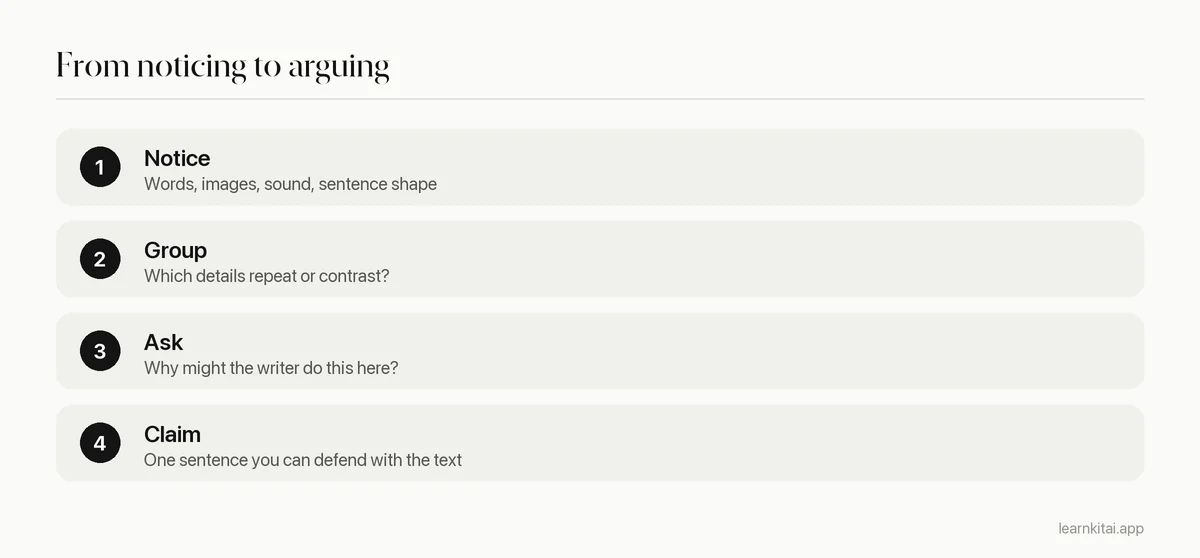
Here is the method on a famous opening. Charles Dickens begins A Tale of Two Cities with: It was the best of times, it was the worst of times. Notice: the sentence repeats the same frame, it was the, with opposites in each slot, and it keeps going for several more pairs. Group: the pattern is balanced contrast. Ask: why open a novel set in London and Paris during the French Revolution with paired opposites? Claim: Dickens signals from the first line that the book is built on doubles and divisions, two cities, two sides, and characters who mirror each other.
That claim is now something you can test as you read on, and it gives you a ready opening point for any essay on structure or theme.
How do you remember quotes for a literature exam?
Choose short quotes, often just a few words, and organize them by theme and character rather than by page. Then test yourself: give the theme and recall the quote, give the quote and explain its meaning. Short, well understood quotes are worth more than long ones half remembered.
Build a theme grid for each text. Each row is a theme; each cell holds a short quote and where it appears. Here is part of one for Macbeth.
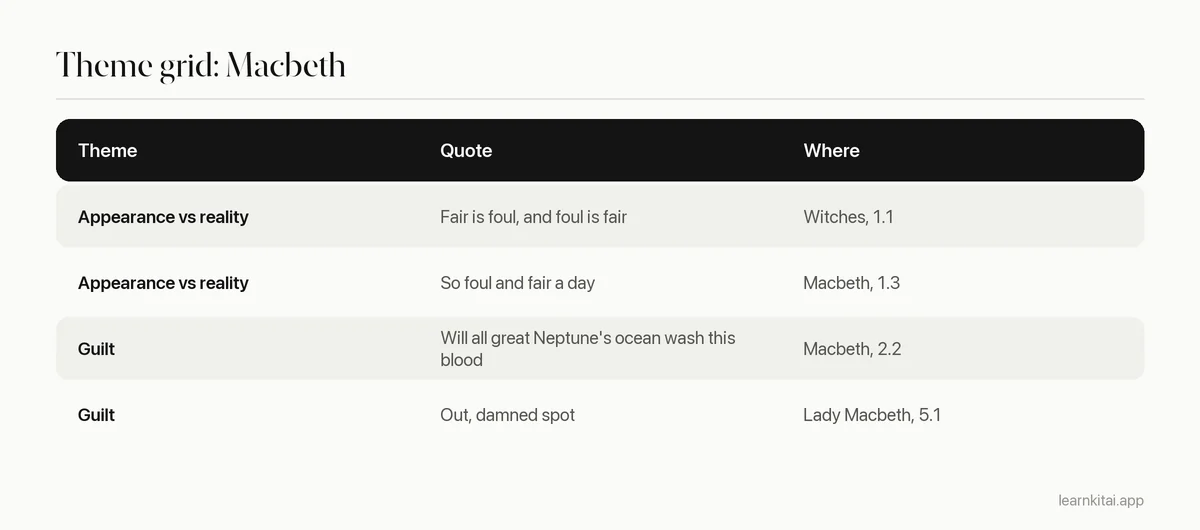
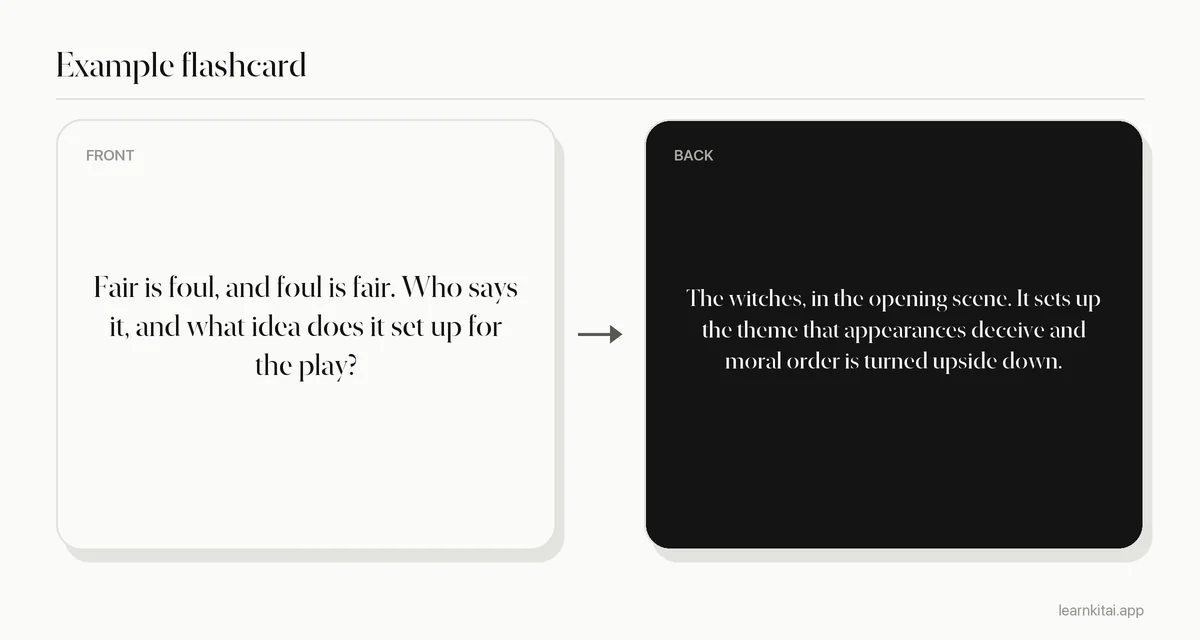
Notice the echo in the first two rows: Macbeth's first line repeats the witches' words before he has even met them. Links like that are exactly what examiners reward, and the grid helps you spot them. Turn each cell into a two-way card, and review with spaced repetition in the weeks before the exam.
How do you practice for a literature essay exam?
Write essay plans, not just full essays. In ten minutes, write a thesis, three points and a quote for each. Do several plans a week on different questions, and write a full timed essay occasionally to build stamina.
Plans let you rehearse the hardest part, deciding your argument and picking evidence, many times in the time one full essay takes. Gather past questions or predict likely questions from the themes your teacher stresses. Before you start a plan, try blurting: write everything you remember about the theme in two minutes, then check your grid for gaps.
- Thesis: one sentence that answers the question with a clear position.
- Point 1: the strongest evidence, with a short quote and one line of analysis.
- Point 2: a development or contrast, ideally from a different part of the text.
- Point 3: structure or form, such as how the ending changes the theme.
- Context: one line connecting to the period, if your course rewards it.
A study plan for the last four weeks
Spend the first two weeks building theme grids and cards, the third on essay plans across many questions, and the fourth on timed essays and quick quote reviews. Reread only passages you plan to use.
Many literature exams cover several texts, so rotate between them rather than finishing one before starting the next. A mix keeps every text fresh and helps you compare them, which some questions ask for directly. Our guide on essay exams covers timing and structure on the day, and the subject guides overview shows how the same recall habits apply across your other courses. If you study literature this way, the exam stops being a memory test and becomes a chance to argue.
Frequently asked questions
Do I need to read the whole book again before the exam?
Usually not. Reread key chapters, scenes and passages you plan to write about, and review your theme grids and cards. A full reread uses time you could spend practicing essay plans.
How many quotes should I memorize per text?
Aim for a focused set of short quotes that cover each major theme and character, rather than a long list. Several well chosen quotes per theme, each a few words long, is easier to recall and use flexibly than dozens of long passages.
Are study guides like SparkNotes useful?
They can help you check your understanding of the plot. They are weaker for analysis, and examiners recognize stock interpretations. Use them after reading, not instead of it, and build your own arguments from the text.
How do I study poetry differently from novels?
Poems are short, so you can analyze the whole text closely. Pay extra attention to sound, line breaks and form. Learn a few key lines from each poem and practice comparing two poems on a shared theme.
Sources
- Literature (Tips and Tools), The Writing Center, University of North Carolina at Chapel Hill (Advice to read closely for patterns and problems, build an evidence list and refine a thesis.)
- Metacognitive strategies in student learning: Do students practise retrieval when they study on their own?, Memory (Karpicke, Butler and Roediger, 2009) (Survey of 177 students: 83.6% listed rereading as a strategy, the most common by far.)
Keep reading
How to Study Science: Think Like the Exam, Not the Textbook
Science asks for four kinds of knowledge at once: terms, mechanisms, problem skills and data. Here is how to study each one, and how they fit together.
Essay Exam Prep: Write Your Answers Before You Sit Down
The best essay exam answers are mostly planned before the exam starts. Predict the prompts, build an evidence bank and rehearse outlines from memory.

Predict Exam Questions Like the Person Who Writes Them
Your instructor leaves clues everywhere: objectives, repeated examples, old papers. Learn to read them, write the likely questions and answer them first.
The Blurting Method: Empty Your Head to Fill It
Write down everything you remember, then check what is missing. A simple revision method with a step-by-step routine, a worked example and four variations.
Open Ended Questions: Study by Explaining, Not Spotting
Questions with no options to pick from force you to build the answer yourself. Here are 12 question stems, a marking method and a weekly routine.
Study Psychology Like a Scientist, Not a Glossary
Psychology exams test whether you can apply terms and read studies, not just define them. Use the field's own research to study it.