Open Book Exam Prep: Why the Book Will Not Save You
Prepare for an open book exam as if it were closed book: learn the core ideas well enough to explain them without notes. Then build a fast lookup system, such as tabs and a one or two page index of formulas, cases and page numbers, and practice applying ideas to new questions under a timer.
When students hear the words open book exam, many relax. If you can bring the textbook, why memorize anything? Then the exam starts, the first question asks you to apply three concepts to a case you have never seen, and you spend twelve minutes flipping pages. Open book exams are rarely easier. They just test something different.
This guide explains what these exams really measure, why light preparation backfires, and how to build notes that help you under time pressure.
Are open book exams easier?
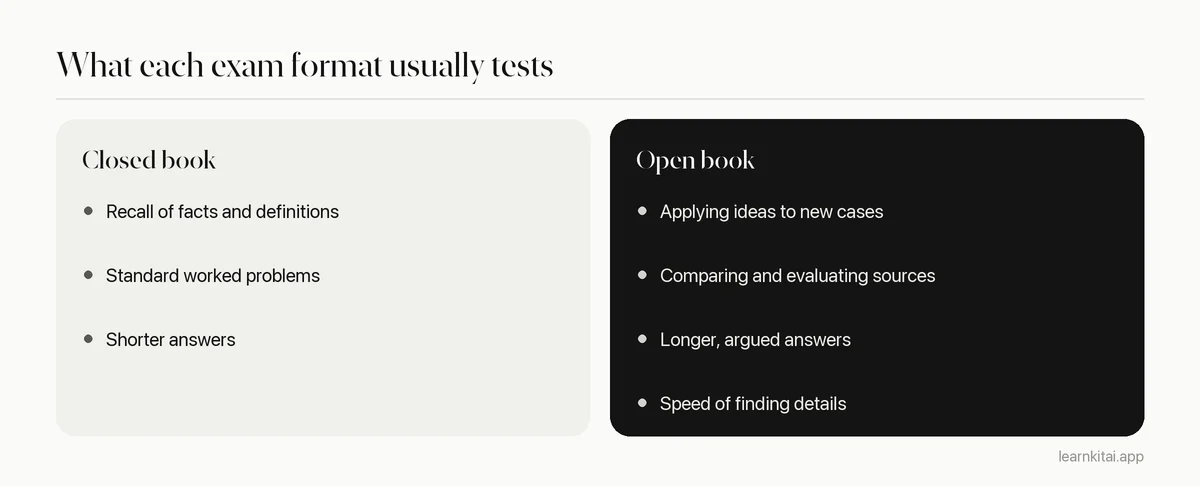
Usually not. Teachers know you can look up facts, so they write questions that ask you to apply, compare and judge ideas. The book helps with details, but it cannot do the thinking, and there is rarely time to read during the exam.
A closed book test can reward recall alone. An open book test assumes recall is free and moves the difficulty to the next level: using ideas. Expect questions like apply this model to a new company, explain which case is most similar and why, or critique this argument using two theories from the course. You cannot answer those by finding a page. You answer them by understanding the material well enough to know which page matters.
Why does expecting an open book exam hurt preparation?
Because students study less. In one experiment, people who expected an open book test spent less time studying and later did worse on a closed book test of the same material than people who expected a closed book test.
Research by Agarwal and Roediger tested this directly. When participants were told to expect an open book test, they spent less time studying, and their later performance on closed book comprehension and transfer tests was worse. The expectation itself changed how they prepared.
An earlier study by Agarwal and colleagues found that open book tests produced better scores in the moment, but that edge did not last. On a delayed test, both formats led to similar retention. The lesson for you is simple: the book raises your score only if you already understand the content. It does not replace learning it.
How to prepare for an open book exam in four steps
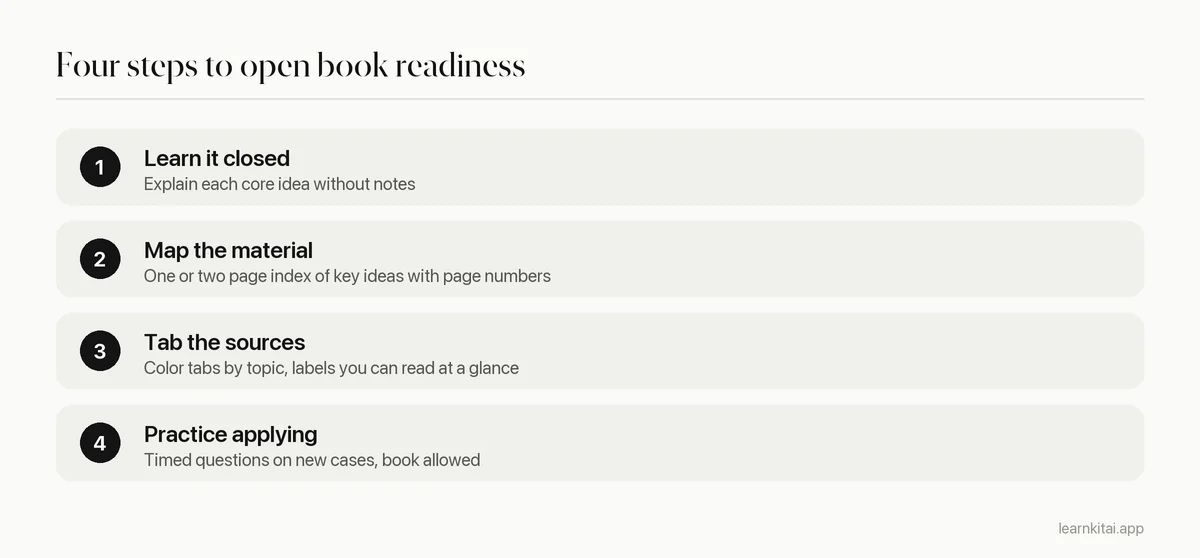
Step 1: learn the core as if the book were closed
Make a list of the 10 to 20 ideas the course is built on: key models, theories, formulas, cases or arguments. For each one, practice explaining it from memory in two or three sentences. Use flashcards or open questions for this. If you can explain an idea without looking, the book becomes a tool for details instead of a crutch. Our guide to active recall covers the method.
Step 2: build a map, not a copy
The most useful document in an open book exam is short. Make a one or two page index that lists each key idea, a one-line reminder of what it means, and where to find the full version (book page, slide number or note section). Long notes slow you down. A tight map gets you to the right page in seconds. The layout from our one page study guide works well here.
To build the map faster, summarize each chapter first and then cut it down. LearnKit can produce a structured summary from a PDF chapter or lecture slides, which gives you a draft to trim into one-line reminders.
Step 3: tab your sources
Use sticky tabs in a few colors, one color per topic. Write a short label on each tab so you can find a section without opening the book. For digital exams, set up bookmarks in your PDF reader and a document with headings that match your index. Test your system: can you find any key formula or case in under 30 seconds?
Step 4: practice applying under a timer
Do practice questions with the book open, but with a strict timer. Choose questions that ask you to apply ideas to new situations. After each one, note every time you had to look something up. Those are gaps to learn properly before the exam, so you are not looking them up on the day. Our guide to open ended questions has examples of the question styles to practice.
How should you manage time during an open book exam?
Plan to look things up for only a small part of the exam. Read all questions first, outline answers from memory, and use the book only to confirm details like exact figures, quotations or page references.
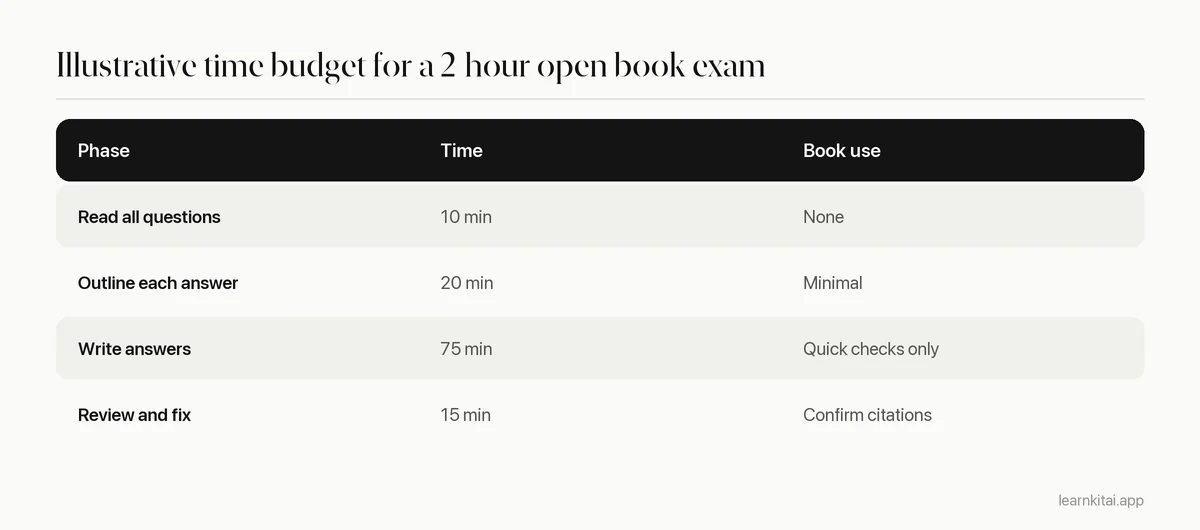
The rule of thumb: if you are reading, you are losing time. Write from what you know, and leave a small marker like (check p. 214) in your draft when you want to confirm a detail. Then do all lookups in one pass at the end of each answer.
What about take-home and online open book exams?
Treat them like a short research paper with a deadline. Plan your time, answer in your own words, cite sources if the course expects it, and check the rules on notes, internet use and AI tools before you start.
Take-home exams give you more time but usually expect more polish and deeper argument. Read the instructions twice. Many courses forbid collaboration or certain tools, and breaking those rules is treated as misconduct even if the exam is open book. If you are unsure about AI tools, read our guide on AI and academic integrity and ask your instructor.
Common open book mistakes
- Studying less because the book is allowed. The research above shows this is exactly the trap.
- Bringing notes you have never used. A system you first test in the exam room will fail under pressure.
- Copying long passages into answers. Markers want your reasoning, not the textbook's wording.
- Looking up things you half know. Write your best answer first, then confirm if time allows.
- Ignoring the clock. Set checkpoints for each question and move on when you hit them.
For the wider picture of exam season, see our finals guide. And if your open book exam is essay based, pair this with our essay exam guide.
Frequently asked questions
Should I bring all my notes to an open book exam?
Bring them if allowed, but rely on a short index to navigate. Thick stacks of notes slow you down. Most of your answers should come from memory, with notes used only to confirm details.
How long should my open book notes be?
Your main navigation sheet should fit on one or two pages. Your full notes can be longer, but every section should be reachable from that short index within a few seconds.
Do I need to memorize formulas for an open book test?
You should know the key formulas well enough to recognize when to use them. Exact constants or long derivations can be looked up, but deciding which formula applies has to come from understanding.
Is an open note test the same as an open book test?
Not always. Open note usually means your own notes only, while open book allows the textbook. Check exactly what is permitted, including printed slides and digital files.
Sources
- Examining the testing effect with open- and closed-book tests, Applied Cognitive Psychology (Agarwal et al., 2008) (Open book tests gave better initial performance, but both formats produced similar retention on a delayed test.)
- Expectancy of an open-book test decreases performance on a delayed closed-book test, Memory (Agarwal and Roediger, 2011) (Expecting an open book test reduced study time and later closed book performance.)
Keep reading
How to Study for Finals: A 3-Week Plan That Holds Up
Finals reward the student who starts with a plan, not the one who studies longest. Here is a three-week system for triage, testing and sleep.
Essay Exam Prep: Write Your Answers Before You Sit Down
The best essay exam answers are mostly planned before the exam starts. Predict the prompts, build an evidence bank and rehearse outlines from memory.
One Page Study Guide: Let the Space Limit Teach You
Squeezing a whole unit onto one page forces you to decide what matters. Here is a layout, a build routine, and the step most students skip.

Active Recall: Why Closing the Book Beats Rereading
Rereading feels productive but fades fast. Here is how to study by pulling answers out of memory, with a session plan, examples and the mistakes to avoid.
AI Academic Integrity: Where Help Ends and Cheating Starts
The tool is rarely the problem. What you submit as your own thinking is. A simple test for staying honest while studying with AI.