Multiple Choice Strategies That Beat Guessing
The most reliable multiple choice strategies are to cover the options and answer the question in your head first, eliminate options you can prove wrong, and change an answer when you find a concrete reason. In one study of 3,291 answer changes, 51% went from wrong to right and only 25% from right to wrong.
Multiple choice exams look easy because the answer is printed on the page. That is also the trap. Four plausible options can talk you out of something you knew. Good multiple choice strategies protect what you know from that noise, and they start long before exam day, in how you study.
Below you will find a method for each question, what the research says about changing answers, and a way to practice that makes the right option easier to spot. For the bigger picture on using quizzes to learn, see the practice testing guide.
What are the best multiple choice strategies during the exam?
Read the stem, cover the options, and form your own answer first. Then look for the option that matches it, eliminate any you can prove wrong, and mark doubtful items to revisit rather than stalling.
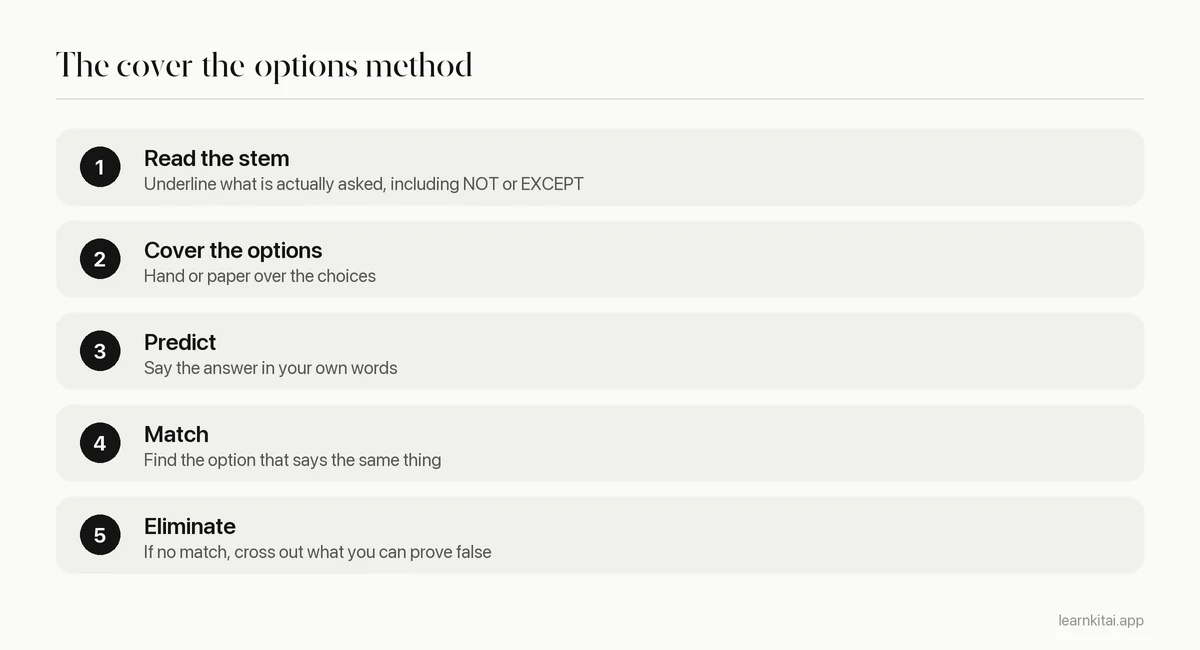
Covering the options turns the question back into recall. You find the answer in your memory first, so the distractors have nothing to anchor to. When your prediction matches an option, choose it and move on. When nothing matches, you have learned that the question is harder than it looked, and you switch to elimination.
Eliminate with reasons, not hunches
- Cross out an option only when you can say why it is false, for example "that is the definition of the other term".
- Watch for options that are true statements but do not answer the question asked.
- Treat absolute words such as always and never as a prompt to check, not as an automatic wrong answer. Some rules really are absolute.
- With "all of the above", two options you know are true are enough to choose it. One option you know is false rules it out.
- If two options say the same thing in different words, neither is likely to be the single right answer.
Manage time in passes
Go through the paper once answering everything you are sure of. Mark the rest. On the second pass, work the marked items with elimination. Leave nothing blank unless wrong answers cost points. A question late in the exam sometimes contains a clue to an earlier one, and the first pass gives you the time to notice.
Should you change your answer on a multiple choice test?
Yes, when you have a concrete reason. Most answer changes go from wrong to right. The belief that your first instinct is safer comes mostly from how vividly people remember the painful right-to-wrong changes.
Researchers Justin Kruger, Derrick Wirtz and Dale Miller looked at the midterm exams of 1,561 introductory psychology students at the University of Illinois. As summarized by NYU Stern, of 3,291 answer changes, 51% went from wrong to right, 25% from right to wrong, and 23% from wrong to wrong. Changing answers helped far more often than it hurt.
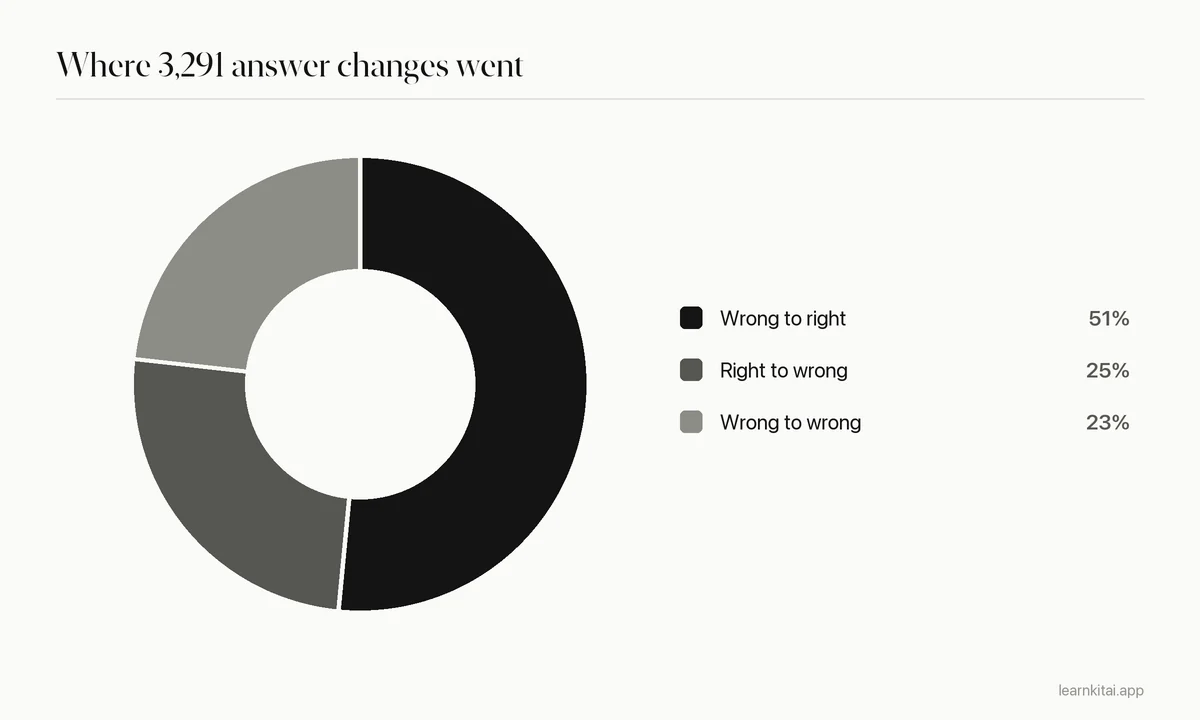
So why does "trust your gut" survive? Their 2005 paper, discussed by the Association for Psychological Science as a classic myth buster, points to memory. Switching away from a right answer stings, so you remember it. Sticking with a wrong answer feels like bad luck and fades. The rule to take away: change an answer when you notice a misread, recall a fact, or find a clue elsewhere in the paper. Do not change it just because you feel uneasy.
How do you study for a multiple choice exam?
Study for recall, not recognition. Quiz yourself with questions that have plausible wrong options, explain why each wrong option is wrong, and add some short answer practice so you can produce the answer without seeing it.
A common belief is that multiple choice practice only trains recognition. A 2012 study by Jeri Little and colleagues in Psychological Science found otherwise. Multiple choice tests with competitive, plausible options triggered real retrieval and helped later recall. They even improved memory for facts about the wrong options, which cued recall tests did not.
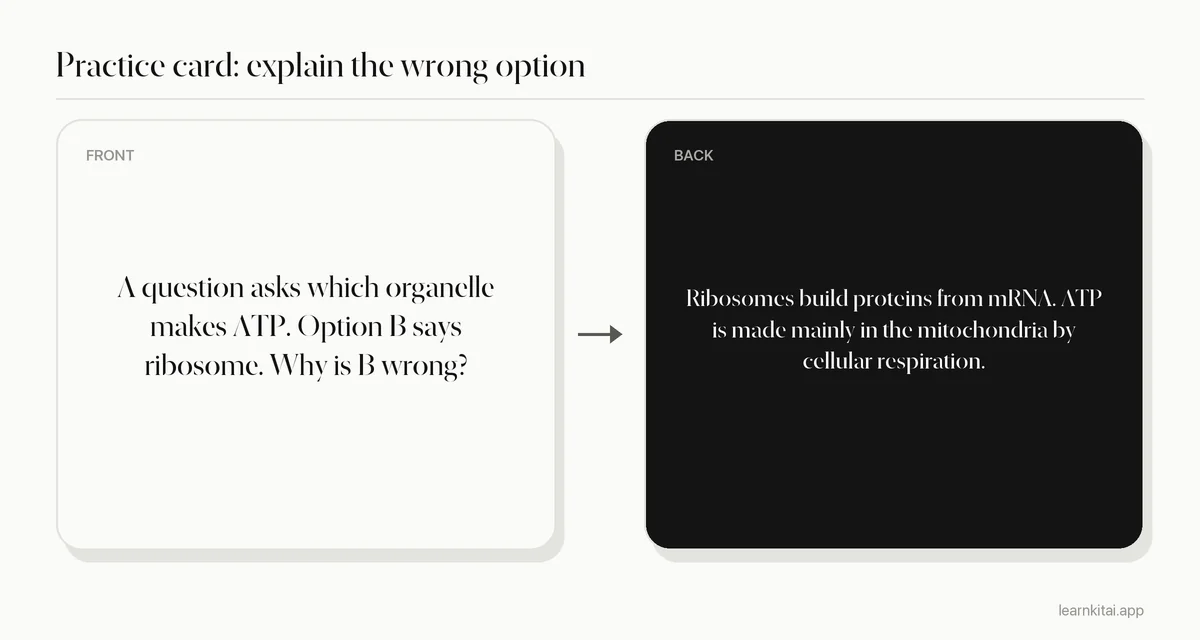
- After each practice question, say why every wrong option is wrong, not just why the right one is right.
- Keep pairs of easily confused terms together in your review, since exam writers build distractors from them.
- Mix topics in each practice set. If questions are grouped by chapter, you get a free clue about the answer.
- Rework missed questions a few days later in a fresh order. A practice test you build yourself is ideal for this.
On the iPhone, LearnKit can generate up to 30 quiz questions from a PDF or lecture with an explanation for each answer, which makes the "explain every wrong option" habit fast to practice.
Are there tricks for guessing when you have no idea?
Pattern tricks such as choosing the longest option or C are unreliable on well made exams. Partial knowledge plus elimination is the best guess: removing even one option lifts your odds on a four option question from 25% to 33%.
Careful exam writers balance answer positions and lengths, so folk rules often cost more than they win. Your best tools are what you half know. If you can rule out two options, a guess between the last two is a coin flip, which is double the blind odds. When wrong answers carry a penalty, check the rules: some exams make it worth leaving a pure guess blank.
Exam nerves make all multiple choice strategies harder to apply, because a racing mind skips the stem. If that is you, our guide to test anxiety covers simple ways to steady yourself before the first question.
Frequently asked questions
Is C really the most common answer?
Not on well constructed exams. Test writers and many testing systems spread correct answers across positions. Guessing C only helps if a particular teacher has a habit, and you cannot count on that.
How long should I spend on each multiple choice question?
Divide the exam time by the number of questions and keep about ten percent in reserve for review. If a question takes more than twice the average, mark it and move on.
Do negative marking rules change the strategy?
Yes. If wrong answers lose points, guess only when you can eliminate at least one option. Without a penalty, never leave a question blank.
Sources
- Think Again, NYU Stern Business (Wirtz, Kruger, Miller and Mathur, 2008) (1,561 students; of 3,291 answer changes, 51% wrong to right, 25% right to wrong, 23% wrong to wrong)
- Myth: It's Better to Stick to Your First Impulse Than Go Back and Change Multiple Choice Test Answers, Association for Psychological Science (Cites Kruger, Wirtz and Miller (2005) on why right-to-wrong changes are remembered more vividly)
- Multiple-Choice Tests Exonerated, at Least of Some Charges, Psychological Science (Little, Bjork, Bjork and Angello, 2012) (Well built MC tests trigger productive retrieval and aid recall of information about incorrect options)
Keep reading

Practice Testing: The Study Habit That Beats Rereading
Testing yourself is not just a way to check what you know. It is one of the best-supported ways to learn. Here is how to do it well, week by week.
Make a Practice Test That Feels Like the Real Exam
A good practice test copies the real exam's format, mixes topics, and comes with an answer key you check honestly. Here is a step by step build.
Open Ended Questions: Study by Explaining, Not Spotting
Questions with no options to pick from force you to build the answer yourself. Here are 12 question stems, a marking method and a weekly routine.
The Testing Effect: Why a Quiz Beats Another Reread
Taking a test is not just a way to measure memory. It changes memory. Here is what the research shows and how to use it this week.
Exam Day Tips: A Checklist From Wake-Up to Last Answer
The night before, the morning of, the first five minutes and the last ten. A calm, research-backed checklist for the day all your studying pays off.