How to Study for an Exam in a Week, Day by Day
Spend day one testing yourself on every topic to find the gaps. On days two to four, work through weak topics with practice questions, returning to each one every two or three days. Take a full timed practice test on day five, fix what it exposes on day six, and keep the last day light.
A week feels short until you see what fits into it. Seven days gives you room for roughly 15 to 25 focused study blocks, enough to cover a typical midterm or unit test twice and still sleep. The trick is to use the time in the right order. If you plan to study for an exam in a week, the first day should not be spent reading chapter one. It should be spent finding out what you do not know.
Below is a day-by-day plan, a worked example of how to rotate topics, and the decisions that matter most when time is tight.
Is one week enough time to study for an exam?
For most midterms and unit tests, yes, if you start with a self-test and spend your time on practice questions rather than rereading. For a large cumulative final, a week is tight, so you need to cut low-value topics early.
The deciding factor is not hours. It is how many times you can revisit each topic. Memory research shows that spreading practice beats massing it. In a study of more than 1,350 learners by Cepeda and colleagues, the best gap between study sessions for a test one week away was about 20 to 40 percent of that week. That works out to roughly every two or three days. A week gives you room for two or three passes per topic at that rhythm, which is plenty for most tests.
How to study for an exam in a week: the seven-day plan
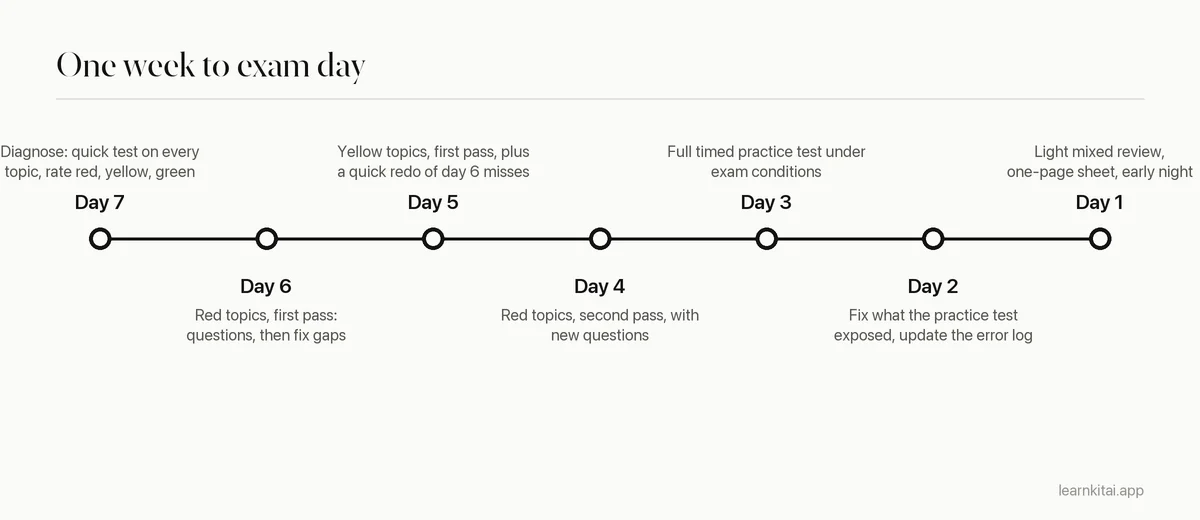
Day 7: diagnose before you study
Collect the syllabus, the review sheet and any past papers. List every topic. Then, for each one, try two or three questions from memory without notes. Mark each topic red (could not do it), yellow (shaky) or green (fine). This takes about two hours and replaces days of guessing. Most students discover that a third of the material is already fine and does not need rereading.
Days 6 to 4: work the gaps
Each study block follows the same loop: a few questions first, then targeted reading only where you failed, then the same questions again from memory. Red topics come first each day, while your focus is freshest. By day four, you are returning to the red topics for a second time with new questions, so you test understanding rather than memory of yesterday's answers.
Day 3: the dress rehearsal
Take a full practice test under real conditions: timed, closed book, phone in another room. Use a past paper if one exists. If not, build one from end-of-chapter problems or a generated quiz. Our guide on how to make a practice test shows how to mix question types so it feels like the real thing.
Days 2 and 1: fix, then rest
Mark the practice test and sort every lost point: did you not know it, misread it, or run out of time? Spend day two fixing the biggest category. On the final day, do a short mixed review, write a one-page summary from memory, and stop early. Do not start a new topic the night before.
How should you split topics across the week?
Rotate them. Give each red topic three sessions spaced two or three days apart, each yellow topic two sessions, and each green topic one quick check. Mix two or three topics into each day rather than doing one topic per day.
Here is a worked example. Sam has a psychology midterm covering six topics. After the day-seven diagnosis, two are red (research methods and memory), two are yellow (learning and development) and two are green (history of psychology and sensation).
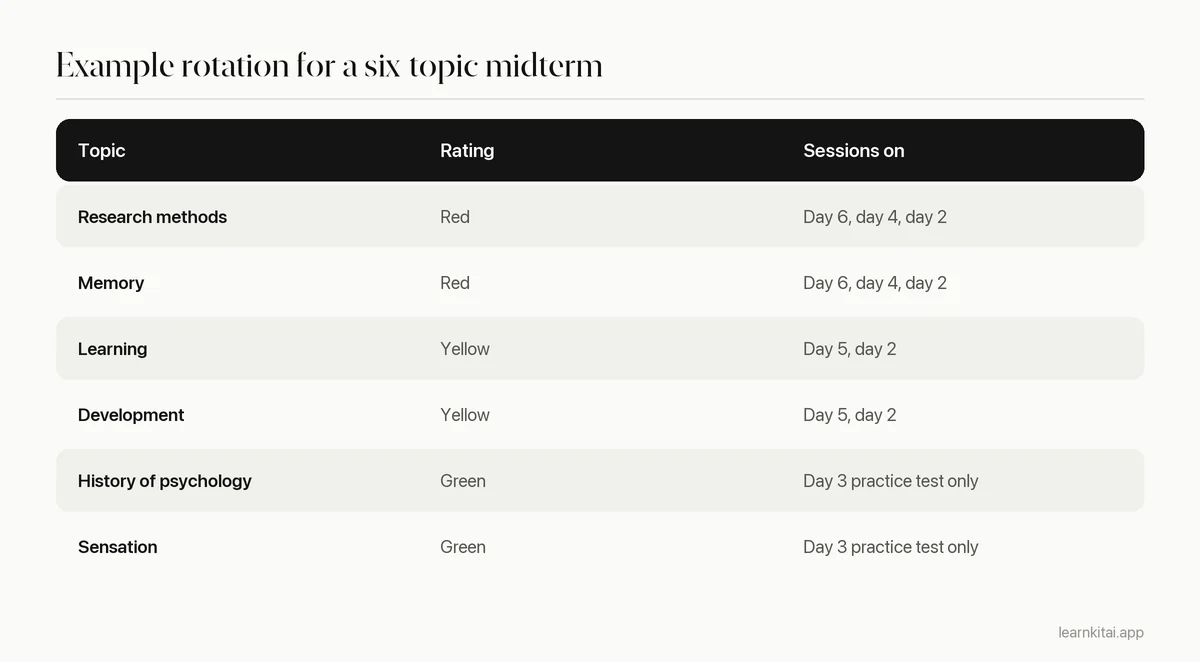
Sam does not spend a minute rereading the green topics. They get checked once, inside the practice test. If the test exposes a problem, that topic moves up to yellow and gets a slot on day two. This is how a week stretches: by refusing to study what you already know.
What should you do in each study session?
Start with questions, not reading. Test yourself for about ten minutes, check answers, read or rework only the parts you missed, then retest the misses before you finish. End by noting what to test next time.
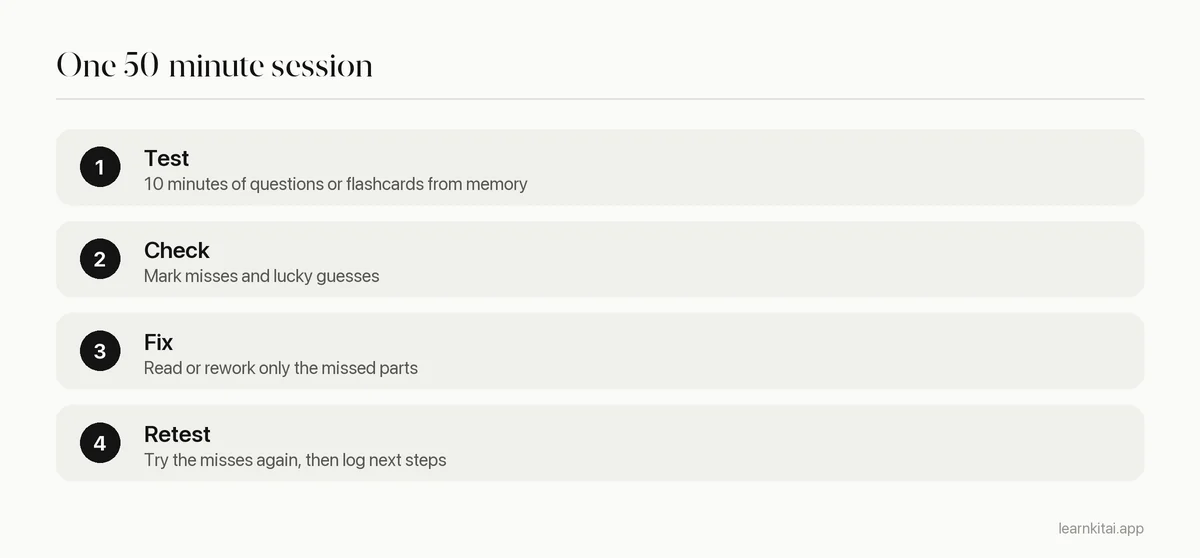
This order matters. In a classic study, students who read a passage once and took three recall tests remembered 61 percent a week later, compared with 40 percent for students who reread it four times (Roediger and Karpicke, 2006). Starting each session with questions builds that benefit into every block. For more on the method, see our guide to active recall.
The slowest part of this plan is writing questions. You can speed it up by generating a quiz from your notes. LearnKit turns a PDF, a set of slides or a lecture recording into multiple choice questions with explanations, which works well for the day-seven diagnosis and the day-three practice test.
How many hours a day should you study in the final week?
Around two to four focused hours a day is enough for most single exams, in blocks of about 50 minutes. If you have several exams, plan by blocks per course rather than total hours, and keep at least seven hours of sleep.
More hours are not automatically better. Focused blocks with clear tasks beat long, drifting sessions, and sleep is when the brain consolidates what you studied. If you have more than one exam this week, use the risk-based triage in our finals guide to split your time.
If you only have a night left, switch to the plan for cramming the night before an exam. If you have more than two weeks, a fuller study schedule will give you more spacing. But if you need to study for an exam in a week, the plan above is a reliable default.
Frequently asked questions
What if I find out on day seven that most topics are red?
Narrow your scope. Use past papers and the review sheet to find the topics that appear most often, and aim to move those to yellow. Accept that a few low-value topics will stay red.
Should I take a day off during the week before an exam?
A full day off is hard to afford, but a free evening is worth keeping. Rest helps you consolidate, and a short break makes the remaining days more focused.
Can I use this plan for a final exam?
Yes, for a single final. For several finals in the same week, combine it with a priority ranking so the riskiest course gets the most sessions.
Do I need past papers for this plan?
They help a lot, but they are not required. You can build practice questions from textbook problems, review sheets, your notes or a quiz generator.
Sources
- Spacing Effects in Learning: A Temporal Ridgeline of Optimal Retention, Psychological Science (Cepeda et al., 2008) (Optimal study gap about 20 to 40 percent of a one-week test delay; more than 1,350 participants.)
- Test-Enhanced Learning: Taking Memory Tests Improves Long-Term Retention, Psychological Science (Roediger and Karpicke, 2006) (61 percent versus 40 percent recall after one week for repeated testing versus repeated study.)
Keep reading
How to Study for Finals: A 3-Week Plan That Holds Up
Finals reward the student who starts with a plan, not the one who studies longest. Here is a three-week system for triage, testing and sleep.
The Study Schedule That Works Backward From Exam Day
Most study plans fail because they start from today. Start from the exam date instead, count your real hours, and space every topic at least three times.
Cramming: What Actually Works the Night Before an Exam
Cramming is a poor way to learn, but sometimes it is the only option left. Here is how to spend one evening so it counts, and when to stop.

Make a Practice Test That Feels Like the Real Exam
A good practice test copies the real exam's format, mixes topics, and comes with an answer key you check honestly. Here is a step by step build.

Active Recall: Why Closing the Book Beats Rereading
Rereading feels productive but fades fast. Here is how to study by pulling answers out of memory, with a session plan, examples and the mistakes to avoid.
Your AP Exam Study Plan: 12 Weeks to May 2027
AP exams run from May 3 to May 14, 2027. A 12-week plan built on unit weightings and released free-response questions beats a frantic April.