Case Briefs: Read Like a Judge, Not a Stenographer
A case brief is a short summary of a court opinion in your own words: the key facts, the procedural history, the legal issue, the holding, and the reasoning. Read the opinion at least twice, write the facts last so you keep only the ones that mattered, and later test yourself on the rule and reasoning.
In the first weeks of law school, reading a single appellate opinion can take an hour, and the brief you write afterward can run longer than the case. That is normal, and it improves fast with the right method. Good case briefs are not transcripts. They are short tools for thinking, written so you can answer a cold call in class and, months later, use the rule on an exam.
This guide covers a three-pass way to read an opinion, a one-page template, a worked example using a classic torts case, and how to turn briefs into material you can actually study. It describes study technique only and is not legal advice.
What goes into a case brief?
Most briefs include the citation, the key facts, the procedural history, the issue, the holding, the reasoning and any concurring or dissenting opinions. Many students add the rule in one sentence and a line of their own analysis. There is no single required format.
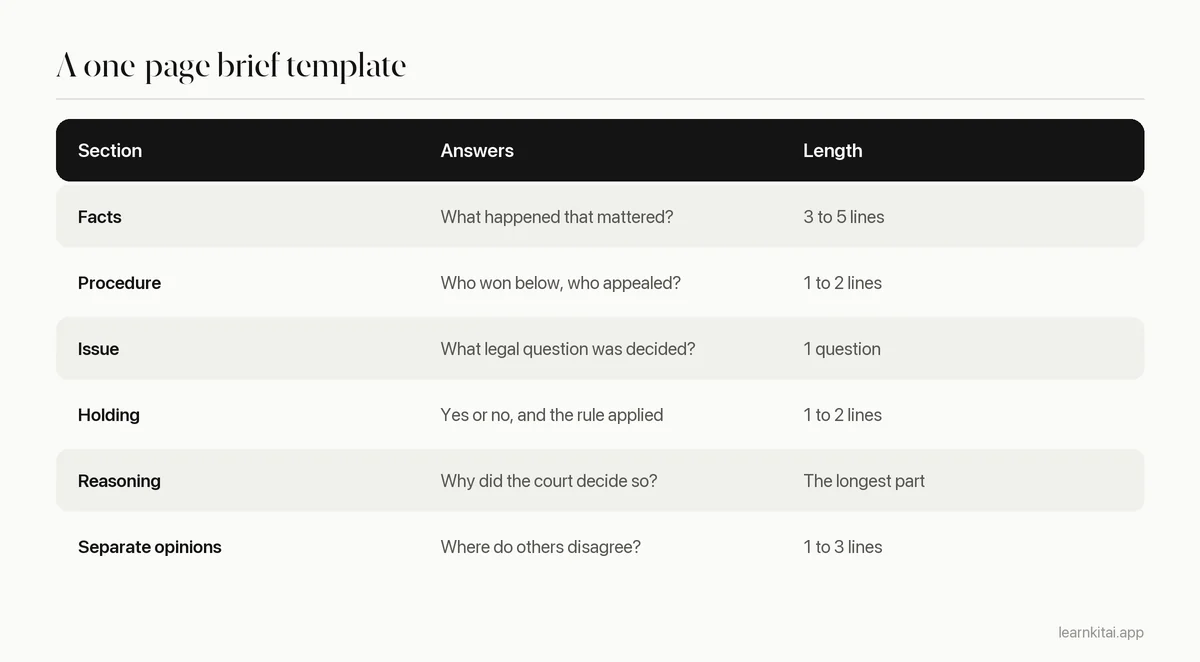
A guide from Penn State on how to brief a case makes two points worth copying. Keep the brief short, ideally well under two pages. And write the facts section last, so you include only the determinative facts, the ones the court relied on to decide.
How do you read a case before briefing it?
Read it in passes. First skim for the court, the parties, who won and the procedural posture. Then read closely for the issue and holding. Finally, read the reasoning and separate opinions with your brief open, writing in your own words.
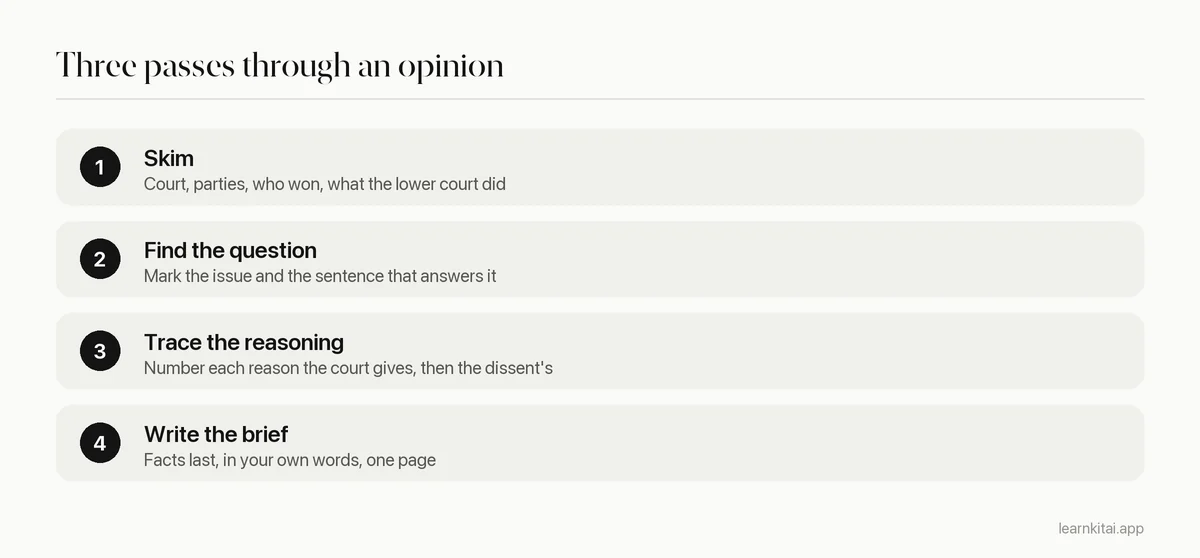
Knowing the outcome before the close read changes everything. When you know who won, every paragraph becomes an answer to why, which is far easier to follow than a story with no ending. Many students also find it useful to read the last few paragraphs first, where courts often state their conclusion plainly.
On the close read, give each part of the brief its own color: one for facts, one for the issue, one for the holding and one for reasons. Highlighting alone does little for memory, but here the colors do a different job. They make you decide what each sentence is doing, and they let you find the reasoning in seconds when you are called on. If a whole page ends up one color, you are marking too much. Aim for a few phrases per page.
Expect reading speed to come slowly. Early on, an opinion of ten pages can take well over an hour, and that is fine. Speed grows as you learn the vocabulary of procedure and the usual structure of opinions. Writing case briefs by hand in those first weeks is the training that makes the later speed possible.
A worked example: Palsgraf v. Long Island Railroad
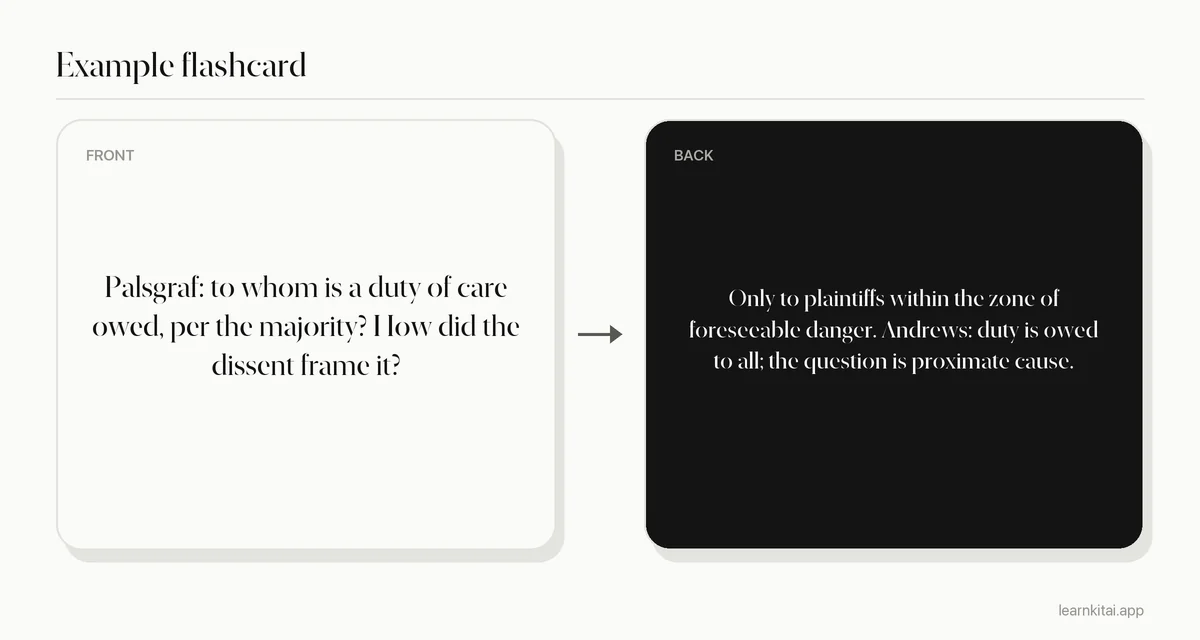
Palsgraf is a classic first year torts case on duty and foreseeability. Briefing it shows how to separate the dramatic facts from the few that decided the case, and how a dissent can frame the same facts as a question of causation.
- Citation: Palsgraf v. Long Island R.R. Co., 248 N.Y. 339 (1928), New York Court of Appeals.
- Facts: Railroad guards helped a man board a moving train and dislodged his package, which held fireworks. It fell and exploded. The shock knocked over scales many feet away, injuring the plaintiff.
- Procedure: The plaintiff won at trial and on the first appeal. The railroad appealed again.
- Issue: Does a defendant owe a duty of care to a plaintiff who was outside the zone of foreseeable danger?
- Holding: No. Judgment reversed and the complaint dismissed.
- Reasoning (Cardozo): Negligence is a breach of duty owed to someone. Nothing about the package signaled danger to a person standing far away, so no duty to her was breached.
- Dissent (Andrews): Everyone owes a duty to the world at large. The real question is proximate cause, which is a matter of policy and fairness.
Notice what is missing: the destination of the train, the size of the package and other vivid details. They do not affect the reasoning, so they stay out. The dissent stays in, because professors love to ask which framing, duty or causation, you find more convincing.
Should you write full case briefs all through law school?
Write full briefs early on, while you learn to spot issues and holdings. Once that becomes quick, many students switch to book briefing, marking the opinion in colors with a short margin summary, and spend the saved time on outlines and practice questions.
A simple decision rule helps. If you can state a case's issue, holding and key reason out loud in thirty seconds after reading, a short book brief is enough. If you cannot, write the full brief. Commercial summaries can help you check your reading, but they do not replace it, because finding the holding yourself is the skill being trained.
How do you study from your case briefs for exams?
Briefs are raw material. Pull the rules and key reasoning into a course outline, then test yourself: state each rule from memory, explain how a case applied it, and work practice hypotheticals. Rereading briefs feels like review but builds little recall.
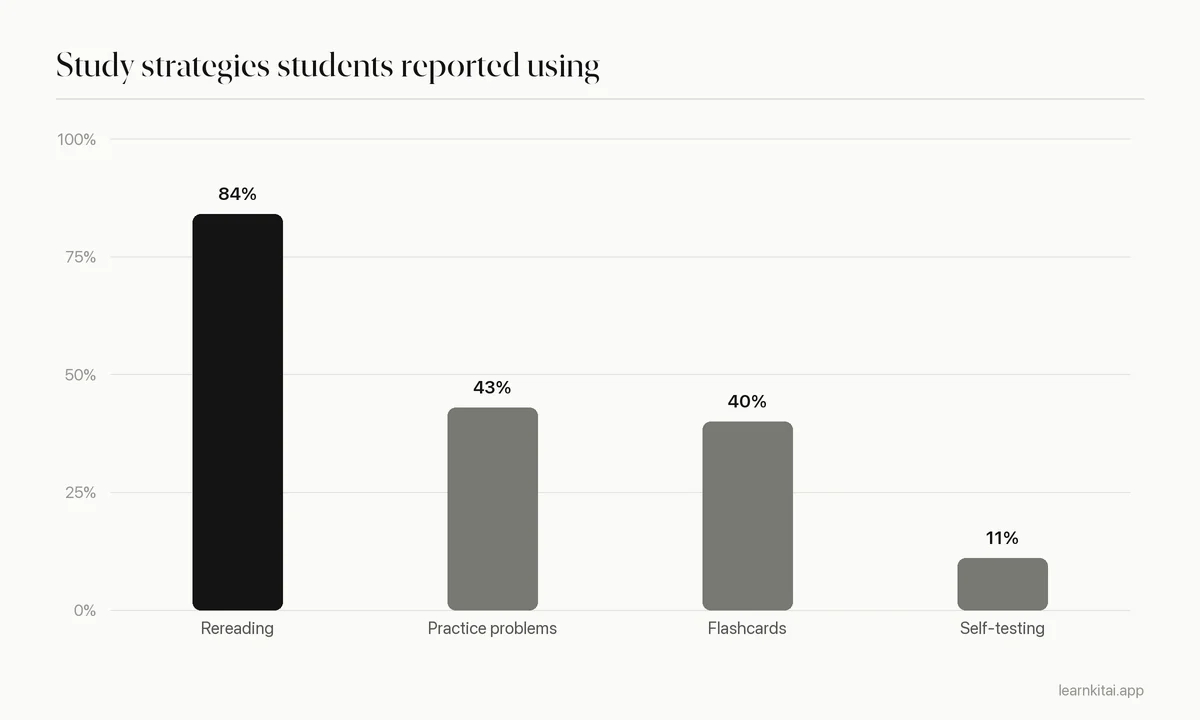
Rereading is the default for most students. In one survey of 177 college students, 84 percent listed rereading notes or textbooks as a study strategy and 55 percent named it their top strategy. Only 11 percent described testing themselves, according to Karpicke, Butler and Roediger. Yet in experiments, taking recall tests on prose produced better retention a week later than restudying it.
For law, self-testing has three layers. First, rules: can you state the rule from memory? Second, cases: can you say how a case applied it and why? Third, application: can you spot the issue in a new fact pattern and argue both sides? The third layer is what exams grade. Our guide to essay exams covers practicing that under time pressure, and the practice testing guide explains why it works.
Common case brief mistakes
Copying long passages from the opinion, recording every fact, skipping the procedural history, stating the holding too broadly or too narrowly, and never coming back to the brief after class. Fixing these makes briefs both shorter and more useful.
- Copying the court's words. Paraphrasing forces you to understand. Quote only a key phrase.
- Writing an issue that is too vague. Did the court err is not an issue. Join the legal question to the key facts.
- Ignoring procedure. Whether a case was reversed or affirmed tells you what the holding actually did.
- Treating the brief as finished. Add one line after class on what the professor emphasized.
Once your briefs are lean, condense each unit onto a one page study sheet of rules and leading cases. The same principle of testing over rereading runs through all of our subject study guides.
Frequently asked questions
How long should a case brief be?
Usually a page or less. If your brief is longer than the opinion's key reasoning, you are copying rather than summarizing. Short briefs are faster to review and force you to decide what matters.
Is IRAC the same as a case brief?
Not quite. IRAC, which stands for issue, rule, application and conclusion, is a way to structure an exam answer or memo. A case brief summarizes one opinion. The two connect, because briefs give you the rules and examples you will apply in IRAC answers.
Should I use commercial case briefs?
Use them to check your work, not to replace it. Finding the holding and reasoning yourself is the skill that classes and exams train. Reading someone else's summary skips the part that builds it.
How do I prepare for cold calls?
Know the facts in two sentences, the issue, the holding and at least two reasons. Then predict one follow up question, such as how the result would change if a key fact changed, and answer it out loud before class.
Sources
- How to brief a case, Penn State (sites.psu.edu) (Brief sections, advice to read at least twice, keep briefs under two pages and write the facts section last.)
- Metacognitive strategies in student learning: Do students practise retrieval when they study on their own?, Memory (Karpicke, Butler and Roediger, 2009) (Survey of 177 students: 83.6% listed rereading, 54.8% ranked it first, 10.7% reported self-testing, 42.9% practice problems, 40.1% flashcards.)
- Test-enhanced learning: taking memory tests improves long-term retention, Psychological Science (Roediger and Karpicke, 2006), via PubMed (Testing on prose passages produced greater retention than restudying on tests 2 days and 1 week later.)
Keep reading

How to Study Science: Think Like the Exam, Not the Textbook
Science asks for four kinds of knowledge at once: terms, mechanisms, problem skills and data. Here is how to study each one, and how they fit together.
Essay Exam Prep: Write Your Answers Before You Sit Down
The best essay exam answers are mostly planned before the exam starts. Predict the prompts, build an evidence bank and rehearse outlines from memory.

One Page Study Guide: Let the Space Limit Teach You
Squeezing a whole unit onto one page forces you to decide what matters. Here is a layout, a build routine, and the step most students skip.

Practice Testing: The Study Habit That Beats Rereading
Testing yourself is not just a way to check what you know. It is one of the best-supported ways to learn. Here is how to do it well, week by week.

Open Book Exam Prep: Why the Book Will Not Save You
Open book sounds easy until the clock runs out while you hunt for a page. Prepare as if the book were closed, then build a system to find things fast.

Study Psychology Like a Scientist, Not a Glossary
Psychology exams test whether you can apply terms and read studies, not just define them. Use the field's own research to study it.