Study Psychology Like a Scientist, Not a Glossary
To study psychology well, learn look-alike terms as contrasting pairs, summarize each key study with its question, method, finding and limitation, and practice applying concepts to new scenarios. Quiz yourself instead of rereading, and spread reviews across the term, which is exactly what psychology's own research on learning recommends.

Psychology looks easy from the outside. The topics are about people, the examples are familiar, and the textbook reads smoothly. Then the exam asks which of four scenarios shows negative reinforcement, and suddenly two answers look right. The best way to study psychology is to borrow from the field itself: its research on memory and learning tells you which habits work, and its research methods tell you how to read the studies you are tested on.
This guide works for an intro course, AP Psychology or upper level classes. It covers how to separate confusable terms, a five-line template for studies, how to practice application questions, and a weekly plan.
Why is psychology harder than it looks?
Because the material feels familiar. Everyday words like memory, attention and reinforcement have precise technical meanings, many terms come in near identical pairs, and exams ask you to apply them to new scenarios. Familiarity breeds false confidence, so students under-practice.
There is a well studied trap here. In one experiment, students who reread a passage felt more confident than students who tested themselves, yet on tests two days and a week later the students who had practiced recall remembered more. Smooth reading creates a feeling of knowing that does not survive the exam. Psychology textbooks are written to be smooth, so the trap is especially deep.
How do you remember psychology terms that sound alike?
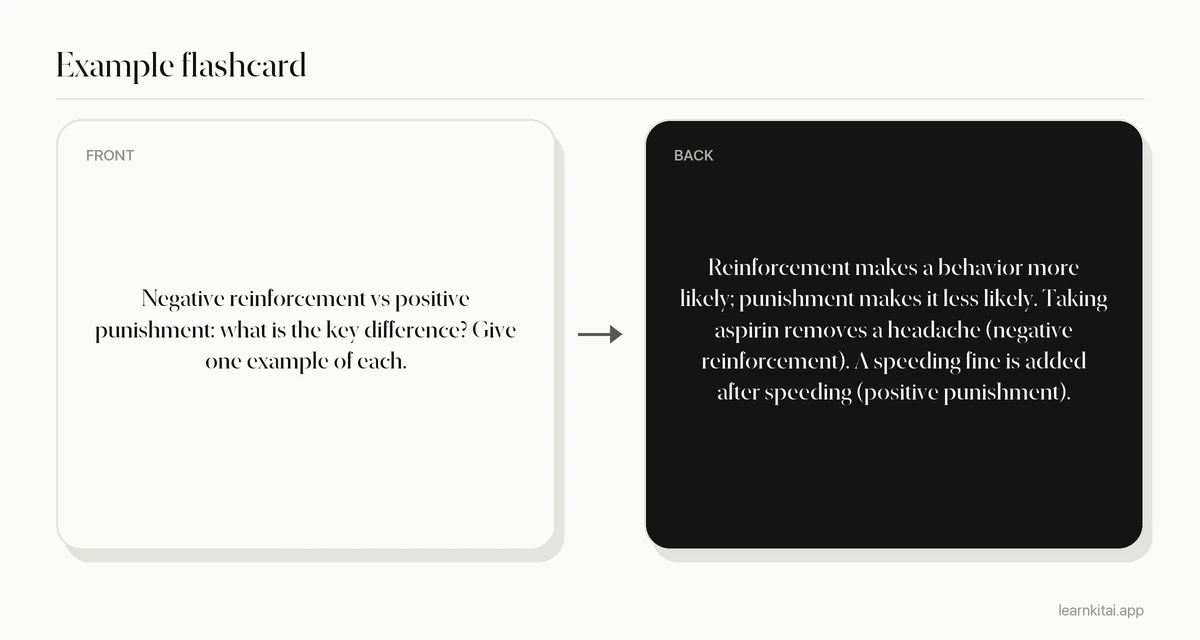
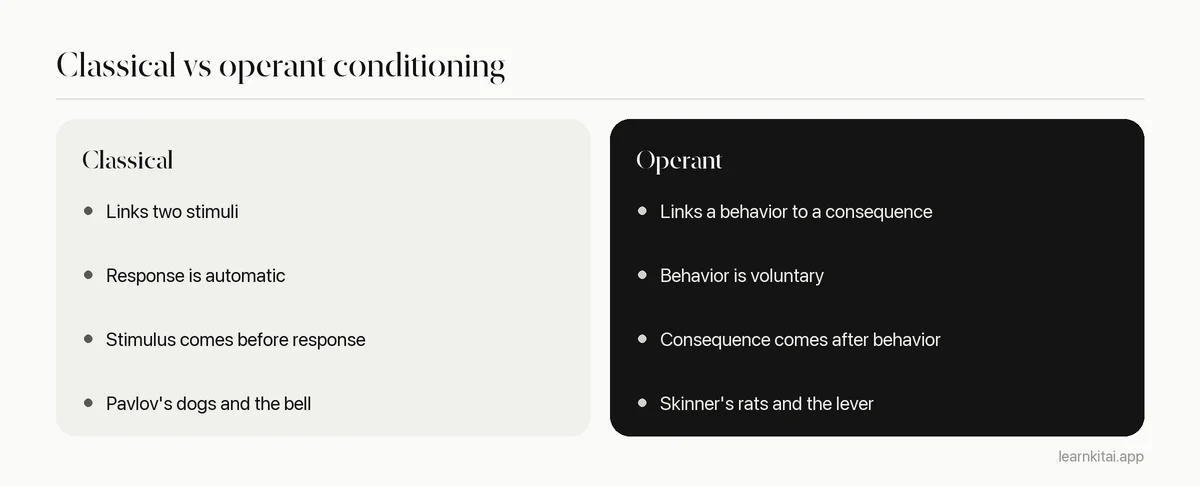
Learn them as contrasting pairs on the same card. Ask what separates the two, then give an example of each. Seeing the difference side by side is what lets you choose correctly when an exam scenario could fit either term.
Classic pairs include negative reinforcement and punishment, classical and operant conditioning, proactive and retroactive interference, validity and reliability, and the independent and dependent variable. Learning each term alone leaves them blurred. Comparing them forces you to find the deciding feature.
How should you study the research studies?
Summarize every key study in five short lines: the question, the method, the main finding, one limitation, and why it matters. This keeps you from memorizing trivia and prepares you for questions about design, ethics and interpretation.
Here is the template filled in with a study you will meet in any chapter on memory. Use the same five lines for every study and they become easy to compare.
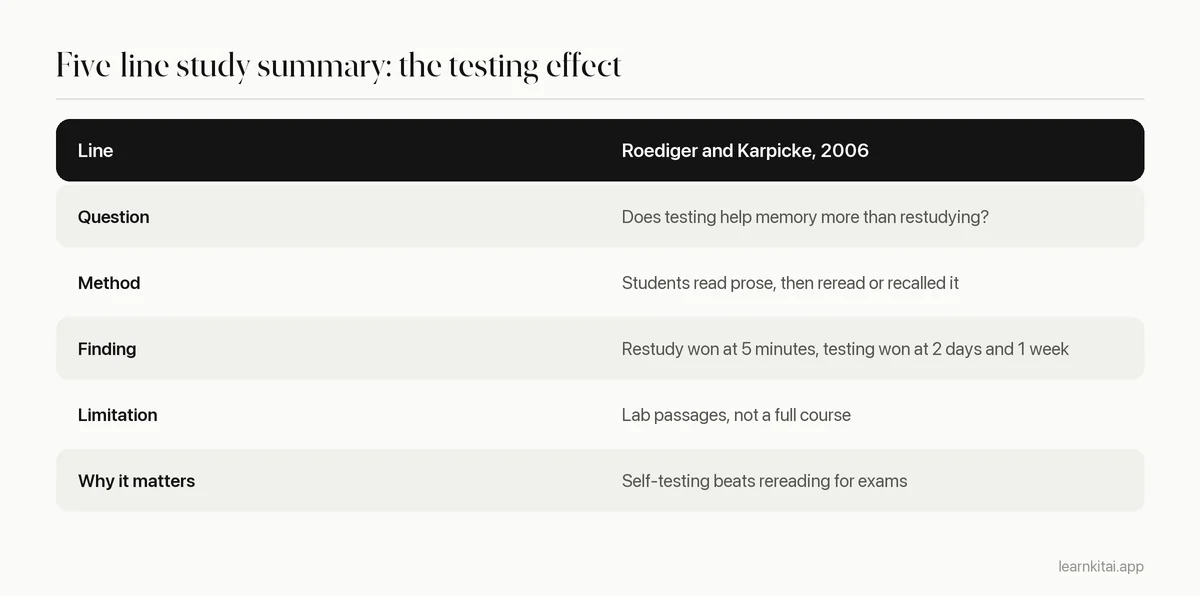
The limitation line is the one students skip, and it is often the one exams ask about. Train yourself to ask the same questions each time: was the sample representative, was there random assignment, could a third variable explain a correlation? Those three questions answer a surprising share of research methods items.
How do you study research methods and statistics in psychology?
Practice identifying the design of short study descriptions: the independent and dependent variables, whether there was random assignment, and whether the claim is causal or correlational. A few minutes of this each week beats one long cram before the methods unit test.
Research methods is the unit many students try to memorize as a list of definitions, and it is the one that most rewards practice. Take any study described in your textbook or a news story and answer four questions in writing. What was manipulated? What was measured? Were people randomly assigned to groups? Does the conclusion claim cause, and is that justified?
News headlines make excellent practice. A headline that says coffee drinkers live longer is a correlation, so ask what third variable could explain it, such as income or overall health. Doing two or three of these a week builds the habit exams test. It also makes the rest of the course easier, because nearly every chapter is built on studies, and you will read each one with a sharper eye.
For statistics, focus on meaning before formulas. Be able to say in plain words what a correlation of 0.3 means, what a p value does and does not tell you, and why a larger sample gives a more reliable estimate. If you study psychology at university, you will meet these ideas again in every later course.
How do you get better at application questions?
Invent your own examples. For each concept, write a new everyday scenario that fits it, and one that almost fits but does not. Then explain why. Generating examples is harder than reading the textbook's, which is exactly why it works.
Asking why a concept applies, and why it does not apply to a near miss, is a form of elaborative interrogation. It builds the deciding feature into memory. Then practice on real items: in multiple choice, cover the options, predict the answer, and only then look. Our guide on multiple choice strategies covers this in detail.
What does psychology research say about studying psychology?
A major review of ten common techniques rated practice testing and spaced practice as the most useful, and rereading and highlighting as low utility. Yet most students rely on rereading. Following the evidence is the simplest upgrade you can make.
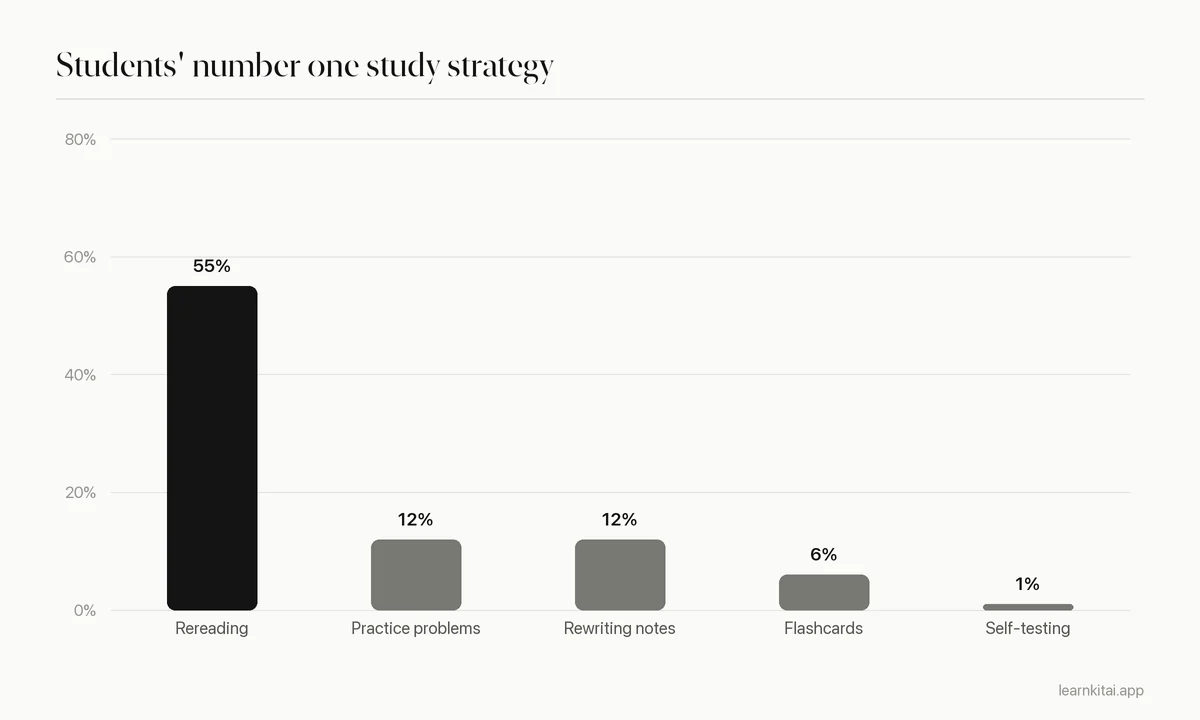
That review, by Dunlosky and colleagues, is summarized by the Association for Psychological Science. A separate survey of 177 college students found that 55 percent named rereading as their number one strategy, while about 1 percent named self-testing, as reported by Karpicke, Butler and Roediger. If you study psychology, you can quote both studies in an exam and use them in your own routine.
A weekly plan to study psychology
Read the chapter once with the study template open, make contrast cards the same day, invent examples midweek, and finish with a mixed quiz that includes earlier chapters. Keep each session under an hour.
- Day 1: Read the chapter. Fill in the five-line template for each named study.
- Day 2: Make contrast cards for every look-alike pair.
- Day 3: Write one new example and one near miss for each key concept.
- Day 4: Quiz on this chapter, then a few cards from older chapters.
- Day 6 or 7: A mixed practice test. Log every miss and why you missed it.
Mixing older chapters into each week matters because psychology finals are cumulative and units build on each other. Learning and memory feed into development, and research methods show up everywhere. For the overall approach across science courses, see our guide on how to study science, and for the core habit behind all of this, active recall.
Frequently asked questions
How do I study for an AP Psychology exam?
Work through the units with contrast cards and the five-line study template, then switch to timed practice questions in the final weeks. Pay special attention to research methods, which appear across units. Review your wrong answers more carefully than your right ones.
Do I need to memorize researcher names?
Know the major names linked to their key studies or theories, because exams use them as cues. Spend more time on what each researcher showed and its limits than on dates. A name with no finding attached earns few marks.
Is psychology a science subject?
Yes, in the sense that it tests claims with data, controls and statistics. That is why research methods run through every unit. Studying it like a science, asking how we know, makes the content much easier to organize.
How can I remember the brain regions and their functions?
Learn them on an unlabeled diagram and say each function aloud as you point. Attach one memorable case or symptom to each region. Test yourself with the labels hidden until you can fill them in quickly.
Sources
- Test-enhanced learning: taking memory tests improves long-term retention, Psychological Science (Roediger and Karpicke, 2006), via PubMed (Restudying won at 5 minutes; testing produced greater retention at 2 days and 1 week, despite restudy raising confidence.)
- Improving Students' Learning With Effective Learning Techniques, Association for Psychological Science (Review of 10 techniques; practice testing and distributed practice high utility, rereading and highlighting low.)
- Metacognitive strategies in student learning: Do students practise retrieval when they study on their own?, Memory (Karpicke, Butler and Roediger, 2009) (177 students: 54.8% ranked rereading first, 12.4% practice problems, 12.4% rewriting notes, 6.2% flashcards, 1.1% self-testing.)
Keep reading
How to Study Science: Think Like the Exam, Not the Textbook
Science asks for four kinds of knowledge at once: terms, mechanisms, problem skills and data. Here is how to study each one, and how they fit together.

Active Recall: Why Closing the Book Beats Rereading
Rereading feels productive but fades fast. Here is how to study by pulling answers out of memory, with a session plan, examples and the mistakes to avoid.
Elaborative Interrogation: Ask Why to Make Facts Stick
A single question, why is this true, can turn a loose fact into one you remember. How to use elaborative interrogation, with prompts for every subject.
Multiple Choice Strategies That Beat Guessing
Cover the options, answer first, then eliminate. Plus what the data says about changing answers, and how to study so the right option jumps out.
The Testing Effect: Why a Quiz Beats Another Reread
Taking a test is not just a way to measure memory. It changes memory. Here is what the research shows and how to use it this week.
Study Literature by Asking Better Questions of the Text
Literature exams reward arguments backed by evidence, not plot summaries. Here is how to read, collect quotes and practice for that.