Pharmacology Study Tips: Learn Drug Classes, Not Drugs
Study pharmacology by class, not by individual drug. Learn the name stems that signal a class, master one prototype drug per class, and derive side effects from the mechanism instead of memorizing lists. Then test yourself with spaced flashcards and practice questions, starting with the drugs that are prescribed most often.

Pharmacology is where many nursing, pharmacy and medical students first feel buried. Every drug seems to come with a mechanism, uses, side effects, interactions and a dose, and there are hundreds of drugs. The good news is that pharmacology is far more organized than it looks. These pharmacology study tips are about using that organization so you memorize much less and reason much more.
This is a study technique guide for students. It is not clinical or prescribing advice; always follow your course materials and official references.
Why does pharmacology feel impossible to memorize?
Because students often try to learn each drug as a separate list of facts. In reality, drugs come in classes that share a mechanism, and most effects and side effects follow from that mechanism. Learn the class logic once and each new drug becomes a small variation.
Think of a drug class as a family. Members share a job, and they also share most of their problems. Once you know why ACE inhibitors lower blood pressure, you already know most of what lisinopril, enalapril and ramipril do. What remains is a short list of differences.
How do drug name stems help you study?
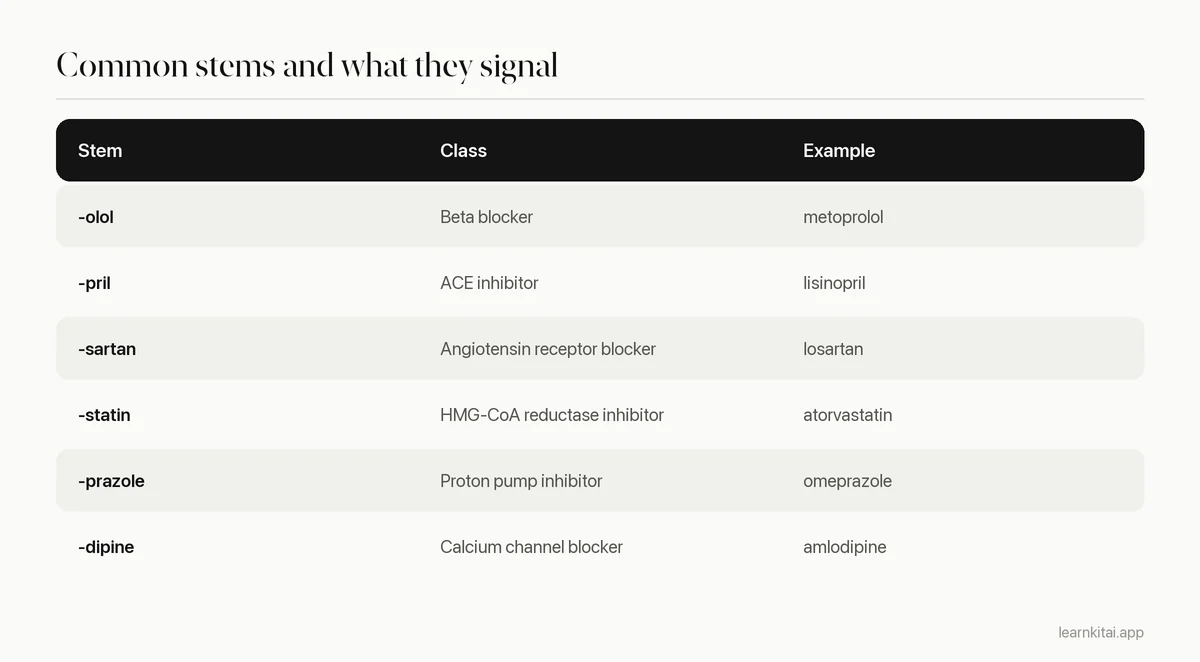
Many generic drug names contain a stem that signals their class, such as -olol for beta blockers or -pril for ACE inhibitors. The World Health Organization assigns these stems on purpose so related drugs are recognizable. Learning about twenty common stems lets you classify many drugs on sight.
Generic names are chosen under the International Nonproprietary Names system, and the WHO publishes the full list of stems and what they mean. You do not need the whole book. Start with the stems your course uses most.
What is a prototype drug and why learn it first?
A prototype is one well known drug that represents its class. Learn it in depth: mechanism, main uses, key adverse effects and important interactions. For other drugs in the class, learn only how they differ from the prototype.
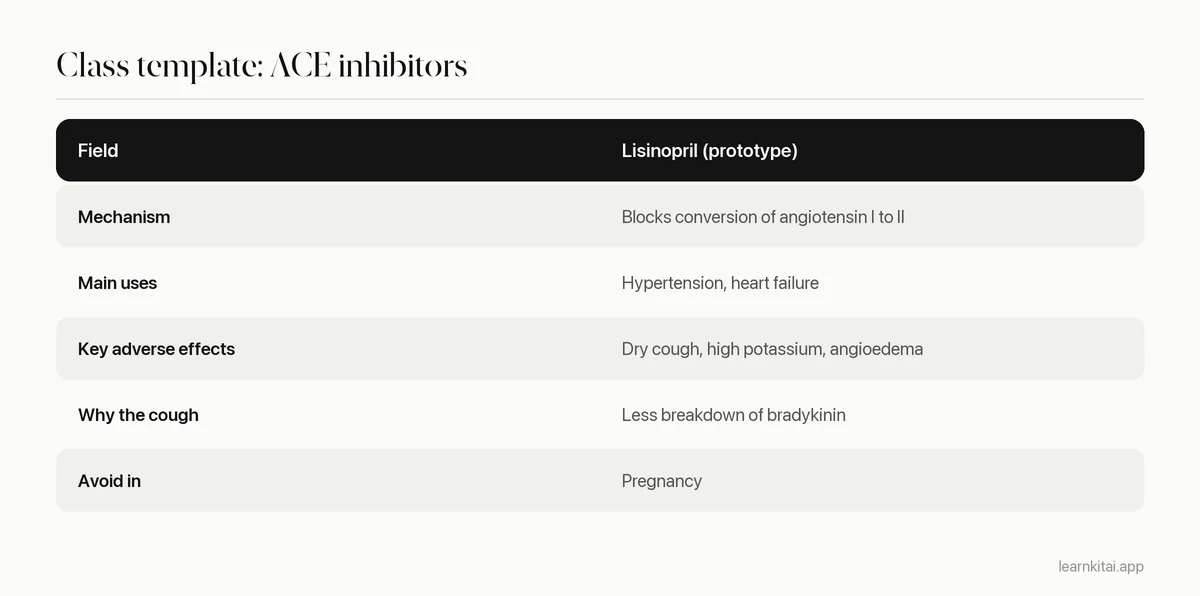
Use the same template for every class so your notes and cards line up. Here is one filled in for ACE inhibitors, using lisinopril as the prototype.
How do you learn side effects without memorizing lists?
Derive them from the mechanism. Ask what the drug blocks or activates, where that target exists in the body, and what happens when it is blocked there. Most major side effects become predictable, and the few that are not are worth a dedicated card.
Take beta blockers. They block beta adrenergic receptors. The heart has beta receptors, so heart rate and contraction fall, which is the therapeutic effect. The airways also have beta receptors, so a non-selective beta blocker can narrow the airways, which is why they are used with caution in asthma. Fatigue and cold hands follow from the same logic. One mechanism, several predictable effects.
This is the same move that works in anatomy and physiology: learn the system, then predict what happens when part of it changes. Asking why at each step is a form of elaborative interrogation, and it makes facts far easier to rebuild under exam pressure.
Which drugs should you learn first?
Start with the drugs and classes your course emphasizes, then the most commonly prescribed drugs, since they appear most often in exams and practice. In the United States, atorvastatin, levothyroxine, metformin, amlodipine and lisinopril topped 2024 prescription counts.
The ClinCalc DrugStats database, built on federal survey data, estimates how often each drug is prescribed in the United States. Its list for 2024 is a practical study order once your course syllabus is covered. Notice that three of the top five carry a stem from the table above.

How should you review pharmacology over a term?
Use spaced flashcards for stems, prototypes and key facts, and practice questions for applying them to cases. Keep cards small, one fact each, and review a little every day rather than in big weekend sessions.
Self-testing pays off in drug heavy courses. In a survey of 72 medical students, the number of practice questions and the number of unique Anki flashcards each independently predicted higher scores on the first licensing exam, after accounting for prior grades and test anxiety, according to a study in Perspectives on Medical Education. The study shows an association, not proof of cause, but it matches decades of research on retrieval practice.
- One fact per card. Mechanism on one card, the cough on another. See the minimum information principle.
- Cards that ask why. Why do ACE inhibitors cause cough? Why avoid non-selective beta blockers in asthma?
- Compare cards. ACE inhibitor vs ARB: which causes cough more often, and why?
- Daily limit. Add new cards at a pace that keeps reviews manageable; our guide on how many flashcards per day helps you set it.
Pharmacology study tips: the mistakes to avoid
Memorizing long side effect lists without the mechanism, learning every drug in a class equally, ignoring stems, and cramming the drug list just before the exam. Each one multiplies the work and fades fast.
- Learning every drug in a class equally. Put most effort into the prototype and only note differences for the rest.
- Memorizing side effect lists cold. Derive them from the mechanism first, then card the ones that do not follow.
- Skipping the stems. They are free classification help built into every generic name.
- Cramming the drug list. Pharmacology is too large for one week; spread it over the term.
The fix for all of them is the same structure: class, prototype, mechanism, differences, then spaced testing. If you build every unit that way, the last weeks before an exam become review instead of first learning. Of all the pharmacology study tips here, that structure is the one to keep. For how these habits fit across science courses, see our guide on how to study science.
Frequently asked questions
How many drugs do I need to know for a pharmacology exam?
It depends on your course, so start with the syllabus and lecture drug lists. Many courses focus on prototypes and major classes rather than every drug. If a drug is on a slide, learn its class and how it differs from the prototype.
Should I learn brand names or generic names?
Learn generic names first, since exams and references mostly use them and the stems are built into them. Add common brand names later if your course or clinical placements use them. Brand names do not carry class information.
What is the best way to learn drug interactions?
Group them by mechanism: drugs that add to the same effect, drugs that change how another is broken down, and drugs that oppose each other. A handful of patterns explains many interactions. Make cards for the high risk ones your course stresses.
Are mnemonics useful in pharmacology?
They help for short lists that have no logic to derive from, such as a set of unrelated adverse effects. For most material, mechanism based reasoning works better and lasts longer. Use mnemonics as a patch, not a foundation.
Sources
- Use of stems in the selection of International Nonproprietary Names (INN) for pharmaceutical substances, 2024, World Health Organization (Official reference for INN stems and how they group pharmaceutical substances.)
- The Top 300 Drugs of 2024, ClinCalc DrugStats Database (MEPS data) (2024 prescriptions: atorvastatin 115,678,209; levothyroxine 82,380,627; metformin 82,288,616; amlodipine 71,333,516; lisinopril 66,676,852.)
- Student-directed retrieval practice is a predictor of medical licensing examination performance, Perspectives on Medical Education (Deng, Gluckstein and Larsen, 2015) (72 students; practice questions and unique Anki cards independently predicted Step 1 scores.)
Keep reading

How to Study Science: Think Like the Exam, Not the Textbook
Science asks for four kinds of knowledge at once: terms, mechanisms, problem skills and data. Here is how to study each one, and how they fit together.

How to Study Anatomy: Learn the Map Before the Streets
Anatomy feels like thousands of names. Learn the layout first, decode the Latin, and test yourself with images, and it starts to fit together.

Minimum Information Principle: Small Cards, Big Recall
One flashcard, one fact. Here is why splitting fat cards into tiny ones makes reviews faster and memories stronger, with worked examples.

How to Make Flashcards That Still Work Three Weeks Later
Most flashcards fail before you ever study them, because of how they are written. Seven rules, real before and after cards, and a study routine that keeps them working.

How Many Flashcards per Day? Count Reviews, Not Cards
The right number of new flashcards depends on the reviews they create later. A simple formula, a budget table and the warning signs that you are adding too many.