IELTS Reading Tips: Beat the Clock on 40 Questions
The best IELTS reading tips are about time and precision. Give each of the three passages about 20 minutes, read the questions before the text, scan for keywords and their synonyms, obey word limits exactly, and treat Not Given as missing information. Then sort every practice mistake by its cause and drill that cause.
You get 60 minutes for 40 questions spread over three long passages, and nobody hands you extra time at the end. That is why most useful ielts reading tips come down to two skills: moving fast without sliding past the answer, and reading slowly and exactly at the moment it counts. Below you will find a timing plan, a decision rule for the question type that trips up most candidates, and a practice routine you can start today.
What is actually on the IELTS Reading test?
The Academic Reading test has three sections, 40 questions and 60 minutes. The texts add up to roughly 2,150 to 2,750 words, and there are 11 question types, from multiple choice to matching headings. Each correct answer earns one mark.
The official IELTS Academic Reading format lists the 11 question types and one rule people forget under pressure: when a question gives a word limit, such as no more than two words and/or a number, you lose the mark if you write more. General Training uses different texts and its own score table, but the habits below work for both.
Eleven types sounds like a lot. In practice they fall into three families, and each family needs a different kind of reading:
- Find the fact: sentence completion, summary, note, table and flow chart completion, diagram labels and short answers. You scan for a detail and copy words exactly.
- Judge the claim: True/False/Not Given, Yes/No/Not Given and multiple choice. You compare a statement with the text, word by word.
- Match the structure: matching headings, information, features and sentence endings. You read for the main idea of a paragraph, not its details.
How should you split the 60 minutes?
Plan about 17 minutes for passage one and 20 minutes each for passages two and three, keeping 3 minutes to check spelling and fill blanks. If one question has eaten more than 90 seconds, make your best guess, mark it and move on.
Many candidates find the later passages harder, so bank time on the first one. The plan below is a starting point. After two timed practice tests, adjust it to your own pace.
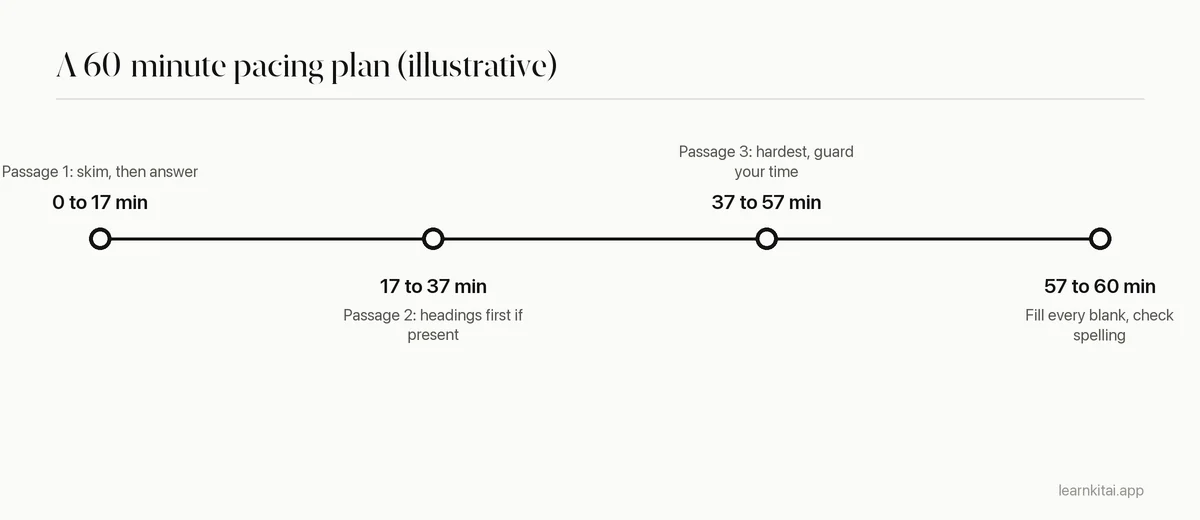
Treat those 60 minutes as the whole job. Write each answer in its final form as you go, rather than planning to tidy things up later. A wrong answer costs you nothing more than a blank, so never leave a box empty.
How do you answer True, False, Not Given correctly?
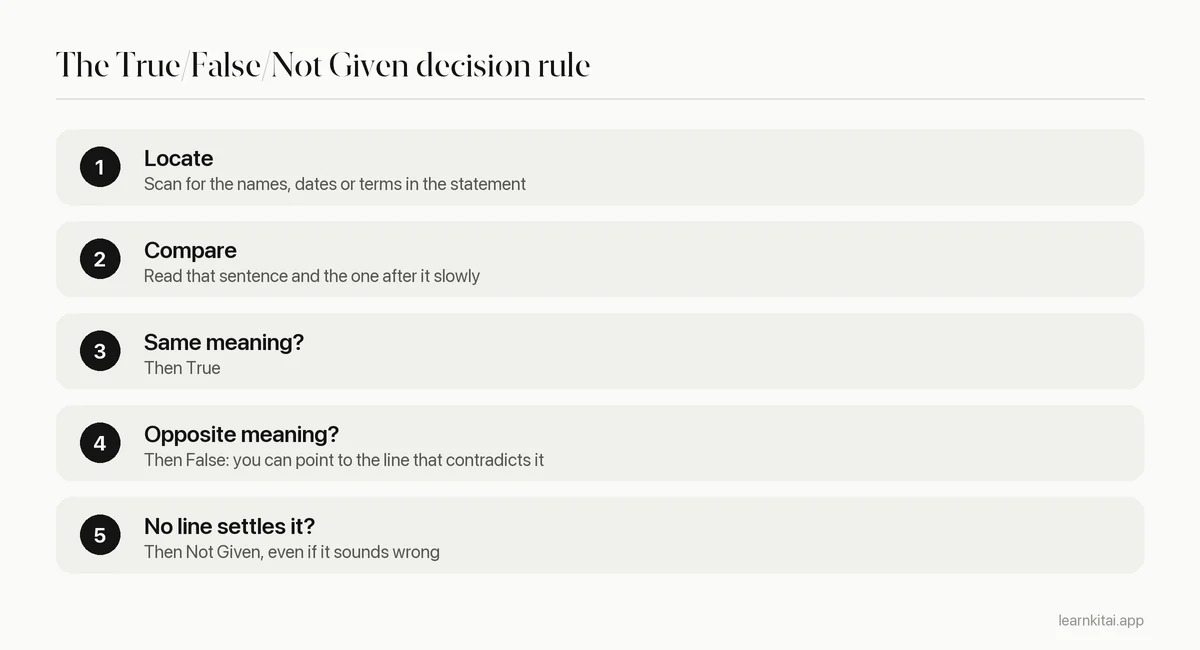
Find the part of the passage the statement is about. If the text says the same thing, it is True. If the text says the opposite, it is False. If the text says nothing that settles it, it is Not Given. Never use your own knowledge to fill a gap.
The official definition is precise: False means the statement contradicts the text, and Not Given means it neither agrees nor contradicts. Yes/No/Not Given works the same way, but you compare the statement with the writer's views instead of with facts. Here is a worked example.
Statement C is the classic trap. It feels false because the text mentions a smaller area, but nothing in the passage rules out a world record either. Ask one question: could I point to a line that proves this wrong? If you cannot, the answer is Not Given.
IELTS reading tips for skimming, scanning and synonyms
Spend about two minutes skimming before you touch the questions: read the title, the first sentence of each paragraph and any words in italics. You are building a map, not learning the content. Then read the questions and scan the map for the right paragraph.
Scanning works best with hard anchors: names, numbers, dates and capitalized terms. For everything else, expect a paraphrase. The question might say 'reduced costs' while the passage says 'cut expenses'. Before scanning, take five seconds to think of two ways the idea could be reworded. This single habit fixes a large share of 'I could not find it' mistakes.
For matching headings, read each paragraph's opening and closing sentences and ask what the whole paragraph is doing. Headings that repeat a single striking word from the text are often distractors. Cross off headings as you use them, and leave the paragraph you are least sure about for last.
How many correct answers do you need for band 7?
On Academic Reading, about 30 correct answers out of 40 usually gives band 7, 23 gives band 6 and 35 gives band 8. The exact cut-offs shift slightly between test versions. General Training needs more correct answers for the same band.
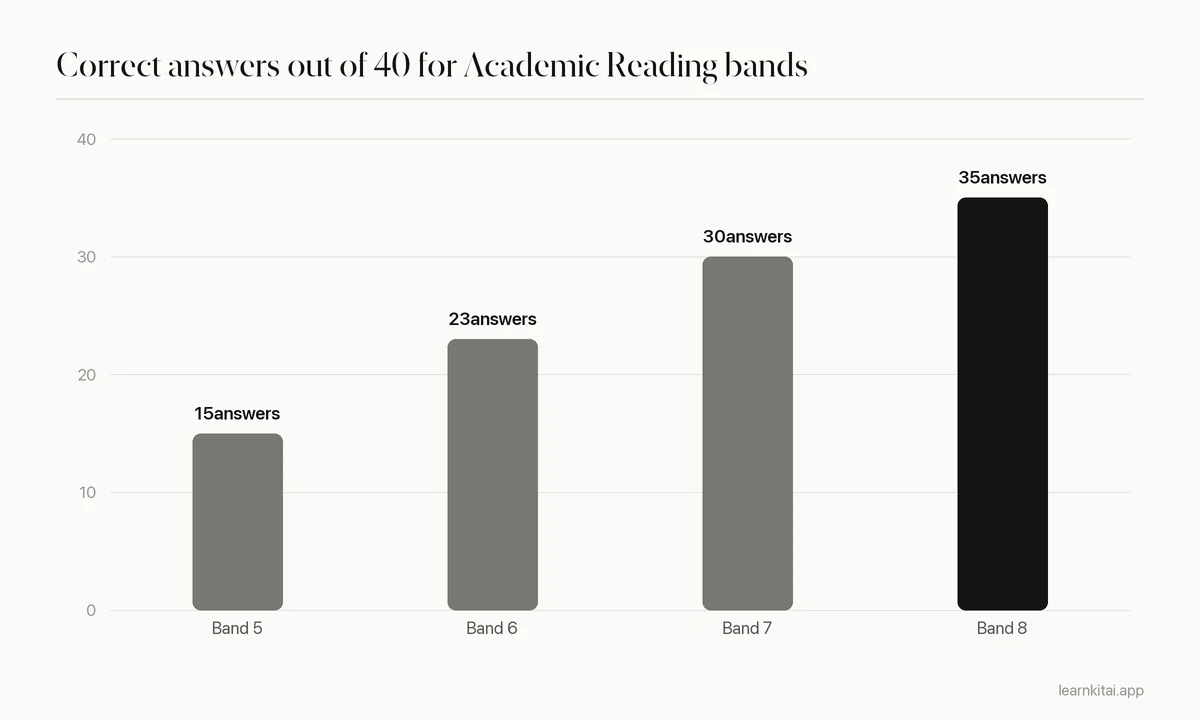
According to the IELTS Australia reading band score guide, General Training candidates need about 30 correct answers for band 6 and 35 for band 7. Read that the other way round: a band 7 on Academic still leaves room for about ten mistakes. You do not need every answer. You need to stop losing easy marks and stop letting one hard question steal time from three easy ones.
What is the best way to practice IELTS reading?
Practice in two modes. Once or twice a week, sit a full timed test under real conditions. On other days, run short untimed drills on your weakest question type and log every mistake by its cause. The log tells you what to drill next.
Timed tests build pacing. Untimed drills build accuracy. Most candidates only do the first and then wonder why their score stalls. After every test, sort each wrong answer into one of four causes:
- Vocabulary: you did not know a key word. Add it to a flashcard deck with an example sentence.
- Paraphrase: the answer was there but reworded. Write the question phrase next to the passage phrase.
- Rules: word limit, spelling or a plural you dropped. Pure carelessness, and the cheapest marks to win back.
- Time: you ran out or rushed. Revisit your pacing plan.
Keeping that list is exactly what an error log is for, and it turns random practice into targeted practice. For the vocabulary column, a simple system like the one in how to learn vocabulary fast works well. Testing yourself also beats rereading for retention, which is the core idea behind practice testing.
To get extra reading practice beyond official test books, take any English article on a topic you like, paste it into LearnKit and generate a multiple choice quiz. Answering questions about a text you just read is close to the skill IELTS measures, and the explanations show you where you misread.
Which small mistakes cost the most marks?
Breaking the word limit, misspelling words you copied, dropping a plural s and changing the form of a word all lose marks you already earned. The fix is to copy words exactly from the passage and check each answer against the instruction before you move on.
- Writing three words when the instruction says no more than two.
- Copying a word with a spelling slip, especially long academic words.
- Answering with 'cost' when the passage and the gap need 'costs'.
- Spending four minutes on one matching question while easy completion questions wait.
- Answering from general knowledge instead of from the text.
If your exam is weeks away, fold these IELTS reading tips into a wider plan like the one in how to study for finals: short daily sessions beat a weekend marathon.
Frequently asked questions
Is IELTS Academic Reading harder than General Training?
The Academic texts are usually denser and more abstract. General Training has a stricter conversion table, so you need more correct answers for the same band. Neither is easy; practice the version you will actually sit.
How many full practice tests should I do before the exam?
There is no magic number, but quality matters more than quantity. One or two timed tests a week, each followed by a careful mistake review, usually beats doing a test every day without reviewing it.
Does reading novels in English help with IELTS Reading?
It builds speed and vocabulary, which helps. It does not train question types like True/False/Not Given or matching headings, so combine general reading with targeted drills.
Should I read the whole passage before looking at the questions?
A quick skim of about two minutes helps you build a map of the text. A slow, full read usually wastes time. Skim first, then read the questions, then read closely only around the lines you need.
Sources
- IELTS Academic format: Reading, IELTS (60 minutes, 40 questions, three sections of 2,150 to 2,750 words, 11 question types, word limit rule and True/False/Not Given definitions)
- IELTS reading band score, IELTS Australia (Average raw scores for bands: Academic 15 = band 5, 23 = 6, 30 = 7, 35 = 8; General Training 23 = 5, 30 = 6, 35 = 7)
Keep reading
How to Study for Finals: A 3-Week Plan That Holds Up
Finals reward the student who starts with a plan, not the one who studies longest. Here is a three-week system for triage, testing and sleep.
Learn Vocabulary Fast by Learning the Right Words First
Speed in vocabulary comes from choosing frequent words, testing yourself past the first right answer, and meeting words again in reading.
Error Log Studying: Turn Every Mistake Into Points
An error log is a simple table of every question you got wrong and why. Kept well, it becomes the most targeted study guide you will ever own.

Practice Testing: The Study Habit That Beats Rereading
Testing yourself is not just a way to check what you know. It is one of the best-supported ways to learn. Here is how to do it well, week by week.
Study in a Second Language Without Translating Everything
Studying in a second language means learning the subject and the words at once. AI can split those jobs apart if you use the right rule.
GCSE Revision: A Month-by-Month Plan for Summer 2027
GCSE exams start on 10 May 2027. Here is how to use the months before them, from autumn flashcards to past papers, without burning out by Easter.