The Forgetting Curve: Why Exam Knowledge Vanishes
The forgetting curve shows that memory drops fastest in the first hours and days after learning, then levels off. You forget exam material quickly because cramming builds memories that were only retrieved once or twice. Spaced, repeated retrieval flattens the curve, so knowledge survives long after the exam.
It is a common experience. You prepare for a final, do well, and three weeks later you cannot explain half of what you wrote. Nothing is wrong with your brain. You are watching the forgetting curve at work, the pattern Hermann Ebbinghaus first measured in the 1880s. The good news is that the curve is not fixed. How you study changes its shape.
This post explains what the curve really shows, why exam knowledge in particular disappears so fast, and a simple plan that keeps what you learn. It is part of our practice testing guide.
What is the forgetting curve?
It is a graph of how much of something you retain over time after learning it. Retention falls steeply at first, then the decline slows. Ebbinghaus measured it by how much faster he could relearn lists after different delays.
Ebbinghaus memorized lists of nonsense syllables, waited, then relearned them. He measured savings: the share of the original learning time he saved the second time around. In 2015, Jaap Murre and Joeri Dros replicated his experiment in PLOS ONE and found a curve very close to the original.
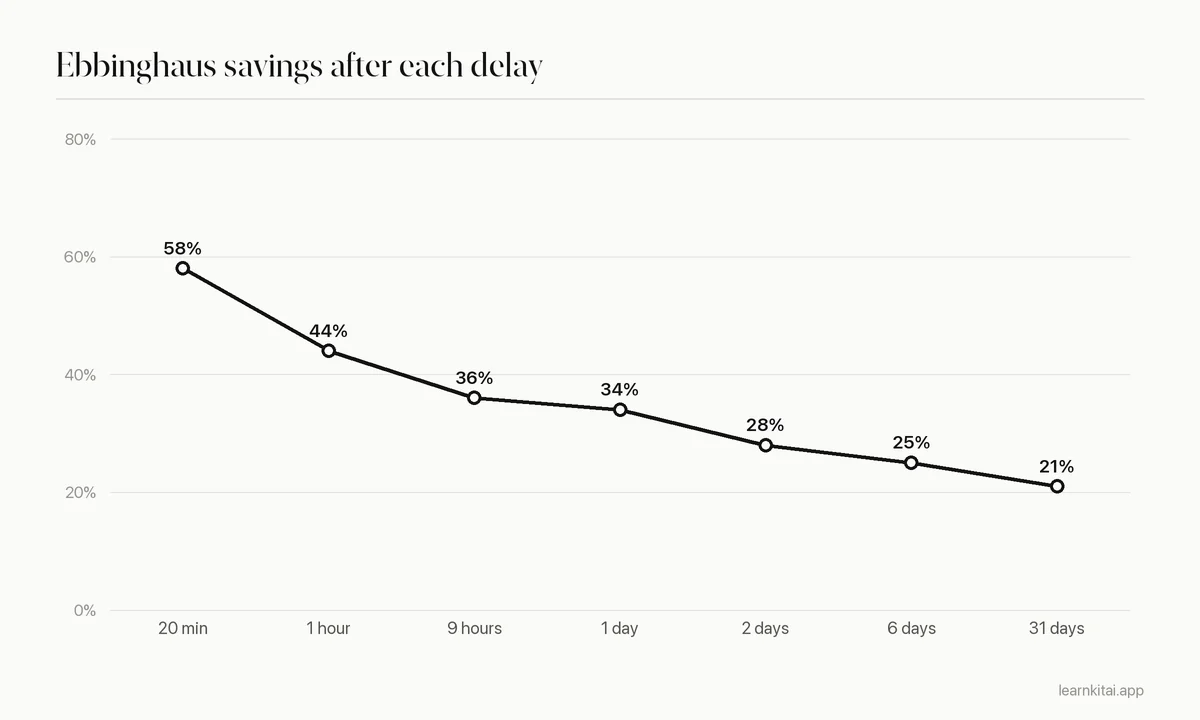
Two things stand out. First, the early drop is steep: after just one hour, Ebbinghaus had to redo more than half of the original learning effort. Second, the decline after the first day was gentle, with savings going from about 34% at one day to about 21% at a month. So most forgetting happens early, and whatever survives the first few days tends to stick around much longer.
Why do you forget everything right after exams?
Because most exam studying is massed into a few days and done by rereading. Those memories were strong enough for one test but were never retrieved again afterward, so they slide down the steep part of the curve.
Cramming works, briefly. A night of review can carry you through a test the next morning. But you have retrieved each fact only once or twice, all within a short window. After the exam you stop using it. That is the worst combination for long term memory: one burst of exposure, then nothing.
Real course data show the same pattern. Donald Bacon and Kim Stewart followed students from a consumer behavior course for up to two years after it ended. Most of the knowledge was gone within two years. Two things helped: material learned at a deeper level, and material that had been tested more than once during the course.
How do you flatten the forgetting curve?
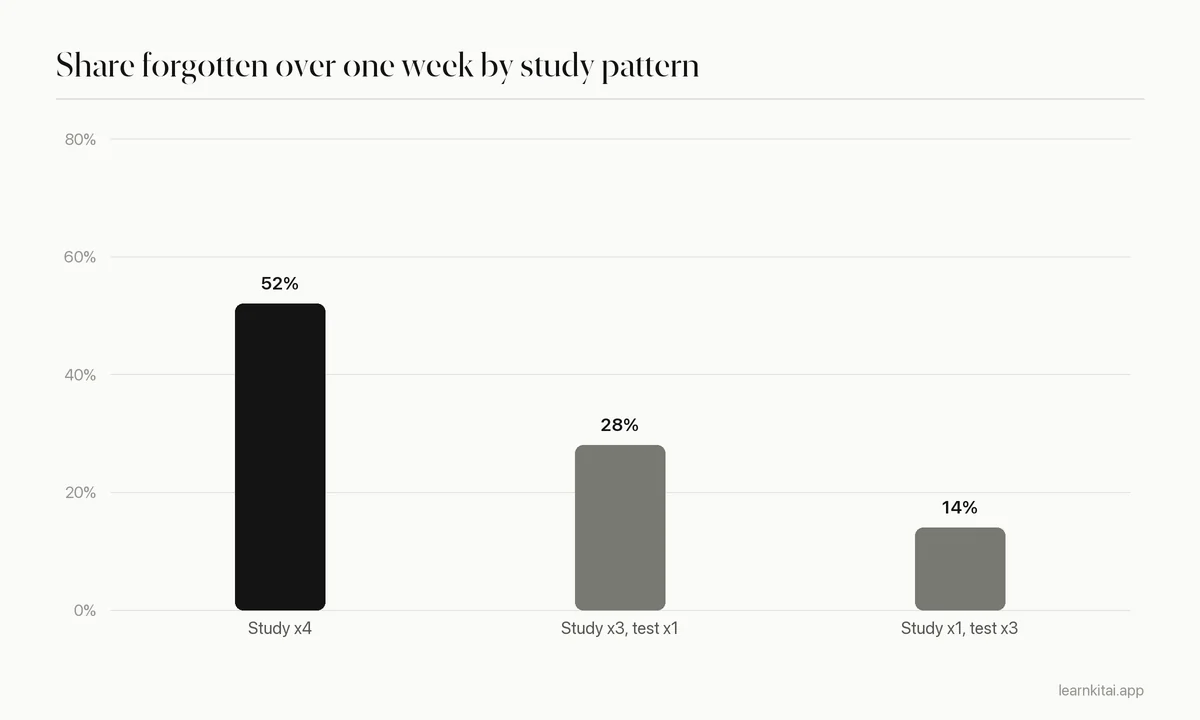
Retrieve the material repeatedly, with gaps between attempts. Each spaced recall makes the next drop slower. Testing yourself also beats rereading: in one study, repeated testing cut forgetting over a week to 14%, against 52% for repeated reading.
In a 2006 experiment, Roediger and Karpicke measured how much of their immediate recall students lost over one week. Students who only reread a passage lost 52%. Students who read it once and tested themselves three times lost just 14%.
Spacing adds to the effect. Each time you recall something just as it is starting to fade, the memory becomes more durable and the next gap can be longer. This is the logic behind spaced repetition, and it is why one hour spread across four days beats the same hour in one sitting.
A review plan that survives the exam
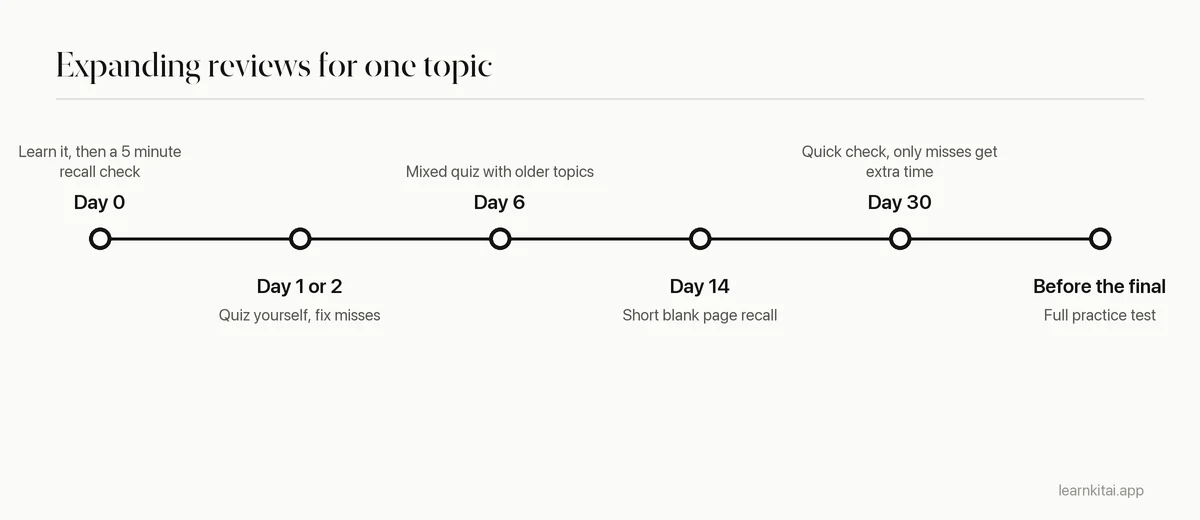
The exact days are flexible. What matters is that each review is a test, not a reread, and that the gaps grow. If a topic keeps failing, shrink the gap for it. If it is easy, stretch the gap. Flashcard apps that schedule reviews automatically do this for you.
Make the material meaningful first
Ebbinghaus used nonsense syllables on purpose, because they had no meaning to hold on to. Your course material does have meaning, and you should use it. Before you start testing a topic, make sure you can explain why each idea is true and how it connects to the ones around it. Bacon and Stewart found that knowledge learned at a deeper level lasted longer than surface knowledge. In practice, that means three quick checks for every topic:
- Can you explain the idea in plain words to someone outside the course?
- Can you give one example that was not in the lecture?
- Can you say how it links to the topic before and the topic after it?
If the answer to any of these is no, fix that first. Spaced quizzes then have something solid to strengthen, rather than a string of memorized words that slide down the curve as soon as you stop reviewing.
LearnKit can turn each week's lecture into a flashcard deck in a minute, which makes it easy to keep old topics in rotation instead of letting them slide down the curve.
Is it bad to cram if you only need to pass?
For a one-off test, cramming can get you through. But most courses build on each other, and cumulative finals, later courses and professional exams will ask for the same material again. Relearning from scratch costs more than keeping it alive.
If you do end up cramming, you can still rescue the material. Quiz yourself on it a few days after the exam and again a few weeks later. It takes far less time than the original study, and it turns a short-lived memory into a lasting one. Our guide on cramming covers how to do a last-minute session with the least damage, and how to study for a cumulative final shows how to plan reviews across a whole term.
Frequently asked questions
How fast do we forget what we learn?
The fastest drop happens within the first hour and the first day. After that, forgetting continues but slows down. Meaningful, well understood material fades more slowly than isolated facts.
Does sleep help against forgetting?
Yes. Sleep helps consolidate new memories, and pulling all nighters cuts into it. Studying earlier and sleeping before the exam is a better trade than an extra night of review.
Is the forgetting curve the same for everyone?
The general shape is similar across people, but the steepness varies with the material, prior knowledge, attention and how the information was studied. Testing and spacing make it flatter for almost everyone.
Sources
- Replication and Analysis of Ebbinghaus' Forgetting Curve, PLOS ONE (Murre and Dros, 2015) (Table 3: Ebbinghaus savings of 0.582 at 20 min, 0.442 at 1 h, 0.358 at 9 h, 0.337 at 1 day, 0.278 at 2 days, 0.254 at 6 days, 0.211 at 31 days)
- How Fast Do Students Forget What They Learn in Consumer Behavior? A Longitudinal Study, Journal of Marketing Education (Bacon and Stewart, 2006) (Most course knowledge lost within 2 years; deeper learning and repeated testing improved retention)
- Test-Enhanced Learning, Psychological Science (Roediger and Karpicke, 2006) (Proportional forgetting over one week: 52% (SSSS), 28% (SSST), 14% (STTT))
Keep reading

Practice Testing: The Study Habit That Beats Rereading
Testing yourself is not just a way to check what you know. It is one of the best-supported ways to learn. Here is how to do it well, week by week.
The Testing Effect: Why a Quiz Beats Another Reread
Taking a test is not just a way to measure memory. It changes memory. Here is what the research shows and how to use it this week.

Spaced Repetition: Why Forgetting Is Part of the Plan
Reviewing right before you forget builds memories that last. Learn how long the gaps should be, with a ready schedule for exams one week to one semester away.
Cramming: What Actually Works the Night Before an Exam
Cramming is a poor way to learn, but sometimes it is the only option left. Here is how to spend one evening so it counts, and when to stop.
Cumulative Final Exam: Review a Whole Semester Calmly
A cumulative final tests week 1 as hard as week 14. Here is how to triage a whole course, rebuild old material and space your review over three weeks.

Study Group Activities That Beat Chatting Over Notes
Most study groups drift into rereading together. These quiz games keep everyone recalling, arguing and correcting each other, and they fit in one hour.