Cumulative Final Exam: Review a Whole Semester Calmly
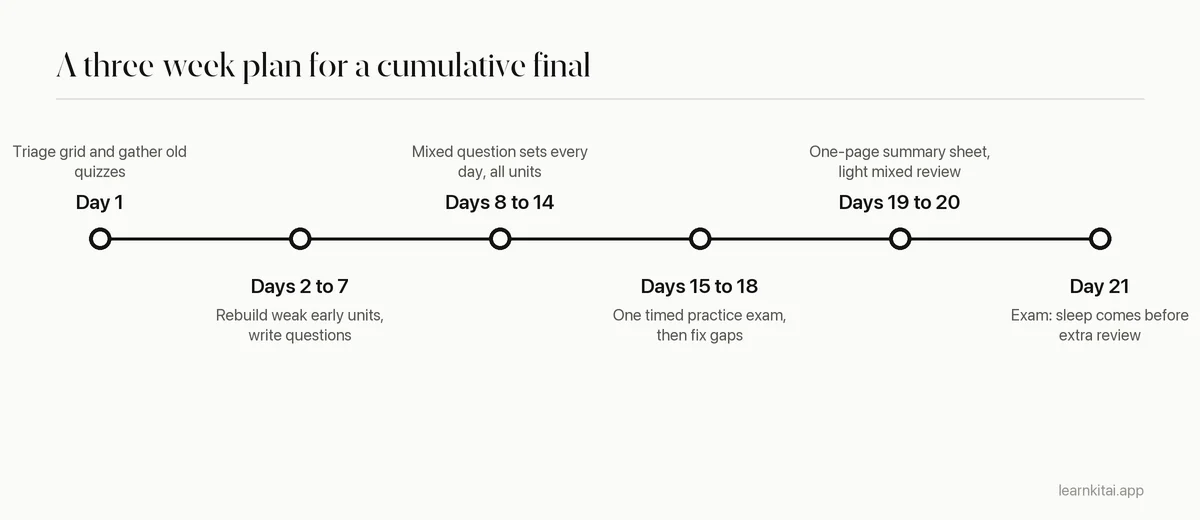
Start three weeks out. Map the course by weight using the syllabus and old exams, rate your confidence on each topic, and rebuild weak early units first. Turn past quizzes and notes into one question bank, then review in mixed sets every few days instead of rereading chapters in order.
A cumulative final exam asks about the first week of the semester just as seriously as the last. The trouble is that week one feels like a different life. You studied it, passed the quiz on it, and then let it fade while new topics piled on top. This guide shows you how to take stock of a whole course, decide what deserves your hours, and review it so that early material is solid on exam day.
Why are cumulative finals so much harder?
Because forgetting has had months to work on the early material, and because the exam mixes topics. You have to recall facts you have not seen in weeks and decide which method fits each question, without chapter headings to tell you.
Two separate problems hide inside one exam. The first is decay: material you learned in September is weaker in December, even if you knew it cold at the time. The second is mixing: on a unit test, every question comes from the same chapter, so you already know which tool to use. On a cumulative final, question 12 could be from week 3 and question 13 from week 11. Your review has to fix both, which is why reading your notes from page one to the end rarely works.
How do you decide what to study first?
Weight each topic by how much of the exam it is likely to cover, then rate your confidence on it from 1 to 3. Start with topics that carry heavy weight and low confidence. Topics with light weight and high confidence get a quick check near the end.
Use three clues to estimate weight: how many lectures the topic took, how much space it gets in the syllabus or study guide, and how often it appeared on past exams and quizzes. Then rate your confidence honestly by trying two or three questions on each topic from memory, not by flipping through the notes and thinking 'I remember this'.
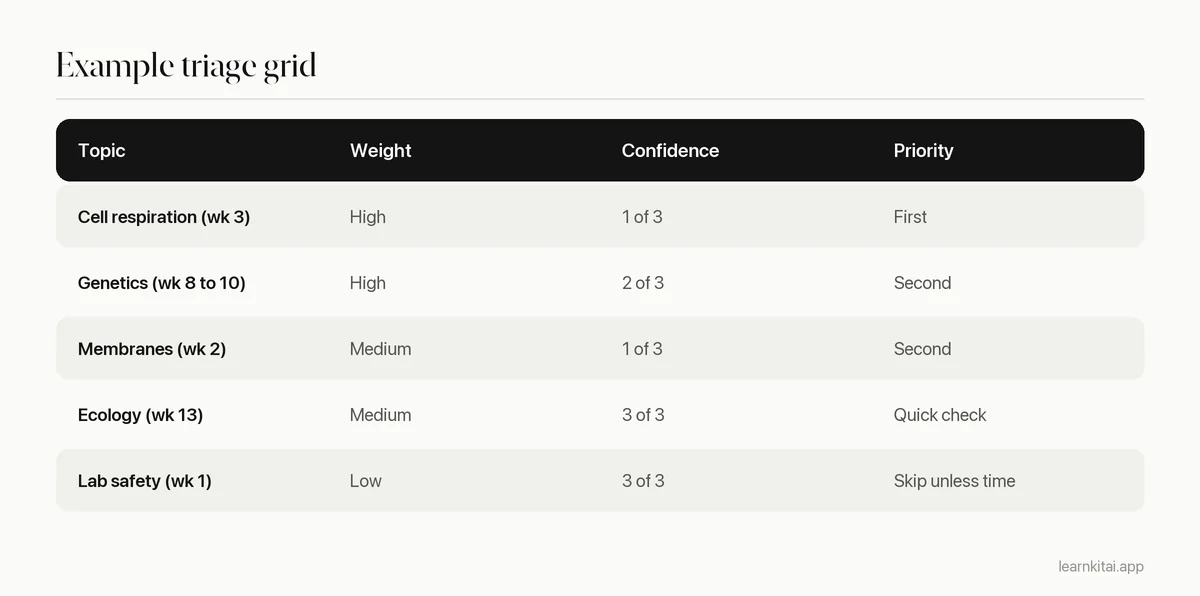
Notice that the newest unit, ecology, ends up near the bottom. That feels wrong, but recent material is usually your strongest. On a cumulative final exam, the units that need you most are the early, heavy ones you have not touched since their quiz.
Build one question bank for the cumulative final exam
Your best study material for a cumulative final is not your notes. It is a set of questions. Collect every quiz, problem set, midterm and practice question from the course into one place. Then fill the gaps: for each topic in your triage grid, write five to ten questions in your own words that someone would need to understand the topic to answer.
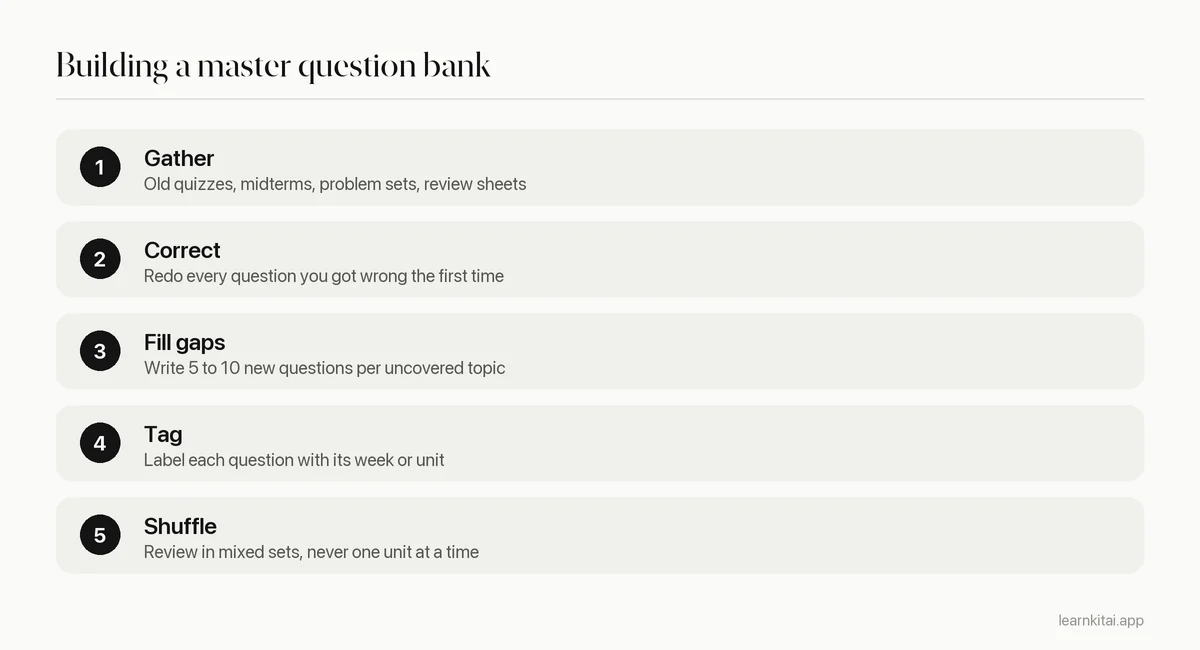
Your graded midterm is gold here. Every mistake on it marks a weak point the professor already knows about, and topics that appeared on the midterm often come back. If you have not studied your old exam carefully, the steps in how to review a graded exam take about an hour per test. For long notes, a tool can speed up the gap-filling: LearnKit turns a lecture PDF into flashcards and quiz questions you can drop straight into your bank, though you should still check each one against your notes.
Is testing yourself better than rereading for a final?
Yes. In a large review of ten common study techniques, practice testing and spaced practice were the only two rated high utility, while rereading and highlighting were rated low. Answering questions forces you to retrieve the material, which is the skill the exam measures.
That review, by Dunlosky and colleagues, is summarized in the Association for Psychological Science report on which study strategies make the grade. The finding matters most on a cumulative final, where rereading a semester of notes can easily eat your whole study budget while leaving you with a false sense of fluency. If you want the full picture, our guide to active recall explains why retrieval works.
How far apart should your review sessions be?
When the exam is a few weeks away, revisit each topic every few days rather than every day or once. Research on spacing found the best gap was about 20 percent of the time until the test. With a final three weeks out, that means reviewing each topic roughly every four days.
That 20 percent figure comes from a study by Cepeda and colleagues in which more than 1,350 people learned facts and reviewed them after different gaps. As their summary of the study explains, the best gap was about 20 percent of the test delay for delays of a few weeks, falling to about 5 percent for a delay of one year. Treat it as a rule of thumb, not a precise formula. The practical lesson is that spaced review beats massed review, and our guide to spaced repetition shows how to schedule it.
What does a mixed review session look like?
Pull 20 to 30 questions from your bank across at least three different units, shuffle them and answer each from memory before checking. Mark the ones you miss, then return to those topics in your notes. Mixing forces you to choose the right method for each question, exactly as the exam will.
This is called interleaving, and it feels harder than working through one chapter at a time. That difficulty is the point: you are practicing the decision of which idea applies, not just the idea itself. Our post on interleaved practice covers why it works and when it does not. A good session takes 45 to 60 minutes and ends with a short list of weak spots for the next session.
Mistakes that sink cumulative final review
- Starting from chapter one and running out of time before the heavy late units. Triage first.
- Rereading notes instead of answering questions. Familiar is not the same as remembered.
- Studying units in order. The exam will not be in order, so your practice should not be either.
- Ignoring the midterm. Its mistakes are a free list of weak spots.
- Cutting sleep in the final week. Memory consolidation needs it, and tired recall is slow recall.
In the last two days, compress what you know onto a one-page study sheet, even if you cannot bring it into the exam. Deciding what deserves a place on one page is a final, useful round of retrieval. For a broader plan that covers several finals at once, see how to study for finals.
Frequently asked questions
How long before a cumulative final should I start studying?
Three weeks is a comfortable runway for most courses, with short daily sessions. If you only have one week, keep the same steps but compress them: triage on day one, mixed questions every day after that.
What if the professor says the final focuses on material after the midterm?
Then adjust the weights in your triage grid, but do not drop early units completely. Later topics usually build on earlier ones, so a quick check of the foundations still pays off.
Should I rewrite my notes for a cumulative final?
Rewriting a full semester of notes takes a long time and is mostly passive. Turning notes into questions, or into a one-page summary, gives you more retrieval for the same effort.
How many questions should my master question bank have?
Aim for enough that every topic in your triage grid has at least five to ten questions. For a typical one-semester course, that often lands somewhere between 100 and 300 questions.
Sources
- Which Study Strategies Make the Grade?, Association for Psychological Science (Dunlosky et al. (2013) review of ten techniques: practice testing and distributed practice rated high utility; rereading and highlighting low)
- Spacing effects in learning: A temporal ridgeline of optimal retention, Cepeda et al., Psychological Science (2008) (Over 1,350 participants; optimal gap about 20% of test delay for a few weeks, about 5% for one year)
- Improving Students' Learning With Effective Learning Techniques, Psychological Science in the Public Interest (PubMed) (Original monograph covering 10 learning techniques and their utility ratings)
Keep reading
How to Study for Finals: A 3-Week Plan That Holds Up
Finals reward the student who starts with a plan, not the one who studies longest. Here is a three-week system for triage, testing and sleep.
The Study Schedule That Works Backward From Exam Day
Most study plans fail because they start from today. Start from the exam date instead, count your real hours, and space every topic at least three times.
Review a Graded Exam: Your Mistakes Are the Study Guide
Most students glance at the score and file the paper away. A short, structured review turns every lost point into a plan for the next test.

Spaced Repetition: Why Forgetting Is Part of the Plan
Reviewing right before you forget builds memories that last. Learn how long the gaps should be, with a ready schedule for exams one week to one semester away.
Interleaved Practice: Why Mixed Sets Feel Worse but Work
Doing ten problems of the same type feels great and teaches less than you think. How to mix topics so you learn to choose the right method on exam day.