Learn Programming Concepts by Predicting Before You Run
To learn programming concepts, predict what a piece of code will do before you run it, then explain any surprise. Trace variables by hand, rewrite small programs from memory a few days later, and mix exercise types. Watching or copying code builds familiarity; predicting and producing it builds understanding.
Many beginners spend weeks following tutorials, nodding along, and then freeze in front of an empty editor. This is sometimes called tutorial hell, and it has a simple cause. Following along asks you to recognize code. Writing a program asks you to produce it. If you want to learn programming concepts that hold up on an exam or in a project, your practice has to look like production.
This guide is for students in a first or second programming course and self-taught beginners. Examples use Python, but every technique works in any language. You will get a predict-then-run loop, a tracing method, a card format for concepts, and a weekly plan.
Why do coding tutorials not stick?
Tutorials make every decision for you, so you never practice the hard part: choosing what to write next. Code you have seen looks familiar later, which feels like knowledge but is only recognition. Recall and prediction are what build a usable mental model.
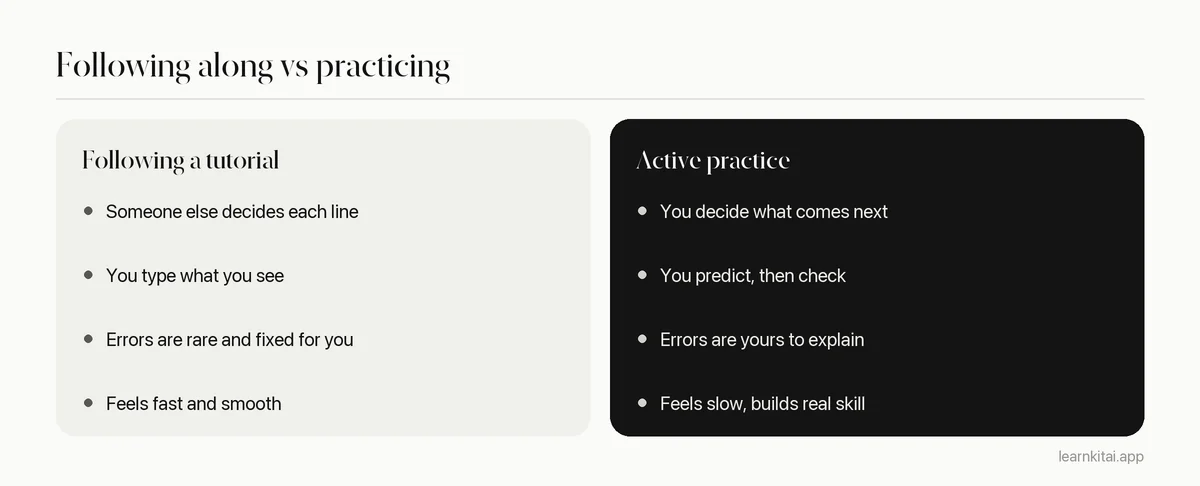
Tutorials still have a place. Use them to meet a new idea. Then close the video and rebuild what you saw from a blank file. Whatever you cannot rebuild is the part to study.
How do you learn programming concepts instead of syntax?
Focus on what the code does in memory: what each variable refers to, how values change, and when. Predict the output of short snippets before running them, and write down why any prediction was wrong. Syntax comes with use; concepts need deliberate practice.
The core habit is a loop of four steps. It takes seconds per snippet and turns every example in your course into practice.
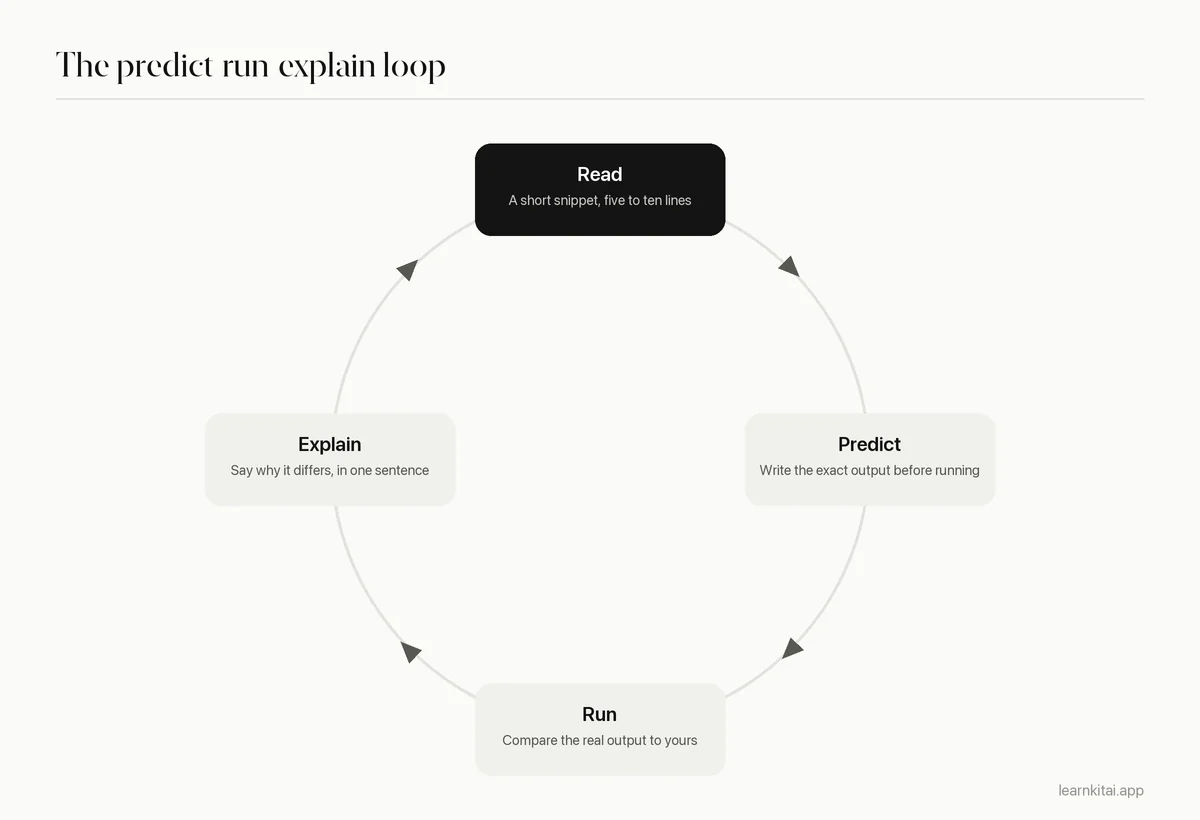
Try it now. In Python, set a = [1, 2, 3], then b = a, then call b.append(4), then print(a). Predict the output before reading on. Many beginners say [1, 2, 3]. The real output is [1, 2, 3, 4], because b = a does not copy the list; both names point to the same list. That one surprise teaches more about how variables work than a page of explanation. The official Python tutorial is full of short snippets you can use the same way.
What is code tracing and why does it help?
Tracing means stepping through code by hand and writing down each variable's value after every line. It forces you to simulate the computer, which is the mental model that writing and debugging both depend on. It is also a common exam question format.
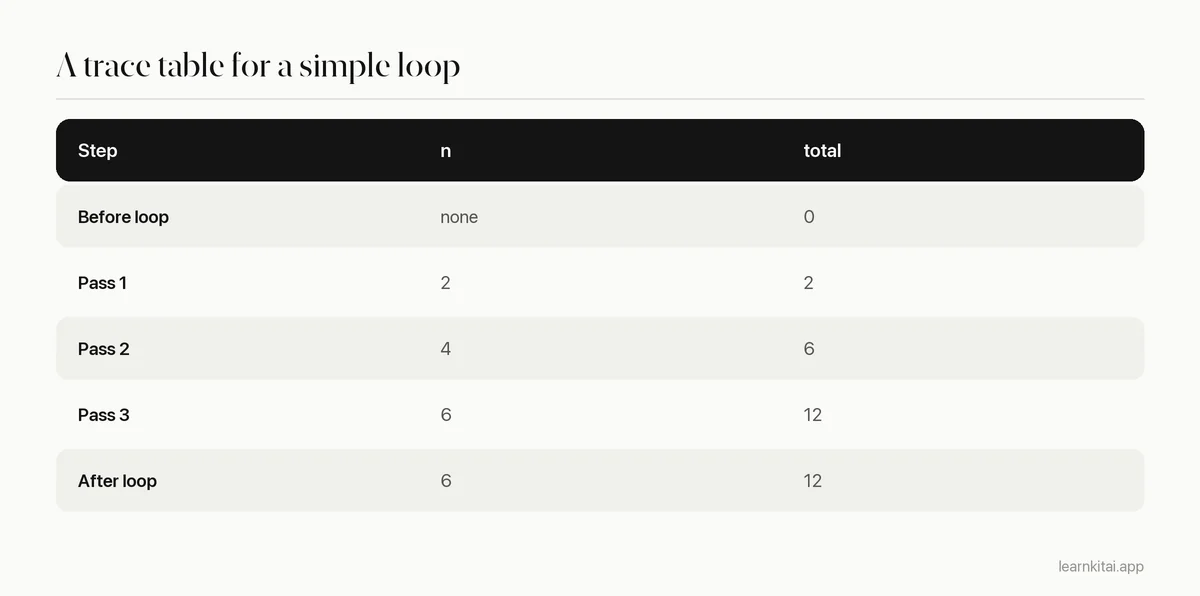
The last row hides a detail that often appears on exams: in Python, the loop variable still holds its final value after the loop ends. You notice that only when you write every row. Trace a few loops, conditionals and function calls each week, especially for topics like recursion that are hard to picture.
How do you remember coding concepts long term?
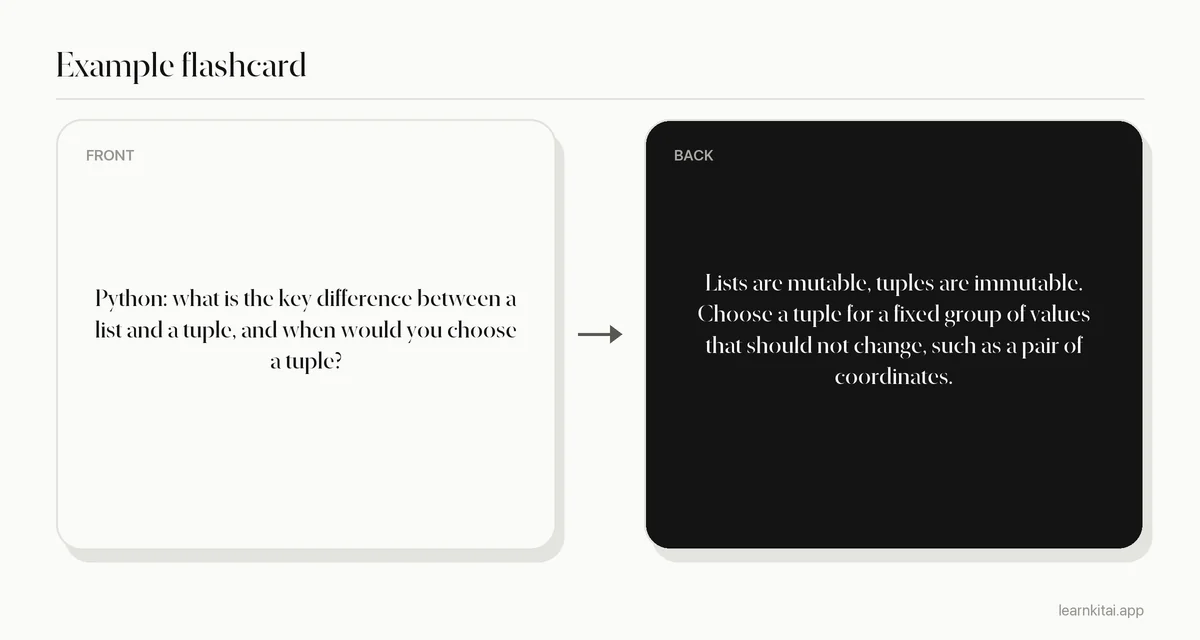
Write small programs from memory again a few days after you first learn them, and keep a deck of concept cards that ask why, not just what. Repeated recall spaced over days keeps concepts available; one successful attempt is not enough.
Research on memory backs this up. In one experiment, students who kept recalling items after their first correct answer remembered about 80 percent a week later, while those who stopped after one success remembered about 35 percent, as Karpicke and colleagues describe. For code, the equivalent is rewriting a binary search or a class definition from a blank file on Monday, Thursday and again next week. See active recall and spaced repetition for the full method.
Does explaining code out loud really help?
Yes. Explaining each line in plain words, to a classmate or even to a rubber duck on your desk, exposes the steps you were glossing over. If you cannot say why a line is there, you have found the concept to study next.
Programmers call this rubber duck debugging, and learning researchers call the general habit self-explanation. The idea is the same: putting reasoning into words forces you to fill gaps that silent reading skips. When you study a worked solution, stop after each block and say what it does and why the author chose it over an alternative.
This is one of the cheapest ways to learn programming concepts deeply, because it works on any code you meet: your course examples, a library's documentation or a classmate's project. Pair it with the predict loop and you will catch most misunderstandings long before they become bugs in an assignment.
Should you mix different kinds of coding exercises?
Yes. Once a topic feels familiar, mix exercises from several topics so you must decide which tool fits, a loop or recursion, a list or a dictionary. That choice is what real problems and exams demand.
In a math study with 787 seventh graders, students who practiced mixed problem types scored 61 percent on a surprise test, compared with 38 percent for students who practiced one type at a time, according to a randomized trial funded by the Institute of Education Sciences. Programming shares the same challenge of choosing a method. Build a small bank of exercises, tag each by topic, and draw from several topics in every session. Our guide to interleaved practice shows how.
A weekly plan for a programming course
Meet the concept in lecture or a tutorial, run the predict loop on its examples the same day, write a small program from scratch midweek, and end the week with a mixed exercise set and a rewrite of last week's program from memory.
- Day 1: Predict and run every example from the lecture.
- Day 2: Trace two snippets by hand, including one with a function call.
- Day 3: Write a small program that uses the concept, without looking at examples.
- Day 5: Mixed exercises from this week and earlier ones.
- Day 7: Rewrite last week's program from memory, then compare.
Keep a bug journal alongside. For each bug, write the symptom, the cause and the concept you misunderstood. After a few weeks it becomes a personal list of your weak spots, much like the error log method used in math and science. For more subject guides, start at how to study science.
Frequently asked questions
How long does it take to learn programming concepts?
The basics, such as variables, loops, conditionals and functions, usually take a few weeks of steady practice to feel natural. Deeper ideas like recursion or object design take longer and keep improving with every project. Regular short sessions matter more than total hours.
Should I learn several programming languages at once?
Usually not as a beginner. The concepts transfer across languages, but learning two syntaxes at once doubles the surface details. Get comfortable in one language first, then a second one will come much faster.
Is it okay to use AI to write code while learning?
Use it to explain code or check your reasoning after you have tried. If it writes the solution first, you skip the practice that builds skill. A good rule is to predict or write your own version, then compare.
How do I study for a programming exam on paper?
Practice tracing and writing code by hand, since that is the exam format. Time yourself on short functions without an editor, and check them by running them afterward. Pay attention to off-by-one errors and loop boundaries.
Sources
- The Python Tutorial, Python Software Foundation (Official tutorial with short code examples suited to predict-then-run practice.)
- Metacognitive strategies in student learning: Do students practise retrieval when they study on their own?, Memory (Karpicke, Butler and Roediger, 2009) (Repeated recall after first success gave about 80% retention a week later versus about 35% when items were dropped.)
- Efficacy Study of Interleaved Mathematics Practice, Institute of Education Sciences, U.S. Department of Education (787 grade 7 students; interleaved practice 61 percent vs 38 percent on an unannounced test.)
Keep reading

How to Study Science: Think Like the Exam, Not the Textbook
Science asks for four kinds of knowledge at once: terms, mechanisms, problem skills and data. Here is how to study each one, and how they fit together.

Active Recall: Why Closing the Book Beats Rereading
Rereading feels productive but fades fast. Here is how to study by pulling answers out of memory, with a session plan, examples and the mistakes to avoid.
Interleaved Practice: Why Mixed Sets Feel Worse but Work
Doing ten problems of the same type feels great and teaches less than you think. How to mix topics so you learn to choose the right method on exam day.
Self Explanation: Talk Yourself Into Understanding
Stopping after each step to ask why it works is one of the simplest study habits with solid research behind it. Here are the prompts and a worked example.
Error Log Studying: Turn Every Mistake Into Points
An error log is a simple table of every question you got wrong and why. Kept well, it becomes the most targeted study guide you will ever own.

Study Economics by Drawing the Graph Before the Words
Economics is a set of models told three ways: in words, graphs and numbers. Learn to switch between them and exam questions get much easier.