How to Study Chemistry: See It, Draw It, Write It
To study chemistry well, connect three views of every idea: what you can observe, what the particles are doing, and the symbols or equations that describe it. Memorize a small core of facts, then spend most of your time on mixed practice problems, checking each mistake and redoing it a few days later.

Most students who struggle with chemistry are not short on effort. They read the chapter, copy the equations and still freeze on the test. The reason is usually structural. Every idea in chemistry lives in three forms at the same time, and the textbook jumps between them without warning. Learning how to study chemistry mostly means learning to move between those forms on purpose.
This guide gives you a three-level habit for every topic, a short list of what is worth memorizing, a way to practice problems that sticks, and a weekly routine you can copy. It fits any course, from a first high school class to university general chemistry.
Why does chemistry feel harder than other sciences?
Chemistry describes the same event on three levels at once: what you can see, what invisible particles are doing, and the symbols that summarize it. Teachers switch between levels fast, and beginners have to hold all three in mind, which overloads working memory.
Chemistry educator Alex Johnstone described this as a triangle. One corner is the macroscopic level: a fizzing tablet, a color change, rust on a bike. The second is the submicroscopic level: atoms, ions and molecules you can never see directly. The third is the symbolic level: formulas, equations and diagrams. The Royal Society of Chemistry notes that novices quickly become overloaded when asked to work with all three at once.
An expert reads NaCl(aq) and pictures separate sodium and chloride ions surrounded by water. A beginner sees four letters and two brackets. The symbols only carry meaning once you have built the picture underneath them. That is why memorizing equations without the picture tends to collapse under exam pressure.
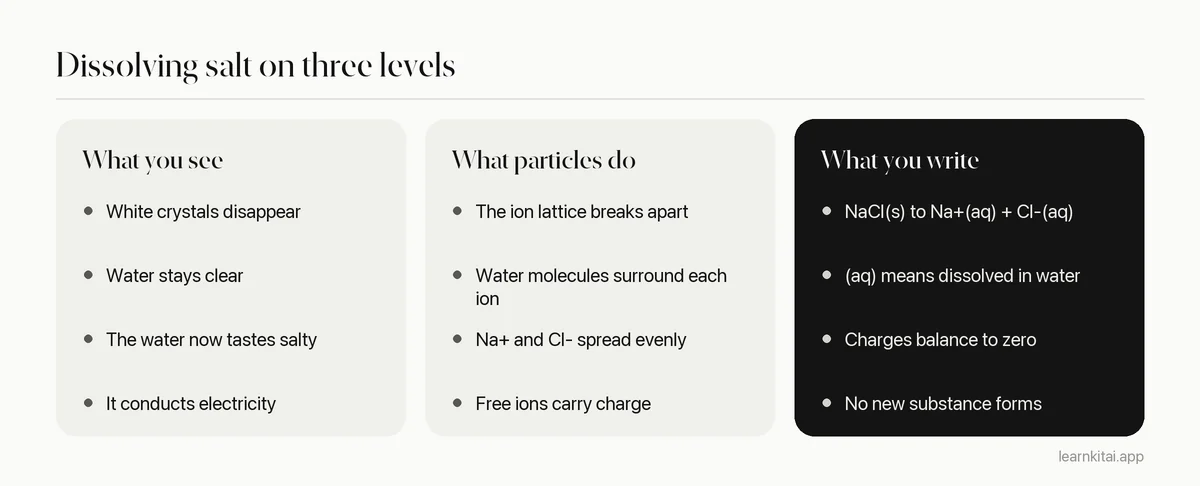
How to study chemistry with the three-level habit
For each new idea, write one line for what you would observe, sketch the particles, then write the symbols. Check that all three tell the same story. If one is missing or contradicts the others, that gap is exactly what to study next.
Turn the triangle into a routine. After each lesson, pick the two or three key reactions or ideas and run them through these steps on a blank page:
- Observe. Write one sentence about what you would see, smell, measure or feel in a lab.
- Draw. Sketch the particles before and after. Use circles for atoms and label charges.
- Write. Give the balanced equation with state symbols.
- Connect. Point to one feature of the drawing that explains the observation, such as free ions explaining conductivity.
- Test. Close the book and redo all four steps from memory the next day.
Take burning methane as a worked example. You observe a blue flame and heat. You draw one CH4 and two O2 molecules turning into one CO2 and two H2O, with bonds breaking and new, stronger bonds forming. You write CH4 + 2O2 to CO2 + 2H2O. You connect the heat release to the stronger bonds in the products. Drawing pictures alongside words is a form of dual coding, and it gives you two routes back to the idea on the exam.
What should you memorize in chemistry, and what can you work out?
Memorize a small core you will use constantly: element symbols, common ion charges, polyatomic ions, key definitions and a few constants. Work out the rest, such as formulas, balanced equations and most trends, from that core plus the periodic table.
Students often swing between two extremes. Some try to memorize every reaction in the chapter. Others refuse to memorize anything because chemistry is about understanding. Both waste time. A small, solid core makes reasoning faster, because you are not looking up charges in the middle of a problem.
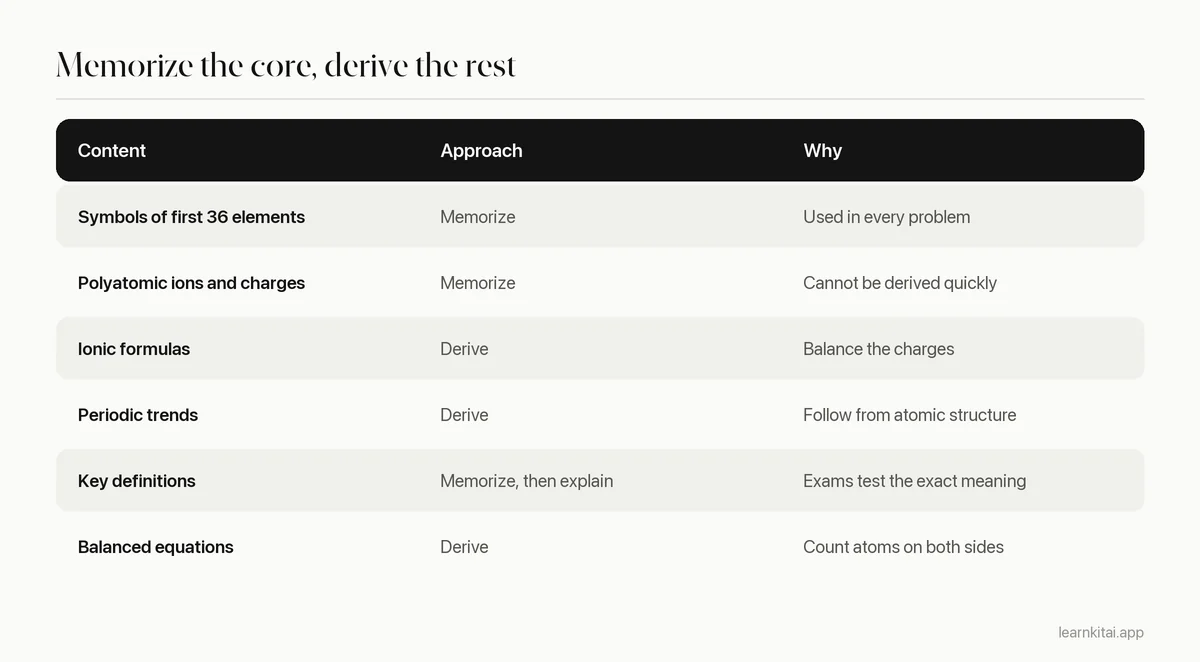
Put the memorize column on flashcards and keep the cards small: one ion per card, with its charge on the back. Review them in short daily sessions with spaced repetition until you answer instantly. Everything in the derive column belongs in problem practice, not on cards.
How do you get better at chemistry problems?
Study one worked example, then solve similar problems with the solution covered. Once you can do them, mix problem types so you must decide which method fits. Keep a log of every mistake and redo those problems a few days later without notes.
Problem skill is built in a sequence. Start by reading a worked example and explaining each step out loud. Next, solve a near copy with the solution hidden. Then move to mixed sets, where a stoichiometry question might sit next to a gas law and a limiting reagent problem. Mixing forces you to choose the method, which is what the exam asks of you.
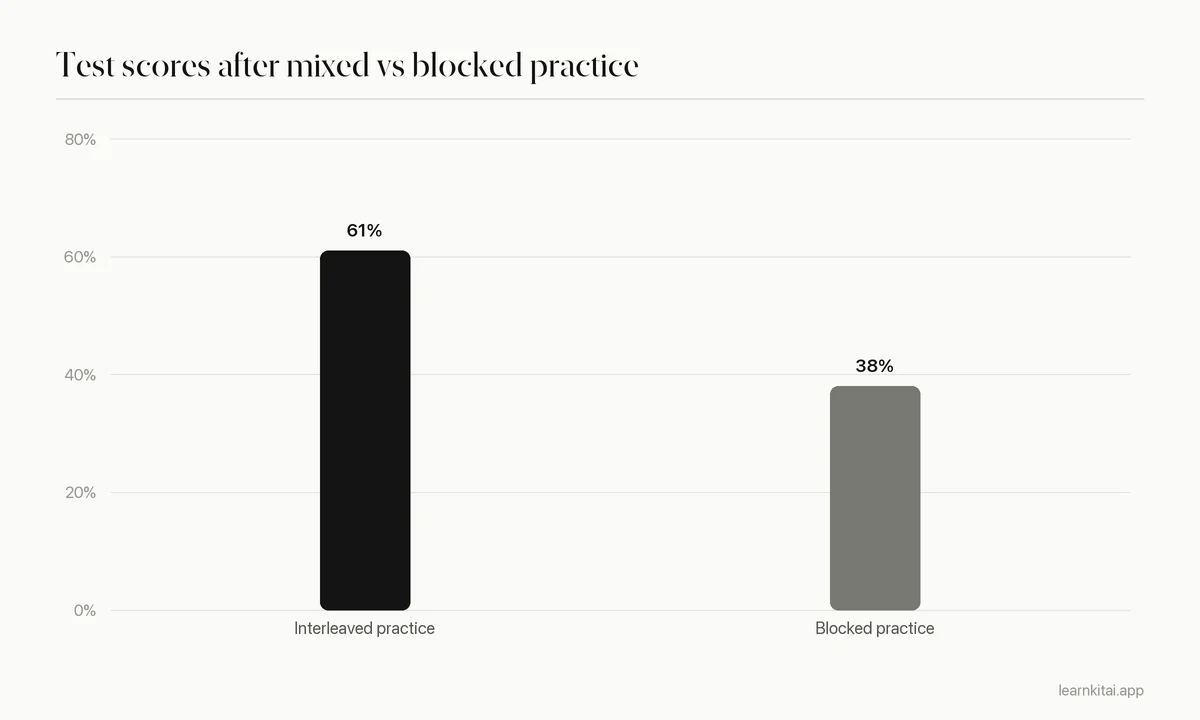
Mixed practice has strong evidence behind it in math, a close cousin of chemistry problem solving. In a randomized trial with 787 seventh graders, students whose homework interleaved problem types scored 61 percent on a surprise test, against 38 percent for students who practiced one type at a time. Read more about why this works in our guide to interleaved practice.
A weekly routine that keeps chemistry from piling up
Short daily sessions beat one long weekend session. Spread the three-level habit, flashcards, and mixed problems across the week, and finish with a timed set that mixes this week with older topics.
Chemistry is cumulative. Moles show up in stoichiometry, which shows up in equilibrium, which shows up in acids and bases. A week where you fall behind tends to cost you the next three. A light, steady routine protects you from that. If you remember one thing about how to study chemistry, make it this: a little every day.
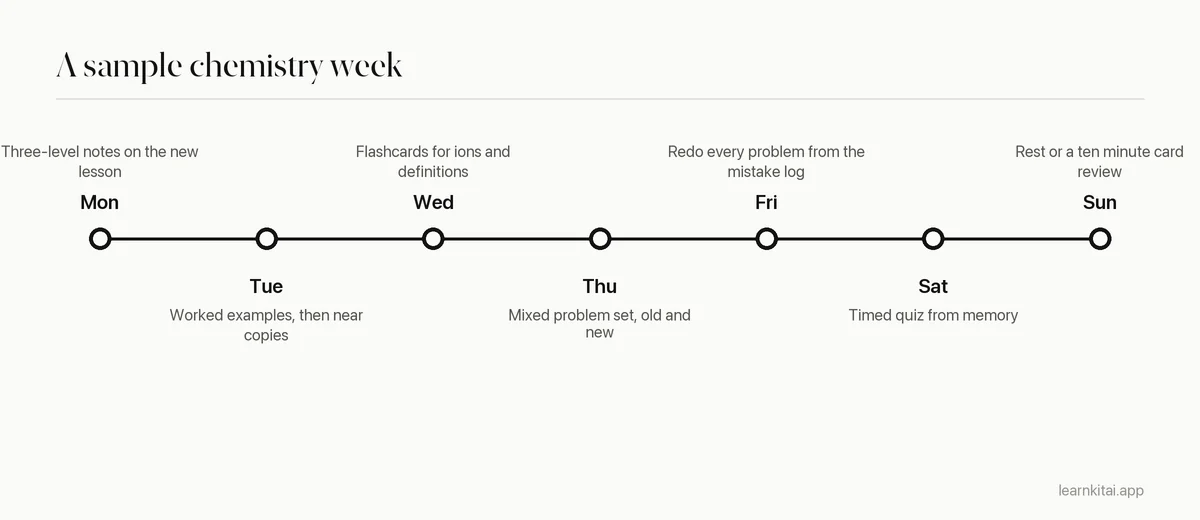
Keep a mistake log next to your problem set. For each error, write which level failed: did you misread what was observed, picture the particles wrongly, or slip on the symbols? Patterns show up fast, and they tell you exactly where to spend next week.
What are the most common chemistry study mistakes?
The big ones are rereading instead of solving problems, memorizing equations without the particle picture, practicing only one problem type at a time, and skipping units. Each one feels productive but leaves you stuck when a question looks unfamiliar.
- Reading worked solutions and calling it practice. Following a solution feels like understanding. Solving it cold is the real test.
- Doing only the odd problems in one section. Real exams mix chapters, so your practice should too.
- Skipping the drawing step. If you cannot sketch the particles, you do not yet own the idea.
- Cramming the night before. Chemistry needs time between sessions to settle, so start a week out.
- Ignoring lab work. Lab results are the macroscopic corner of the triangle. Link each lab to an equation and a particle sketch.
Rereading and highlighting rank among the weakest strategies in a review of ten common learning techniques, while practice testing and spaced practice rank highest. Chemistry rewards the second pair more than most subjects, because almost every exam question asks you to do something rather than recall a sentence. For a wider view of these habits across subjects, see our guide on how to study science.
Frequently asked questions
How many hours a week should I study chemistry?
There is no single right number, and consistency matters more than the total. Five sessions of 40 minutes usually beat one five hour session, because chemistry needs time between sessions to settle. Let your quiz and problem set results tell you whether to add time.
Is chemistry more math or memorization?
It is mostly reasoning with a small memorized core. You need some algebra for stoichiometry and gas laws, and you need to know symbols and common ions by heart. Most marks come from applying ideas to problems.
How can I catch up in chemistry if I am already behind?
Go back to the earliest topic you cannot do from memory, usually moles or ionic formulas, and rebuild from there. Do a few problems from each later topic as you move forward. Skipping ahead without the base tends to make every new topic harder.
Do I need to understand organic chemistry mechanisms or memorize them?
Understand them. Mechanisms follow a few patterns, such as electrons moving from rich to poor areas. Once you see those patterns, you can predict many reactions instead of memorizing each one.
Sources
- Improve students' understanding with Johnstone's triangle, Royal Society of Chemistry, Education in Chemistry (Describes the macroscopic, submicroscopic and symbolic levels and that novices become overloaded when working with all three.)
- Efficacy Study of Interleaved Mathematics Practice, Institute of Education Sciences, U.S. Department of Education (787 grade 7 students; interleaved practice group scored 61 percent vs 38 percent on an unannounced test.)
- Improving Students' Learning With Effective Learning Techniques, Association for Psychological Science (Review of 10 techniques; practice testing and distributed practice rated high, rereading and highlighting low.)
Keep reading

How to Study Science: Think Like the Exam, Not the Textbook
Science asks for four kinds of knowledge at once: terms, mechanisms, problem skills and data. Here is how to study each one, and how they fit together.

How to Study Biology: Learn the Story, Not Just the Words
Biology looks like a mountain of vocabulary. It is really a set of cause-and-effect stories. Learn them as stories and the words follow.

Interleaved Practice: Why Mixed Sets Feel Worse but Work
Doing ten problems of the same type feels great and teaches less than you think. How to mix topics so you learn to choose the right method on exam day.

Error Log Studying: Turn Every Mistake Into Points
An error log is a simple table of every question you got wrong and why. Kept well, it becomes the most targeted study guide you will ever own.

Practice Testing: The Study Habit That Beats Rereading
Testing yourself is not just a way to check what you know. It is one of the best-supported ways to learn. Here is how to do it well, week by week.

Case Briefs: Read Like a Judge, Not a Stenographer
A good brief is short, written in your words, and built to answer the questions a professor or an exam will ask. Here is how to write one.